

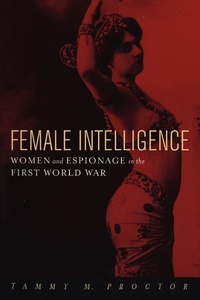
Female Intelligence
Women and Espionage in the First World War
Published on 1. June 2003
277 pages
978-0-8147-4538-0 (ISBN)
Description

When the Germans invaded her small Belgian village in 1914, Marthe Cnockaert's home was burned and her family separated. After getting a job at a German hospital, and winning the Iron Cross for her service to the Reich, she was approached by a neighbor and invited to become an intelligence agent for the British. Not without trepidation, Cnockaert embarked on a career as a spy, providing information and engaging in sabotage before her capture and imprisonment in 1916. After the war, she was paid and decorated by a grateful British government for her service.
Cnockaert's is only one of the surprising and gripping stories that comprise Female Intelligence. This is the first history of the female spies who served Britain during World War I, focusing on both the powerful cultural images of these women and the realities, challenges, and contradictions of intelligence service. Between the founding of modern British intelligence organizations in 1909 and the demobilization of 1919, more than 6,000 women served the British government in either civil or military occupations as members of the intelligence community. These women performed a variety of services, and they represented an astonishing diversity of nationality, age, and class. From Aphra Behn, who spied for the British government in the seventeenth century, to the most well known example, Mata Hari, female spies have a long history, existing in juxtaposition to the folkloric notion of women as chatty, gossipy, and indiscreet.
Using personal accounts, letters, official documents and newspaper reports, Female Intelligence interrogates different, and apparently contradictory, constructions of gender in the competing spheres of espionage activity.
Cnockaert's is only one of the surprising and gripping stories that comprise Female Intelligence. This is the first history of the female spies who served Britain during World War I, focusing on both the powerful cultural images of these women and the realities, challenges, and contradictions of intelligence service. Between the founding of modern British intelligence organizations in 1909 and the demobilization of 1919, more than 6,000 women served the British government in either civil or military occupations as members of the intelligence community. These women performed a variety of services, and they represented an astonishing diversity of nationality, age, and class. From Aphra Behn, who spied for the British government in the seventeenth century, to the most well known example, Mata Hari, female spies have a long history, existing in juxtaposition to the folkloric notion of women as chatty, gossipy, and indiscreet.
Using personal accounts, letters, official documents and newspaper reports, Female Intelligence interrogates different, and apparently contradictory, constructions of gender in the competing spheres of espionage activity.
Reviews / Votes
"How did women's work contribute to the propagation of war, and impact their own changing relation to the nation-state? How did women themselves, their contemporaries and popular culture represent their war work in gendered terms? Tammy Proctor addresses these significant questions in her intriguing study of women spies. As Proctor shows, women's substantial work for the developing British intelligence service belied the figure of the treacherous and seductive woman spy." - Angela Woollacott,author of On Her Their Lives Depend: Munitions Workers in the Great War "This engaging and intelligent study of women in espionage adds to our understanding of the experience of women during the First World War and of the legacy of their work, both mythic and real. Proctor carefully explores why the image of the female spy seductressnotably the iconic Mata Harihas endured and uncovers the largely unknown history of this pivotal generation of women intelligence workers." - Susan R. Grayzel,author of Womens Identities At War: Gender, Motherhood, and Politics in Britain and France during the First World War "Retells forgotten stories and unearths new evidence of intrepid female field agents. . . . Proctors archival discoveries hint at countless small acts of audacity and defiance. . . . Thanks to books like this one, the history of female espionagefrom Aphra Behn to Elizabeth Van Lew to Lotus Blossum to Stella Rimingtonis slowly being filled out." (London Review of Books) "In Female Intelligence, Tammy Proctor attempts to rescue female spies from cliches that classed them as either sexual predators or martyred virgins, manipulators or dupes, heartless vamps or emotional basket cases." (New Yorker) "A useful and engaging history of women in the British intelligence service during World War I. The book is an important contribution to the history of British intelligence and sheds light on the unglamorous reality of a highly romanticized aspect of women's work." (American Historical Review)More details
Language
English
Place of publication
New York
United States
Target group
College/higher education
Professional and scholarly
File size
3,70 MB
ISBN-13
978-0-8147-4538-0 (9780814745380)
Copyright in bibliographic data and cover images is held by Nielsen Book Services Limited or by the publishers or by their respective licensors: all rights reserved.
Schweitzer Classification
Other editions
Additional editions
Book
01/2006
New York University Press
€34.50
Shipment within 15-20 days
Person
Tammy M. Proctor is professor of history at Wittenberg University in Springfield, Ohio. She is the author of On My Honour: Guides and Scouts in Interwar Britain, Scouting for Girls: A Century of Girl Guides and Girl Scouts, and Female Intelligence: Women and Espionage in the First World War (NYU Press).
Content
ContentsPreface List of Illustrations List of Abbreviations Timeline Introduction 1 Intelligence before the Great War 2 DORA's Women and the Enemy within Britain 3 Women behind the Scenes4 Soldiers without Uniforms5 Spies Who Knew How to Die 6 Intimate Traf?c with the Enemy Conclusion: "Perpetual Concubinage to Your King and Country” NotesBibliography Index About the Author
