

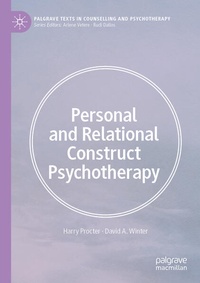
Personal and Relational Construct Psychotherapy
Description

This book introduces Personal and Relational Construct Psychotherapy, a development by the authors of an approach to psychotherapy originated in the 1950's by George A. Kelly. Drawing on a lifetime of experience in working with people in mental health settings, Procter and Winter focus on the crucial relationships that form the context of human struggles, and how these can be a fertile resource in problem-resolution. The book provides step-by-step descriptions of assessment and therapeutic methods for working with individuals, families, and groups, as well as exploring the philosophical background of the approach, its application to formulation, supervision, and reflective practice, its relationships to other models of psychotherapy, and its evidence base. The book will be invaluable for psychotherapists, counsellors, and psychologists of all levels and traditions, and useful for students and trainees in health, education, social work, and any field involving helping people with thedifficulties of everyday life.
Reviews / Votes
"This is a remarkable book, destined to become a point of reference in the large field of clinical psychology and psychotherapy. . This comprehensive, conceptually grounded and documented volume is a total pleasure to read. The reader is introduced to personal and relational construct psychotherapy through a compelling clinical case, which is accompanied in the following chapters by a clear and engaging style." (Valeria Ugazio, Australian & New Zealand Journal of Family Therapy, May 20, 2022)
"Easy read it may be, but being able to write such a demanding book and deliver it as an easy read is all-together another matter. . The book is replete with a lot of useful knowledge . . Having read the book Personal and Relational Construct Psychotherapy I sincerely hope that it may represent the beginning of relationality which may start the eagerly awaited recovery of the interpretative paradigm preferred by many." (Dusan Stojnov, Personal Construct Theory & Practice, Vol. 19, 2022)
"The book achieves its objectives extremely well. It is full to the brim with practical resources for therapists, and brings the richness and sophistication of Kelly's legacy also to those unfamiliar with it." (Raya Jones, Theory & Psychology, August 21, 2021)
"The notion of reflexivity is so brilliantly put in the context of truly democratizing the field of personal and group transformation. The book could so much contribute to initial education and training of psychologists, but also other professionals who define their job as creating change without resistance. The questions then is how to scale up and make the approach described in the book more widely available and accessible." (Jelena Pavlovic, Journal of Constructivist Psychology, March 27, 2021)
"The quality of the writing is superb and the interlacing of theory and practice means that my attention never wandered even when the going was tough in terms of following the complexity of the material. I think this book will appeal to anybody who wants to enhance their therapeutic practice. It should be compulsory reading for trainee individual and relationship therapists and for trainee clinical psychologists." (Andy Treacher, CONTEXT, Issue 173, February, 2021)
"A timely and important contribution to the psychotherapy literature. . The book gives a clear and concise overview of PCP and its underlying philosophy before Procter and Winter then extend Kelly's theory to more clearly elaborate what Kelly had to say about interpersonal relationships . . This book should have a place on every psychotherapist's bookshelf - either as a comprehensive introduction of PRCP in its own right, or to complement and enhance the practice of any other approach to psychotherapy." (Kev Harding, The Journal of Critical Psychology, Counselling and Psychotherapy, Vol. 20 (4), 2020)
"Personal and Relational Construct Psychotherapy is a scholarly tome. It is extensively referenced and, between them, the authors demonstrate an impressive familiarity with contemporary developments in a range of psychological treatments, schools of philosophy, systemic therapy and research methodology as well as their predictably comprehensive understanding of Kelly's own work. My three word summary - erudite; readable; original." (David Green, Clinical Psychology Forum, Issue 336, December, 2020)
More details
Other editions
Additional editions
Persons
David Winter is Professor Emeritus of Clinical Psychology at the University of Hertfordshire, UK. He has around 200 publications, primarily on personal construct psychology and psychotherapy research.
Content
1. Brian's Story.- 2. Philosophical Background.- 3. Personal Construct Theory.- 4. From the Personal to the Relational.- 5. Personal and Relational Construct Interviewing.- 6. Structured Assessment Methods.- 7. Personal and Relational Construct Formulation .- 8. Individual Psychotherapy.- 9. Working with Couples and Families.- 10. Group Psychotherapy.- 11. Reflexivity, Reflective Practice, and Supervision.- 12. Relationships with Other Therapeutic Approaches.- 13. Evidence Base.
