

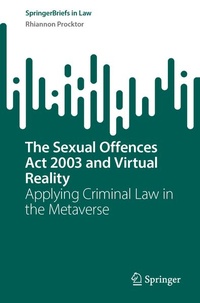
The Sexual Offences Act 2003 and Virtual Reality
Description

This book investigates online sexual interaction and its place within the law. Though this question is not new, the technological landscape is evolving rapidly enough to warrant further analysis. We are witnessing an explosion of virtual and augmented reality technology which outpaces legal development. Relying on multidisciplinary research from computer scientists, psychologists, philosophers, lawyers and engineers, this book explores the place of sexual wrongdoing and justice in this virtual new world. As an example it will focus on the provisions of the Sexual Offences Act 2003: the challenges surrounding physical touch and the ambiguity surrounding gender, deception, and consent in a virtual future.
More details
Other editions
Additional editions
Person
Rhiannon Procktor is a graduate of Exeter College, University of Oxford and Université Paris Panthéon Assas. Having had the opportunity to study and live in multiple countries, she enjoys focusing on interactions between technology and law from a comparative perspective. Her work primarily centres on domestic and comparative criminal law, and she is interested in developments in bioethics, neuroscience, artificial intelligence and computer science.
Content
Introduction.- The Metaverse, Virtual Reality and the Law.- The Sexual Offences Act 2003 in a Virtual Future: Some Key Issues.- Penetration and Physicality.- Consent and Deception.- Contextualising the Argument.- Conclusion.
