

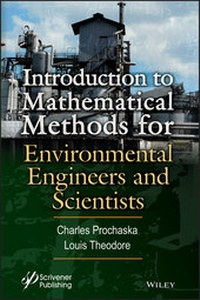
Introduction to Mathematical Methods for Environmental Engineers and Scientists
Description

The material in this book addresses mathematical calculations common to both the environmental science and engineering professionals. It provides the reader with nearly 100 solved illustrative examples and the interrelationship between both theory and applications is emphasized in nearly all of the 35 chapters. One key feature of this book is that the solutions to the problems are presented in a stand-alone manner. Throughout the book, the illustrative examples are laid out in such a way as to develop the reader's technical understanding of the subject in question, with more difficult examples located at or near the end of each set.
In presenting the text material, the authors have stressed the pragmatic approach in the application of mathematical tools to assist the reader in grasping the role of mathematical skills in environmental problem-solving situations. The book is divided up into 5 parts:
* Introduction; Analytical Analysis; Numerical Analysis; Statistical Analysis; and Optimization.
* The analytical analysis includes graphical, trial-and-error, search, etc. methods.
* The numerical analysis includes integration, differentiation, differential equation, Monte Carlo, etc.
* The statistical analysis includes probability, probability distribution, decision trees, regression analysis, etc.
* Optimization includes both traditional approaches and linear programming.
More details
Other editions
Additional editions
Content
Preface ix
Part I: Introduction 1
1 Fundamentals and Principles of Numbers 3
2 Series Analysis 21
3 Graphical Analysis 29
4 Flow Diagrams 43
5 Dimensional Analysis 53
6 Economics 73
7 Problem Solving 89
Part II: Analytical Analysis 99
8 Analytical Geometry 101
9 Differentiation 115
10 Integration 121
11 Differential Calculus 133
12 Integral Calculus 147
13 Matrix Algebra 161
14 Laplace Transforms 173
Part III: Numerical Analysis 183
15 Trial-and-Error Solutions 185
16 Nonlinear Algebraic Equations 195
17 Simultaneous Linear Algebraic Equations 209
18 Differentiation 219
19 Integration 225
20 Ordinary Differential Equations 235
21 Partial Differential Equations 247
Part IV: Statistical Analysis 259
22 Basic Probability Concepts 261
23 Estimation of Mean and Variance 275
24 Discrete Probability Distribution 287
25 Continuous Probability Distribution 307
26 Fault Tree and Event Tree Analysis 343
27 Monte Carlo Simulation 357
28 Regression Analysis 371
Part V: Optimization 385
29 Introduction to Optimization 387
30 Perturbation Techniques 395
31 Search Methods 405
32 Graphical Analysis 419
33 Analytical Analysis 435
34 Introduction to Linear Programming 449
35 Linear Programming Applications 465
