

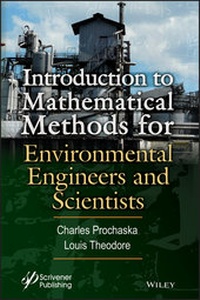
Introduction to Mathematical Methods for Environmental Engineers and Scientists
Description

The material in this book addresses mathematical calculations common to both the environmental science and engineering professionals. It provides the reader with nearly 100 solved illustrative examples and the interrelationship between both theory and applications is emphasized in nearly all of the 35 chapters. One key feature of this book is that the solutions to the problems are presented in a stand-alone manner. Throughout the book, the illustrative examples are laid out in such a way as to develop the reader's technical understanding of the subject in question, with more difficult examples located at or near the end of each set.
In presenting the text material, the authors have stressed the pragmatic approach in the application of mathematical tools to assist the reader in grasping the role of mathematical skills in environmental problem-solving situations. The book is divided up into 5 parts:
* Introduction; Analytical Analysis; Numerical Analysis; Statistical Analysis; and Optimization.
* The analytical analysis includes graphical, trial-and-error, search, etc. methods.
* The numerical analysis includes integration, differentiation, differential equation, Monte Carlo, etc.
* The statistical analysis includes probability, probability distribution, decision trees, regression analysis, etc.
* Optimization includes both traditional approaches and linear programming.
More details
Other editions
Additional editions
Persons
Charles Prochaska is a graduate student at Manhattan College pursuing a M.S. degree in chemical engineering. He is currently working in pre-clinical manufacturing process development at Regeneron Pharmaceuticals.Before exploring chemical engineering, Charles worked as a cosmetics chemist and procedure consultant for three years. Charles researched biomolecule-nanoparticle interactions for the Center for Functional Nanomaterials located in Brookhaven National Laboratory as well as novel DNA nanotag development at St. Joseph's College.
Louis Theodore, MChE and EngScD, is a retired professor of chemical engineering (50 years). He is the author of several publications, including Fluid Flow for the Practicing Chemical Engineer, Thermodynamics for the Practicing Engineer, Mass Transfer Operations for the Practicing Engineer, and Air Pollution Control Equipment Calculations. Dr. Theodore is also a contributor to Perry's Chemical Engineers' Handbook.
Content
Preface ix
Part I: Introduction 1
1 Fundamentals and Principles of Numbers 3
2 Series Analysis 21
3 Graphical Analysis 29
4 Flow Diagrams 43
5 Dimensional Analysis 53
6 Economics 73
7 Problem Solving 89
Part II: Analytical Analysis 99
8 Analytical Geometry 101
9 Differentiation 115
10 Integration 121
11 Differential Calculus 133
12 Integral Calculus 147
13 Matrix Algebra 161
14 Laplace Transforms 173
Part III: Numerical Analysis 183
15 Trial-and-Error Solutions 185
16 Nonlinear Algebraic Equations 195
17 Simultaneous Linear Algebraic Equations 209
18 Differentiation 219
19 Integration 225
20 Ordinary Differential Equations 235
21 Partial Differential Equations 247
Part IV: Statistical Analysis 259
22 Basic Probability Concepts 261
23 Estimation of Mean and Variance 275
24 Discrete Probability Distribution 287
25 Continuous Probability Distribution 307
26 Fault Tree and Event Tree Analysis 343
27 Monte Carlo Simulation 357
28 Regression Analysis 371
Part V: Optimization 385
29 Introduction to Optimization 387
30 Perturbation Techniques 395
31 Search Methods 405
32 Graphical Analysis 419
33 Analytical Analysis 435
34 Introduction to Linear Programming 449
35 Linear Programming Applications 465
Chapter 1
Fundamentals and Principles of Numbers
The natural numbers, or so-called counting numbers, are the positive integers: 1, 2, 3, . and the negative integers: -1, -2, -3, . The following applies to real numbers:
(1.1)
(1.2)
(1.3)
(1.4)
(1.5)
(1.6)
(1.7)
(1.8)
(1.9)
(1.10)
(1.11)
(1.12)
(1.13)
(1.14)
(1.15)
(1.16)
(1.17)
(1.18)
(1.19)
Based on the above, one may write
Given any quadratic equation of the general form
(1.20)
a number of methods of solution are possible depending on the specific nature of the equation in question. If the equation can be factored, then the solution is straightforward. For instance, consider
(1.21)
Put into the standard form,
(1.22)
this equation can be factored as follows:
(1.23)
This condition can be met, however, only when the individual factors are zero, i.e., when x = 5 and x = -2. That these are indeed the solutions to the equation may be verified by substitution.
If, upon inspection, no obvious means of factoring an equation can be found, an alternative approach may exist. For example, in the equation
(1.24)
the expression
(1.25)
could be factored as a perfect square if it were
(1.26)
which equals
(1.27)
This can easily be achieved by adding 9 to the left side of the equation. The same amount must then, of course, be added to the right side as well, resulting in:
(1.28)
so that,
(1.29)
This can be reduced to
(1.30)
or
(1.31)
and
(1.32)
Since above has two solutions, i.e., +4 and -4, the first equation leads to the solution x = 0.5 while the second equation leads to the solution x = -7/2, or x = -3.5.
If the methods of factoring or completing the square are not possible, any quadratic equation can always be solved by the quadratic formula. This provides a method for determining the solution of the equation if it is in the form
In all cases, the two solutions of x are given by the formula
For example, to find the roots of
(1.35)
the equation is first put into the standard form of Equation (1.33)
(1.36)
As a result, a = 1, b = -4, and c = 3. These terms are then substituted into the quadratic formula presented in Equation (1.34).
(1.37)
(1.38)
The practicing environmental engineer and scientist occasionally has to solve not just a single equation but several at the same time. The problem is to find the set of all solutions that satisfies both equations. These are called simultaneous equations, and specific algebraic techniques may be used to solve them. For example, a simple solution exists given two linear equations and two unknowns:
The variable y in Equation (1.40) is isolated (y = 5 - 2x), and then this value of y is substituted into Equation (1.39).
(1.41)
This reduces the problem to one involving the single unknown x and it follows that
or
(1.42)
so that
(1.43)
When this value is substituted into either equation above, it follows that
(1.44)
A faster method of solving simultaneous equations, however, is obtained by observing that if both sides of Equation (1.40) are multiplied by 4, then
If Equation (1.39) is subtracted from Equation (1.45), then 5x = 10, or x = 2. This procedure leads to another development in mathematics, i.e., matrices, which can help to produce solutions for any set of linear equations with a corresponding number of unknowns (refer also to Chapter 13).
Four sections compliment the presentation of this chapter. Section numbers and subject titles follow:
1.1: Interpolation and Extrapolation
1.2: Significant Figures and Approximate Numbers
1.1 Interpolation and Extrapolation
Experimental data (and data in general) in environmental engineering and science may be presented using a table, a graph, or an equation. Tabular presentation permits retention of all significant figures of the original numerical data. Therefore, it is the most numerically accurate way of reporting data. However, it is often difficult to interpolate between data points within tables.
Tabular or graphical presentation of data is usually used if no theoretical or empirical equations can be developed to fit the data. This type of presentation of data is one method of reporting experimental results. For example, heat capacities of benzene might be tabulated at various temperatures. This data may also be presented graphically. One should note that graphs are inherently less accurate than numerical tabulations. However, they are useful for visualizing variations in data and for interpolation and extrapolation.
Interpolation is of practical importance to the environmentalist because of the occasional necessity of referring to sources of information expressed in the form of a table. Logarithms, trigonometric functions, water properties of steam, liquid water and ice vapor pressures, and other physical and chemical data are commonly given in the form of tables in the standard reference works. Although these tables are sometimes given in sufficient detail so that interpolation may not be necessary, it is important to be able to interpolate properly when the need arises.
Assume that a series of values of the dependent variable y are provided for corresponding tabulated values of the independent variable x. The goal of interpolation is to obtain the correct value of y at any value of x. (Extrapolation refers to a value of x lying outside the range of tabulated values of x.) Clearly, interpolation or extrapolation may be accomplished by using data for x and y to develop a linear relationship between the two variables. The general method would be to fit two points (y1, x1), and (y2, x2) by means of
(1.46)
and then employ this equation to calculate y for some value of x lying between x1 and x2. Most practitioners do this mentally when reading values from a table, e.g., steam tables. If a number of points are used, a polynomial of a correspondingly higher degree may be employed. Thus, interpolation may be viewed as the process of finding the value of a function at some arbitrary point when the function is not known but is represented over a given range as a table of discrete points. (See also Table 1.1 where y represents a reservoir's height as a function of time in days during a rainy season.) Interpolation is thus necessary to find y when x is some value not given in the table. For instance, one may be interested in finding y when x = 11. (The process of finding x when y is known is referred to as inverse interpolation). Given a table such as Table 1.1, one can draw a picture and write the equation of the straight line through the points (x1, y1) and (x2, y2) for y.
Table 1.1 Reservoir height vs. time in days.
x, height y, days 0 30 3 31 6 33 9 35 12 39 15 46 18 52Equation (1.47) can be solved for y in terms of...
