

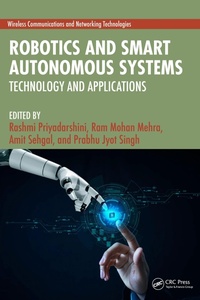
Robotics and Smart Autonomous Systems
Technology and Applications
1st Edition
Published on 25. November 2024
288 pages
978-1-040-16006-0 (ISBN)
Description

The text discusses fundamental, advanced concepts and applications of robotics and autonomous systems. It further discusses important topics, such as robotics techniques in the manufacturing sector, applications of smart autonomous systems in the healthcare sector, resource optimization in mobile robotics, and smart autonomous transport systems.
Features
Covers design and application aspects of robotic systems for implementing the concepts of smart manufacturing with reduced human intervention, better accuracy, and enhanced production capacity
Discusses techniques including supervised learning, unsupervised learning, and reinforced learning with real-life examples
Highlights a unified intermodal approach for automated transportation including cars, trucks, ships, and port management
Explains the mechanical design of planetary rovers, and the mechanical design of space manipulators, actuators, and sensors
Presents programming tools and platforms for autonomous robotic systems
The book is primarily written for senior undergraduates, graduate students, and academic researchers in fields including electrical engineering, electronics and communications engineering, computer science and engineering, and automotive engineering.
Features
Covers design and application aspects of robotic systems for implementing the concepts of smart manufacturing with reduced human intervention, better accuracy, and enhanced production capacity
Discusses techniques including supervised learning, unsupervised learning, and reinforced learning with real-life examples
Highlights a unified intermodal approach for automated transportation including cars, trucks, ships, and port management
Explains the mechanical design of planetary rovers, and the mechanical design of space manipulators, actuators, and sensors
Presents programming tools and platforms for autonomous robotic systems
The book is primarily written for senior undergraduates, graduate students, and academic researchers in fields including electrical engineering, electronics and communications engineering, computer science and engineering, and automotive engineering.
More details
Series
Edition
1. Auflage
Language
English
Place of publication
London
United Kingdom
Publishing group
Taylor & Francis Ltd
Target group
College/higher education
Illustrations
12 Tables, black and white; 15 Line drawings, black and white; 19 Halftones, black and white; 34 Illustrations, black and white
ISBN-13
978-1-040-16006-0 (9781040160060)
Copyright in bibliographic data and cover images is held by Nielsen Book Services Limited or by the publishers or by their respective licensors: all rights reserved.
Schweitzer Classification
Other editions
Additional editions
Rashmi Priyadarshini | Ram Mohan Mehra | Amit Sehgal
Robotics and Smart Autonomous Systems
Technology and Applications
Book
approx. 07/2026
1st Edition
CRC Press
€66.00
Not yet published
Rashmi Priyadarshini | Ram Mohan Mehra | Amit Sehgal
Robotics and Smart Autonomous Systems
Technology and Applications
Book
11/2024
1st Edition
CRC Press
€166.20
Shipment within 10-20 days
Persons
Rashmi Priyadarshini has a Ph.D, M.E, (Electronics and Communication Engineering, from IGIT, GGSIP University, Delhi, India) and B.Tech degree, (Electronics and Communication Engineering, from Institution of Electronics and Telecommunication Engineering, New Delhi, India). She has published 100 research papers in various reputed journals. She has 18 years of teaching experience in various engineering colleges across India. She was associated with Sharda University, India, in 2006, and is currently associated with the School of Engineering & Technology as a Professor in the Department of Electrical Electronics & Communication Engineering. Her main research interests are the design and deployment of wireless sensor networks for assistive purposes and monitoring. She has guided multiple research scholars in the area of wireless sensor networks and memristors. In total, she has eight patents, out of which one is funded by the Govt. of India (MSME). She is a senior Member of IEEE and Faculty IN charge of students' chapter of IETE. She was awarded the best researcher award for her outstanding contributions in the field of wireless sensor networks at the International Conference on Computational Intelligence for Engineering and Management Applications (CIEMA) -2022. She received the accolade of being the best paper presenter at the 3rd International Conference on Advances in Science, Engineering & Management (ICASEM- 2022). She has served as a reviewer for IEEE Transaction on Wireless Communication and Journal of Network and Computer Applications.
Ram Mohan Mehra holds a Ph.D. degree in Physics from the University of Delhi, Delhi. He superannuated from the University of Delhi in January 2010 and joined as Professor Emeritus at Sharda University. At the University of Delhi, he was engaged in teaching, research, and administration. He has been a post- doctoral research fellow of the Japan Society for Promotion of Sciences (JSPS, Japan). He is formally HOD, Department of ECE, Dean Research. Presently he is an Advisor at the Learning Resource Center, Sharda University. He has already supervised 45 Ph.D. research scholars for the award of doctoral degrees. He is presently supervising six research scholars for Ph.D. degree at Sharda University. He has written two review articles, mainly on amorphous semiconductors, which have been widely accepted and recognized by the international research community. He has published 211 research papers in journals cited in SCOPUS with a h- index of 37 and citations of more than 4000. He is reviewer for research papers of several important international journals, such as Applied Physics Letters (AIP, USA), Journal of Applied Physics (AIP, USA), Journal of Non-?crystalline Solids (Elsevier Science), Thin Solid Films (Elsevier Science), Journal of Applied Polymer Science (Wiley Inter Science, USA), Solar Energy Materials and Solar Cells (SOLMAT), Applied Surface Science (Elsevier Science), and Polymer Engineering Science. He has executed more than 17 research projects sponsored by national (DRDO, UGC, DST, CSIR, MNRE, IUAC) and international (NSF, USA & JSPS, Japan) agencies. He has widely traveled abroad for research, teaching, and consultancy assignments to universities in the USA, Japan, and Europe. He is member of several academic and professional bodies and has chaired the Semiconductor Society (India). He has organized national and international conferences in the field of semiconductors. He has been deputed by the Government of India for development of faculty.
Amit Sehgal has a Ph.D. in Electronics Engineering from Dr. A P J Abdul Kalam Technical University, Lucknow. He completed his M. Tech. in electronics and communication engineering from Guru Nanak Dev Engineering College, Ludhiana and B. E. in electronics and communication engineering from C R State College of Engineering (now DCRUST). He has more than 20 years of experience in industry, academia, and research. He has contributed to several research and development projects in the field of wireless networks, health informatics, and IoT, including with corporate and international academic collaboration. Several projects guided by him have received project grants under various State and Central Government Schemes. He is a voluntary startup mentor for Atal Innovation Mission Incubators and Atal Tinkering Labs. He has been contributing to the startup ecosystem by mentoring innovators and early age startups. On completion of his Cambridge Certification for International Teachers and Trainers and Dale Carnegie Certificate for High Impact Teaching Skills, he made a significant contribution to pedagogic uplift of engineering education by serving as Master Trainer for Mission 10X - a faculty development initiative by Wipro Technologies, for more than 2 years. He has more than 35 research papers in journals and conferences. His research interests include wireless networks, remote monitoring systems, and IoT. He has mentored several student entrepreneurs and has wide experience in the field of innovation and incubation.
Prabhu Jyot Singh serves as a Lecturer at CQ University, Australia, having earned his Ph.D. from the same institution. With a fervent dedication to research and education, he imparts knowledge to a diverse student body spanning undergraduate to postgraduate levels, embracing various social and cultural backgrounds. A passionate and driven academic, Dr. Singh specializes in computer networks, particularly focusing on private UAV networks, communication protocols, LAN of drones and UAV communication, software development, software engineering, artificial intelligence, and robotics. His extensive experience of over 8 years in higher education equips him with a profound understanding of the field, enabling him to effectively teach and mentor students across a spectrum of expertise. His commitment extends to staying abreast of cutting- edge technological advancements, notably in computer networking, UAV networks, software engineering, artificial intelligence, and machine learning, which he seamlessly integrates into his teaching and research endeavors. Dr. Singh's scholarly contributions manifest through numerous publications in esteemed indexed journals, conferences, and book chapters, showcasing his adeptness in conducting high- quality research. His doctoral thesis, "Design and implementation of an experimental UAV network," underscores his keen interest in exploring UAV applications in networking, further solidifying his expertise in this domain.
Ram Mohan Mehra holds a Ph.D. degree in Physics from the University of Delhi, Delhi. He superannuated from the University of Delhi in January 2010 and joined as Professor Emeritus at Sharda University. At the University of Delhi, he was engaged in teaching, research, and administration. He has been a post- doctoral research fellow of the Japan Society for Promotion of Sciences (JSPS, Japan). He is formally HOD, Department of ECE, Dean Research. Presently he is an Advisor at the Learning Resource Center, Sharda University. He has already supervised 45 Ph.D. research scholars for the award of doctoral degrees. He is presently supervising six research scholars for Ph.D. degree at Sharda University. He has written two review articles, mainly on amorphous semiconductors, which have been widely accepted and recognized by the international research community. He has published 211 research papers in journals cited in SCOPUS with a h- index of 37 and citations of more than 4000. He is reviewer for research papers of several important international journals, such as Applied Physics Letters (AIP, USA), Journal of Applied Physics (AIP, USA), Journal of Non-?crystalline Solids (Elsevier Science), Thin Solid Films (Elsevier Science), Journal of Applied Polymer Science (Wiley Inter Science, USA), Solar Energy Materials and Solar Cells (SOLMAT), Applied Surface Science (Elsevier Science), and Polymer Engineering Science. He has executed more than 17 research projects sponsored by national (DRDO, UGC, DST, CSIR, MNRE, IUAC) and international (NSF, USA & JSPS, Japan) agencies. He has widely traveled abroad for research, teaching, and consultancy assignments to universities in the USA, Japan, and Europe. He is member of several academic and professional bodies and has chaired the Semiconductor Society (India). He has organized national and international conferences in the field of semiconductors. He has been deputed by the Government of India for development of faculty.
Amit Sehgal has a Ph.D. in Electronics Engineering from Dr. A P J Abdul Kalam Technical University, Lucknow. He completed his M. Tech. in electronics and communication engineering from Guru Nanak Dev Engineering College, Ludhiana and B. E. in electronics and communication engineering from C R State College of Engineering (now DCRUST). He has more than 20 years of experience in industry, academia, and research. He has contributed to several research and development projects in the field of wireless networks, health informatics, and IoT, including with corporate and international academic collaboration. Several projects guided by him have received project grants under various State and Central Government Schemes. He is a voluntary startup mentor for Atal Innovation Mission Incubators and Atal Tinkering Labs. He has been contributing to the startup ecosystem by mentoring innovators and early age startups. On completion of his Cambridge Certification for International Teachers and Trainers and Dale Carnegie Certificate for High Impact Teaching Skills, he made a significant contribution to pedagogic uplift of engineering education by serving as Master Trainer for Mission 10X - a faculty development initiative by Wipro Technologies, for more than 2 years. He has more than 35 research papers in journals and conferences. His research interests include wireless networks, remote monitoring systems, and IoT. He has mentored several student entrepreneurs and has wide experience in the field of innovation and incubation.
Prabhu Jyot Singh serves as a Lecturer at CQ University, Australia, having earned his Ph.D. from the same institution. With a fervent dedication to research and education, he imparts knowledge to a diverse student body spanning undergraduate to postgraduate levels, embracing various social and cultural backgrounds. A passionate and driven academic, Dr. Singh specializes in computer networks, particularly focusing on private UAV networks, communication protocols, LAN of drones and UAV communication, software development, software engineering, artificial intelligence, and robotics. His extensive experience of over 8 years in higher education equips him with a profound understanding of the field, enabling him to effectively teach and mentor students across a spectrum of expertise. His commitment extends to staying abreast of cutting- edge technological advancements, notably in computer networking, UAV networks, software engineering, artificial intelligence, and machine learning, which he seamlessly integrates into his teaching and research endeavors. Dr. Singh's scholarly contributions manifest through numerous publications in esteemed indexed journals, conferences, and book chapters, showcasing his adeptness in conducting high- quality research. His doctoral thesis, "Design and implementation of an experimental UAV network," underscores his keen interest in exploring UAV applications in networking, further solidifying his expertise in this domain.
Content
1. Robotics in Smart Manufacturing. 2. Role of AI in Smart Robotic Systems. 3. Programming Platforms of Autonomous Robotic Systems. 4. Emerging Trends in Mobile Robots. 5. Applications of Smart Autonomous Systems in Healthcare. 6. Robots in Agriculture - Farm Mechanization & Precision Farming. 7. Smart Autonomous Transport - Land and Water. 8. Innovation in STEM Education - Robotics and AI. 9. Applications of Robots in Assistive Technology. 10. Automated Solar-Powered Bot for Identifying Damage in Vegetable Fields Using AI. 11. Robots in Space Exploration.
