

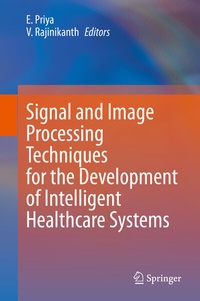
Signal and Image Processing Techniques for the Development of Intelligent Healthcare Systems
Description

This book comprehensively reviews the various automated and semi-automated signal and image processing techniques, as well as deep-learning-based image analysis techniques, used in healthcare diagnostics.
It highlights a range of data pre-processing methods used in signal processing for effective data mining in remote healthcare, and discusses pre-processing using filter techniques, noise removal, and contrast-enhanced methods for improving image quality.
The book discusses the status quo of artificial intelligence in medical applications, as well as its future. Further, it offers a glimpse of feature extraction methods for reducing dimensionality and extracting discriminatory information hidden in biomedical signals. Given its scope, the book is intended for academics, researchers and practitioners interested in the latest real-world technological innovations.
More details
Other editions
Additional editions
Persons
Dr E Priya
is a Professor at the Department of ECE, Sri Sairam Engineering College. She holds a B.E degree in Electronics and Communication Engineering from the University of Madras and an M.E degree from Madras Institute of Technology, Anna University. She received her PhD in Biomedical Engineering from the same university. With 17 years of teaching experience, she is currently guiding students in the areas of biomechanical modeling and image & signal processing. Her research interests include biomedical imaging, image processing, signal processing, and the application of artificial intelligence and machine learning techniques. A recipient of the DST-PURSE fellowship, she has published several articles in international journals and conference proceedings, as well as book chapters, in the areas of medical imaging and infectious diseases. She also serves on the editorial review board of the International Journal of Information Security and Privacy (IJISP), IGI Global.
Dr V Rajinikanth is a Professor at the Department of Electronics and Instrumentation Engineering, St Joseph's College of Engineering, Chennai, India. His research chiefly concerns medical image and signal analysis, including: EEG signals, brain MRI assessment, histopathology image analysis, evaluation of dermoscopy images, and ischemic stroke examination using brain MRIs recorded with various modalities. With 18 years of teaching experience in the fields of controller design, artificial intelligence applications, optimization and biomedical instrumentation, he has published more than 75 research articles in peer-reviewed international journals and conference proceedings, and has authored or co-authored 8 book chapters. He edited the book Advances in Artificial Intelligence Systems and currently serves as an Associate Editor for the International Journal of Rough Sets and Data Analysis (IJRSDA).
