

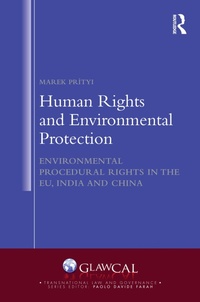
Human Rights and Environmental Protection
Environmental Procedural Rights in the EU, India and China
1st Edition
Published on 15. November 2024
302 pages
978-1-040-22834-0 (ISBN)
Description

This book explores the complex relationship between human rights and environmental protection. It analyzes the concept of environmental procedural rights from a comparative perspective in the European Union, India, and China. Arguing the need to apply a holistic approach which acknowledges the interlinkages between democracy, environmental protection, and climate change, it examines both theoretical and practical dimensions of the topic, with case studies drawn from empirical research. The work highlights the important role of environmental procedural rights at the intersection of environmental law and human rights, emphasizing the need for effective channels of communication between citizens and public authorities. The study calls for the taking into account of non-binding recommendations, such as the Maastricht Recommendations on Promoting Effective Public Participation in Environmental Matters, for developing public participation procedures in a manner that allows authorities to tailor these to the needs and situations of marginalized people. The book will be a valuable resource for academics, researchers and policy makers working in the areas of environmental law, international human rights law and transnational law and governance.
Reviews / Votes
'Marek Prityi significantly reminds readers that for environmental law to be legitimate, citizens must not only have access to institutions to exercise their rights, but also have access to the information that enables citizens to maintain those rights. Examples demonstrate that citizens can exercise those rights directly or through supportive state action, by connecting human rights with environmental protection. In an illuminating functionalist comparison of China, India and several EU member states, Prityi makes a convincing case that environmental protection and human rights can work together, especially through procedural rights. He provides concrete meaning to the overused word "sustainable", bridging environmental protection and the more general human rights to water, food, and health, but also to such specific rights as privacy, expression, fair trial, free expression, property, and the enjoyment of indigenous culture. The sharp procedural rights focus offers real insight to citizens and legal practitioners.'Prof. Dr. Kirk W. Junker, Chair of U. S. Law at the University of Cologne, Director of the Environmental Law Center at the University of Cologne
'Following the UN General Assembly's Resolution declaring the access to clean and healthy environment as a universal human right, Marek Prityi's book is a timely intervention in establishing the nexus between human rights and environmental rights. The book provides a detailed look at how the human rights and environmental rights have intersected over the years, at the international and regional levels. The greatest strength of the book lies in Prityi's detailed research on multiple jurisdictions from the Global North, particularly case studies form the European Union, and jurisdictions from the Global South, including India and China. Prityi also innovatively analyses established human rights through an environmental lens; offering insights on how established human rights institutions can address environmental rights. I would definitely recommend this book to students of international environmental law, especially to get a detailed and accessible understanding of environmental human rights, especially public participation in environmental decision-making.'
Mrinalini Shinde, Lecturer, Environmental Law Center, University of Cologne, former Legal Affairs Fellow at the United Nations Framework Convention on Climate Change
'I highly recommend this book not only to scholars and practitioners but also to all those actively involved in advocating for the protection of human rights and the environment during these critical times of climate crisis and ongoing environmental degradation.
The author delves into the intricate relationship between human rights and environmental protection, with a specific focus on environmental procedural rights. By analysing and comparing approaches in the European Union, India, and China, the author argues that meaningful public participation in environmental matters allows for consideration of various aspects that are often overlooked or not fully addressed. Consequently, this active involvement contributes to better environmental protection and empowers marginalized communities.
Furthermore, the author highlights that governance structures and respect for civil and political rights serve as prerequisites for realizing economic, social, and cultural rights. This underscores the interdependence between rule of law matters, including democratic and institutional standards, and the effective implementation of environmental procedural rights.'
Milan Chrenko, Expert and Official at the European Environment Agency, former Minister of Environment of the Slovak Republic
More details
Series
Edition
1. Auflage
Language
English
Place of publication
London
United Kingdom
Publishing group
Taylor & Francis Ltd
Target group
College/higher education
Professional and scholarly
Illustrations
1 Tables, black and white
ISBN-13
978-1-040-22834-0 (9781040228340)
Copyright in bibliographic data and cover images is held by Nielsen Book Services Limited or by the publishers or by their respective licensors: all rights reserved.
Schweitzer Classification
Other editions
Additional editions
Marek Prityi
Human Rights and Environmental Protection
Environmental Procedural Rights in the EU, India and China
Book
approx. 07/2026
1st Edition
Routledge
€57.50
Not yet published

Marek Prityi
Human Rights and Environmental Protection
Environmental Procedural Rights in the Eu, India, and China
Book
12/2024
Taylor & Francis
Unfortunately, price unknown
Available (delivery time upon request)
Marek Prityi
Human Rights and Environmental Protection
Environmental Procedural Rights in the EU, India and China
Book
11/2024
1st Edition
Routledge
€196.70
Shipment within 10-20 days
Person
Marek Prityi is a lawyer, presently working at the law firm Eversheds Sutherland, Slovak Republic. Prior to that, he worked at the Ministry of Environment of the Slovak Republic and the Ministry of Justice of the Slovak Republic. He completed his doctoral studies at the University of Cologne, Germany. He collaborated as a research associate with the organization gLAWcal (Global Law Initiatives for Sustainable Development).
Content
Introduction; 1. Connecting the Dots: Recognition of the Link between Man and Nature; 2. The Research Approach: Analysis of Established Human Rights; 3. Environmental Dimensions of Established Human Rights; 4. EU, India and China: Justification for the Choice of Regions; 5. Case study: Comparative Analysis; 6. Lessons Learned from the Comparison of Regions; 7. Conclusion
