

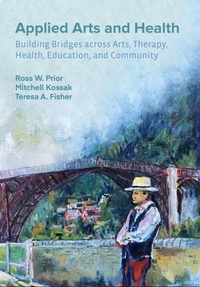
Applied Arts and Health
Building Bridges across Arts, Therapy, Health, Education, and Community
Published on 18. July 2022
978-1-78938-627-1 (ISBN)
Description

This collection documents diverse approaches in creative arts engagement, building metaphoric bridges across the field with an emphasis on creativity and well-being in education and community development.
Focussing on applied arts and health practice, research, scholarship, expressive arts therapy, community and education, the book advances integrative and multimodal art-based processes. This book aims to give prominence to art-based research and provides useful support to those working and researching across applied arts and health, education and community contexts. The book brings together a collection of world-leading authors in the field spanning a range of cultures, documenting projects and significantly adding to cohesive research in the field.
In continuing to advance applied arts and health, whilst furthering a commitment to art-based research, this new book places emphasis upon the artistic research methodology, underlining that art (performing art and visual art) is the evidence. It offers the field an integral vision for the arts both theoretically and practically. Further, the book breaks down the silos of practice that have been unhelpful in their development.
The audience for this book will include art-based researchers, expressive arts practitioners and scholars, arts educators, and those interested in bridging the gap between arts and health practice. Masters and doctoral level students in art-based research, participatory research, and qualitative research with an arts-focus are another audience for the book. All applied arts and health practitioners and academics, arts educators, art therapists and university PaR programmes. Whilst of particular use to postgraduate students, this text will also be useful to final year undergraduate students in assisting them with creative practice-based dissertations and projects. Also useful to researchers, practitioners and a range of research degree programmes in applied arts and health, education and community engagement.
Focussing on applied arts and health practice, research, scholarship, expressive arts therapy, community and education, the book advances integrative and multimodal art-based processes. This book aims to give prominence to art-based research and provides useful support to those working and researching across applied arts and health, education and community contexts. The book brings together a collection of world-leading authors in the field spanning a range of cultures, documenting projects and significantly adding to cohesive research in the field.
In continuing to advance applied arts and health, whilst furthering a commitment to art-based research, this new book places emphasis upon the artistic research methodology, underlining that art (performing art and visual art) is the evidence. It offers the field an integral vision for the arts both theoretically and practically. Further, the book breaks down the silos of practice that have been unhelpful in their development.
The audience for this book will include art-based researchers, expressive arts practitioners and scholars, arts educators, and those interested in bridging the gap between arts and health practice. Masters and doctoral level students in art-based research, participatory research, and qualitative research with an arts-focus are another audience for the book. All applied arts and health practitioners and academics, arts educators, art therapists and university PaR programmes. Whilst of particular use to postgraduate students, this text will also be useful to final year undergraduate students in assisting them with creative practice-based dissertations and projects. Also useful to researchers, practitioners and a range of research degree programmes in applied arts and health, education and community engagement.
Reviews / Votes
Many incisive metaphors frame this impressive book concerning the interstices between art and health in community settings: bridges, walls, diseases and pandemics, souls and identities, threads and stories. The authors and editors skillfully weave these and similar images into a fabric of rich hues and tones to demonstrate how art, a timeless frame of being, holds together illness and wellness, thinking and creating, isolation and communitas, mind and body and spirit. Read this book, dear artists, arts educators, therapists and community workers, with an open heart, and you will find your way through the antipodes. -- Robert Landy, Professor Emeritus, Founding Director of the Drama Therapy Program, New York University This stimulating book will help provide the foundations for building new bridges of mutual understanding and collaboration in applied arts and health. -- Stephen Clift, Professor Emeritus, Canterbury Christ Church University This book is indeed one of bridge building. Through the voices of many experts in the field, we are challenged to reconsider old paradigms, embrace new perspectives and imagine the future of applied arts and healthcare in a post-pandemic world.-- Lisa M. Wong, MD, Associate Co-Director, Arts and Humanities Initiative, Harvard Medical School
More details
Edition
New edition
Language
English
Place of publication
United Kingdom
Publishing group
Intellect
Target group
Professional and scholarly
Edition type
New edition
Illustrations
60 Halftones, black and white
ISBN-13
978-1-78938-627-1 (9781789386271)
Copyright in bibliographic data and cover images is held by Nielsen Book Services Limited or by the publishers or by their respective licensors: all rights reserved.
Schweitzer Classification
Other editions
Additional editions
Ross W. Prior | Mitchell Kossak | Teresa A. Fisher
Applied Arts and Health
Building Bridges across Arts, Therapy, Health, Education, and Community
Book
11/2022
Intellect Books
€45.10
Shipment within 3-4 weeks
Persons
Ross W. Prior is Professor of Learning and Teaching in the Arts in Higher Education at the University of Wolverhampton, United Kingdom. Prior is best known for his books Teaching Actors and Using Arts as Research in Learning and Teaching (Intellect) and his work in applied arts and health as founding principal editor of the Journal of Applied Arts and Health, first published in 2010.
Professor Mitchell Kossak is a professor and former director in the Expressive Therapies programme at Lesley University, Cambridge, Massachusetts, USA as well as a licensed clinical counsellor and registered expressive arts therapist who has presented his work and research on rhythmic attunement, improvisation, psychospiritual and community-based approaches to working with trauma at conferences nationally and internationally. He is the Associate Editor of the international Journal of Applied Arts and Health and author of Attunement in Expressive Arts Therapy: Toward an Understanding of Embodied Empathy.
Teresa A. Fisher is an Associate Professor in the Department of Communication Arts and Sciences at Bronx Community College (City University of New York/CUNY) in the USA. She is the author of Post-Show Discussions in New Play Development (2014), the Assistant Editor for the Journal of Applied Arts and Health (Intellect), and the Producer of New Plays for Young Audiences at New York University.
Professor Mitchell Kossak is a professor and former director in the Expressive Therapies programme at Lesley University, Cambridge, Massachusetts, USA as well as a licensed clinical counsellor and registered expressive arts therapist who has presented his work and research on rhythmic attunement, improvisation, psychospiritual and community-based approaches to working with trauma at conferences nationally and internationally. He is the Associate Editor of the international Journal of Applied Arts and Health and author of Attunement in Expressive Arts Therapy: Toward an Understanding of Embodied Empathy.
Teresa A. Fisher is an Associate Professor in the Department of Communication Arts and Sciences at Bronx Community College (City University of New York/CUNY) in the USA. She is the author of Post-Show Discussions in New Play Development (2014), the Assistant Editor for the Journal of Applied Arts and Health (Intellect), and the Producer of New Plays for Young Audiences at New York University.
Content
Acknowledgements
Preface
Foreword - Shaun McNiff
Introduction: Art as a Bridge - Ross W. Prior, Mitchell Kossak, and Teresa A. Fisher
PART 1: ARTISTIC EVIDENCE
1. Art Is the Evidence: Convincing Public Communication of Art-Based Research and Its Outcomes - Shaun McNiff
2. Bridging Past, Present, and Future: What If There Were No Art? - Mitchell Kossak
3. Beyond the Walls: The Artist-Researcher and Performative Dissemination - Rebecca Stancliffe, Kate Wakeling, Lucy Evans, and Stella Howard
4. Making Music Together: Music Therapy with Women Experiencing Breast Cancer - Yanyi Yang
PART 2: UNDERSTANDING THROUGH ARTISTIC PRACTICE
5. Soulfulness: The Becoming of Being - Malcolm Ross
6. Bridging Arts and Healthcare Communities - J. Todd Frazier and Shay Thornton Kulha
7. Becoming our Story: Emergent Design through Affect - Carole Miller and Juliana Saxton
8. Building a Bridge between the Improvisational Expressive Arts and Music Education - Tawnya D. Smith
PART 3: WORKING TOGETHER
9. Slowly Winding the Thread: Art Therapy and Crisis: Supporting Communities through Art - Debra Kalmanowitz
10. A Bridge to Meaning: Creating Performance with Neurodiverse Young People - Rea Dennis
11. Beyond the Verbal: Dementia and PARticipatory Arts Research - Meghann Catherine Ward, Christine Milligan, Emma Rose, and Mary Elliott
12. Transformative Impact of Drama in Mental Healthcare Education - Bruce Burton, Ingrid Femdal, Eva Bjorg Antonsen, and Margret Lepp
PART 4: WIDENING THE FIELD
13. The Healing Power of Art: Old Nordic Folk Knowledge Re-claimed - Wenche Torrissen, Anita Jensen, and Anita Salamonsen
14. Bridging Modalities and Playing with Identities: Art-based Workshop Reflections - Hillary Rubesin, Laura Teoli, Yu-Ying Chen, Dina Fried, and Michal Lev
15. Caring Attunement: The Performance of Ageing - Lisa Schouw
16. Reading as Community: Solace, Pleasures, and Becoming during COVID-19 Pandemic - Joanne O'Mara and Glenn Auld
Notes on Contributors
Index
Preface
Foreword - Shaun McNiff
Introduction: Art as a Bridge - Ross W. Prior, Mitchell Kossak, and Teresa A. Fisher
PART 1: ARTISTIC EVIDENCE
1. Art Is the Evidence: Convincing Public Communication of Art-Based Research and Its Outcomes - Shaun McNiff
2. Bridging Past, Present, and Future: What If There Were No Art? - Mitchell Kossak
3. Beyond the Walls: The Artist-Researcher and Performative Dissemination - Rebecca Stancliffe, Kate Wakeling, Lucy Evans, and Stella Howard
4. Making Music Together: Music Therapy with Women Experiencing Breast Cancer - Yanyi Yang
PART 2: UNDERSTANDING THROUGH ARTISTIC PRACTICE
5. Soulfulness: The Becoming of Being - Malcolm Ross
6. Bridging Arts and Healthcare Communities - J. Todd Frazier and Shay Thornton Kulha
7. Becoming our Story: Emergent Design through Affect - Carole Miller and Juliana Saxton
8. Building a Bridge between the Improvisational Expressive Arts and Music Education - Tawnya D. Smith
PART 3: WORKING TOGETHER
9. Slowly Winding the Thread: Art Therapy and Crisis: Supporting Communities through Art - Debra Kalmanowitz
10. A Bridge to Meaning: Creating Performance with Neurodiverse Young People - Rea Dennis
11. Beyond the Verbal: Dementia and PARticipatory Arts Research - Meghann Catherine Ward, Christine Milligan, Emma Rose, and Mary Elliott
12. Transformative Impact of Drama in Mental Healthcare Education - Bruce Burton, Ingrid Femdal, Eva Bjorg Antonsen, and Margret Lepp
PART 4: WIDENING THE FIELD
13. The Healing Power of Art: Old Nordic Folk Knowledge Re-claimed - Wenche Torrissen, Anita Jensen, and Anita Salamonsen
14. Bridging Modalities and Playing with Identities: Art-based Workshop Reflections - Hillary Rubesin, Laura Teoli, Yu-Ying Chen, Dina Fried, and Michal Lev
15. Caring Attunement: The Performance of Ageing - Lisa Schouw
16. Reading as Community: Solace, Pleasures, and Becoming during COVID-19 Pandemic - Joanne O'Mara and Glenn Auld
Notes on Contributors
Index
