

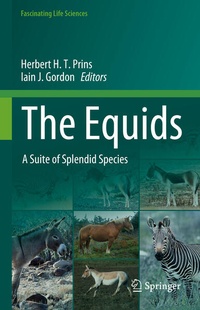
The Equids
Description

The narrative of the progression of the 'horse family' through geological time, from dog-sized fruit-eating animals with four toes on their front and three toes on their hind legs, to the valiant long-legged, single-toed modern grazing horses, beloved by racing enthusiasts, is the poster child of evolution. However, like the rhinos or tapirs, the horse-like zebras, wild asses, kulans, kiangs, onagers, and the real horses are often portrayed as being past their evolutionary peak as compared to the more recently evolved ruminants (especially bovids and deer) which now dominate the grazing niche. That story of a species group over its evolutionary zenith is compelling, but anyone who has travelled in the remote savannas of Africa or the cold wild deserts of Central Asia is awed with herds of glorious animals that clearly do not ruminate. It appears as though these, so-named 'hind-gut fermenters', are perhaps much better adapted to these environments than one is led to believe. The purpose of this book is to dispel the myth of the inferior Equidae by describing, and investigating, the evolutionary and ecological journey of the horse family in all its glory.
More details
Other editions
Additional editions
Persons
Herbert Prins is Professor Emeritus in Resource Ecology at Wageningen University. He studied the ecology of African savannas but also Asian high-altitude ecosystems. He (co-)authored several hundred scientific publications and edited a number of books on ecology for different publishers. He supervised the work of one hundred PhD students. He is Officer in the Order of the Golden Ark and Officer in the Order of Oranje-Nassau for his contribution to conservation.
Iain Gordon holds Honorary Professorships from the Australian National University, Central Queensland University and Lincoln University in New Zealand, Honorary Fellowships from CSIRO and the James Hutton Institute. Over the past 35 years, he has gained an international reputation for scientific leadership and research excellence in interdisciplinary approaches, particularly in the context of managing land use to benefit biodiversity. In recognition of his contribution to science, he was elected as a Fellow of the Royal Society of Biology in 1995 and Fellow of the Royal Society of Edinburgh in 2012.
Content
Chapter 1. Are Equids Evolutionary Dead Ends?.- Chapter 2. Evolutionary Radiation of Equids.- Chapter 3. The Miocene Browsing Horses: Another Way to Be a Successful Large Equid.- Chapter 4. Why There Are No Modern Equids Living in Tropical Lowland Rainforests.- Chapter 5. Evolution of Equid Body Size.- Chapter 6. Forage Consumption and Digestion in the Modern Equids.- Chapter 7. Revisiting the Jarman-Bell Principle.- Chapter 8. Equid Adaptations to Cold Environments.- Chapter 9. Adaptations to Hot Environments.- Chapter 10. Diseases and the Distributions of Wild and Domestic Equids.- Chapter 11. How Equids Cope with Macroparasites.- Chapter 12. Equids and Predators.- Chapter 13. Evolution of the Equid Limb.- Chapter 14. On Humanity and Equids: Ecologies, Trajectories, and Relationships.- Chapter 15. Conclusion - A New Story of the Modern Equids.
