

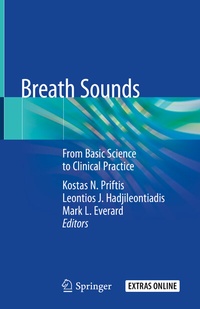
Breath Sounds
Description

Reviews / Votes
"This is a comprehensive resource on the origin, transmission, recording, and analysis of breath sounds, including an introduction to current and future respiratory sound research. Although it could be helpful to all clinicians, it is particularly of value to researchers in the field of respiratory sound recording and analysis." (Santosh Dhungana, Doody's Book Reviews, August, 2018)More details
Other editions
Additional editions
Persons
Kostas N. Priftis, MD is Associate Professor in Paediatric Pulmonology, at the Children's Respiratory and Allergy Unit, 3rd Department of Paediatrics, National & Kapodistrian University of Athens Medical School, Greece. He graduated from the Medical School of the Aristotle University of Thessaloniki (1976) and defended his PhD thesis at the University of Athens (1982). Completed his residency training in Paediatrics at the University of Patras (1985) and a research fellowship in Paediatric Respiratory Medicine at the University of Nottingham Medical School, UK (1989). His research focuses on childhood asthma, allergy and chronic endobronchial infections. He has authored more than 160 scientific publications in peer reviewed international journals (h-index = 38, Google Scholar), edited 5 books or special issues.
Leontios J. Hadjileontiadis received the Diploma (1989) and PhD (1997) degrees in Electrical and Computer Engineering (1989) from the Aristotle University of Thessaloni150 papers in peer reviewed international conference proceedings, 6 books, 2 books edited, 24 book chapters and 3 patents [h-index=34 (Google scholar), 28 (Scopus)]. He has a vast experience in project management and has been awarded, amongst other awards, as innovative researcher and champion faculty from Microsoft, USA. He is a Senior Member of IEEE.
Mark Everard
is the McCusker Foundation Professor of Paediatric Respiratory Medicine at the University of Western Australia and Princess Margaret Hospital for Children, Perth. His research includes the spectrum from bench top to bedside with particular interests in 'difficult asthma'; the interaction of the host and micro-organisms including respiratory microbiome, persistent bacterial bronchitis, viral-bacterial interaction, the respiratory syncytial virus and viral lower respiratory tract infections; aerosol therapy and the impact of patient behaviour on clinical outcomes.
Content
1 Introduction.- Part I: General Considerations.- 1 Historic review.- 2 Clinical usefulness of breath sounds.- 3 Nomenclature.- Part II: Sound recording, analysis, and perception. 4 Physics of sounds.- 5 Sound transmission through the human body.- 6 Breath sound recording.- 7 Current techniques for breath sound analysis.- Part III. Respiratory sounds. 8 Normal versus adventitious sounds.- 9 Crackles.- 10 Wheeze.- 11 Other lung sounds.- 12 Cough sound.- 13 Extrathoracic origin sounds.- Part IV. Where Are We Going? 14 Future prospectes for respiratory sound research .- 15 Towards a unified nomenclature.- 16 Epilogue.
