

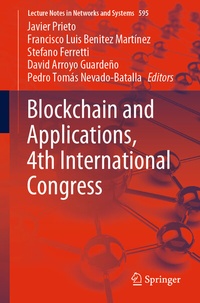
Blockchain and Applications, 4th International Congress
Published on 7. January 2023
XX, 462 pages
978-3-031-21229-1 (ISBN)
Description

This book constitutes the refereed proceedings of the 4th International Congress on Blockchain and Applications 2022, BLOCKCHAIN'22, held in L'Aquila, Italy, in July 2022. Among the scientific community, blockchain and artificial intelligence are a promising combination that will transform the production and manufacturing industry, media, finance, insurance, e-government, etc. Nevertheless, there is no consensus with schemes or best practices that would specify how blockchain and artificial intelligence should be used together.
The 37 full papers presented in the main track were carefully reviewed and selected from more than 75 submissions. They contain the latest advances on blockchain and artificial intelligence and on their application domains, exploring innovative ideas, guidelines, theories, models, technologies, and tools and identifying critical issues and challenges that researchers and practitioners must deal with in the future research. The bookalso includes 3 papers from the WEB3-TRUST workshop and 2 papers from the Doctoral Consortium.
The 37 full papers presented in the main track were carefully reviewed and selected from more than 75 submissions. They contain the latest advances on blockchain and artificial intelligence and on their application domains, exploring innovative ideas, guidelines, theories, models, technologies, and tools and identifying critical issues and challenges that researchers and practitioners must deal with in the future research. The bookalso includes 3 papers from the WEB3-TRUST workshop and 2 papers from the Doctoral Consortium.
More details
Series
Edition
1st ed. 2023
Language
English
Place of publication
Cham
Switzerland
Publishing group
Springer International Publishing
Target group
Professional and scholarly
Product notice
Reflowable
Illustrations
XX, 462 p. 132 illus., 100 illus. in color.
File size
29,67 MB
ISBN-13
978-3-031-21229-1 (9783031212291)
DOI
10.1007/978-3-031-21229-1
Schweitzer Classification
Other editions
Additional editions
Javier Prieto | Francisco Luis Benítez Martínez | Stefano Ferretti
Blockchain and Applications, 4th International Congress
Book
01/2023
Springer
€213.99
Shipment within 15-20 days
Content
- Intro
- Organization
- Preface
- Contents
- BLOCKCHAIN 2022 Main Track
- Modelling of the Internet Computer Protocol Architecture: The Next Generation Blockchain
- 1 Introduction
- 2 Background and Related Work
- 2.1 Related Technologies
- 2.2 Related Work
- 3 The Internet Computer Protocol (ICP)
- 3.1 Network Nervous System
- 3.2 Chain Key Cryptography
- 4 Modelling and Simulation of the ICP Architecture
- 4.1 Design and Implementation of an ICP Simulator
- 5 Conclusions
- References
- Assessing Blockchain Challenges in the Maritime Sector
- 1 Introduction
- 1.1 Technological Literary Recommendations for the Maritime Sector
- 2 Blockchain Overview
- 2.1 Blockchain Features
- 2.2 The Need to Identify Blockchain Challenges in the Maritime Sector
- 3 Addressing Blockchain Challenges in the Maritime Sector
- 3.1 A Heterogeneous Ecosystem
- 3.2 Transparency: A Double Edged Sword
- 3.3 Technology Predates Regulations
- 3.4 Distinct Technical Capabilities
- 3.5 Data Storage
- 3.6 Smart Contracts
- 3.7 Blockchain Is Isolated from the Real-World
- 3.8 Energetic Concerns
- 4 Conclusion
- References
- A Model of Decentralised Distribution Line Using Layer 2 Blockchains
- 1 Introduction
- 2 Related Literature
- 3 A Model of Perishable Supply Chain
- 3.1 Problem of Designing Decentralised Distribution Lines
- 4 Dynamic Distribution with Blockchains
- 4.1 Channel Between a Buyer and a Mediator
- 4.2 Channel Between a Seller and a Mediator
- 4.3 Channel Among Mediators
- 4.4 Decentralised Product Matching
- 5 Analysis
- 6 Evaluation
- 7 Conclusion
- References
- ChronoEOS: Configuration Control System Based on EOSIO Blockchain for On-Running Forensic Analysis
- 1 Introduction
- 2 Background
- 2.1 Forensic Analysis
- 2.2 Blockchain in Forensic Analysis
- 3 Use Case Description
- 4 ChronoEOS
- 5 Experimental Results
- 5.1 Deployment and Evaluation
- 5.2 Discussion
- 6 Conclusion
- References
- Sharding-Based Proof-of-Stake Blockchain Protocol: Security Analysis
- 1 Introduction
- 2 Probabilistic Model
- 2.1 Notations and Definitions
- 2.2 Architecture
- 2.3 Probability distributions
- 2.4 Years to Fail
- 3 Results and Evaluation
- 3.1 Simulation Setup
- 3.2 Results and Analysis
- 4 Conclusion
- References
- Cryptocurrencies, Survey on Legal Frameworks and Regulation Around the World
- 1 Introduction
- 2 Legal Frameworks
- 2.1 European Union
- 2.2 United States
- 2.3 BRICS
- 2.4 Legal Issues Summary
- 3 Conclusion
- References
- SmartTwin: A Blockchain-Based Software Framework for Digital Twins Using IoT
- 1 Introduction
- 2 Related Work
- 3 The SmartTwin Framework
- 3.1 M1: Device Module
- 3.2 M2: Gateway Module
- 3.3 M3: Blockchain Module
- 4 Use Cases
- 4.1 Agri-food Traceability
- 4.2 Water Management
- 5 Conclusions and Future Work
- References
- Proofs and Limitations of the Pathway Protocol
- 1 Introduction
- 2 State of the Art
- 3 Pathway Operations
- 3.1 Step 1: Removing Liquidity from the Pool
- 3.2 Step 2: Swapping T1 Tokens to T2
- 4 Impact of Pathway Operations on the Pool
- 5 Proofs
- 6 Discussion and Limitations
- 6.1 A Potential Attack Vector: A Sandwich Attack
- 6.2 Pathway Protocol Might Lead to a Decreased Influence on the Pool
- 7 Outlook and Future Work
- References
- Profitable Fee Controller for Payment Channel Networks
- 1 Introduction
- 2 Background
- 2.1 Participants of PCN
- 2.2 Issues in PCN
- 3 Related Works
- 4 MPC Based Fee Controller (MPC-FC)
- 4.1 Model
- 4.2 Optimization Problem
- 4.3 Model Predictive Control
- 5 Implementation
- 6 Experiments and Results
- 6.1 Setup
- 6.2 Exhaustion and Revenue
- 7 Evaluation and Discussion
- 8 Conclusion
- References
- R?ddle: A Fully Decentralized Mobile Game for Fun and Profit
- 1 Introduction
- 2 Related Work
- 3 System Overview and Implementation
- 4 Evaluation
- 5 Discussion
- 6 Conclusions
- References
- Mitigation of Scaling Effects in NTF-Based Ticketing Systems
- 1 Introduction
- 2 Related Work
- 3 Architecture
- 3.1 Algorithm-w/Return
- 3.2 Algorithm-wo/Return
- 3.3 Algorithm-Cache
- 3.4 Test Scenarios
- 4 Implementation
- 4.1 NFT
- 4.2 QR Code
- 4.3 Authentication
- 4.4 Cache
- 4.5 Test Scenario
- 5 Evaluation
- 5.1 Evaluation Strategy
- 5.2 Results
- 5.3 Discussion
- 6 Conclusion and Outlook
- 6.1 Conclusion
- 6.2 Outlook
- References
- Digital Content Verification Using Hyperledger BESU
- 1 Introduction
- 2 Technological Background and Related Work
- 2.1 Designing the Prototype
- 2.2 Certification Modalities. A Review of Literature
- 2.3 Current Business Solutions Using Different Approaches
- 3 Prototype for Digital Certification Using Hyperledger BESU
- 4 Conclusions and Future Work
- References
- Prototyping a Smart Contract Application for Fair Reward Distribution in Software Development Projects
- 1 Introduction
- 2 State of the Art
- 2.1 Relevant Work
- 3 Software Architecture
- 4 Implementation
- 4.1 Distribution of Compensation
- 4.2 Limitations
- 4.3 Conclusion
- References
- Blockchain in the Public Sector: An Umbrella Review of Literature
- 1 Introduction
- 2 Background
- 3 Method
- 4 Under the Umbrella
- 5 Discussion
- 5.1 Initiatives of Blockchain in the Public Sector
- 5.2 Challenges and Concerns of Blockchain in the Public Sector
- 5.3 Public Services Potentially Affected by Blockchain
- 6 Conclusions, Limitations and Further Work
- References
- Digital Identity Using Hyperledger Fabric as a Private Blockchain-Based System
- 1 Introduction
- 2 Proposed System
- 2.1 Hyperledger Fabric
- 2.2 Verification Using Face and Optical Character Recognition Technologies
- 3 System Development
- 3.1 Development and Operations
- 3.2 System Main Features
- 4 Discussion
- 5 Conclusion
- References
- Cryptocurrencies, Systematic Literature Review on Their Current Context and Challenges
- 1 Introduction
- 2 Proposed Framework
- 2.1 Q1: What Research Has Been Carried Out Previously in the Literature Regarding the Use of Cryptocurrencies?
- 2.2 Q2: What Are the Vulnerabilities that Affect the Adoption of Cryptocurrencies?
- 2.3 Q3: How Are Crimes with Crypto Affecting the Socio-economic Ecosystem in the World?
- 3 Conclusion
- References
- Blockchain Assisted Voting in Academic Councils
- 1 Introduction
- 2 Background
- 3 Related Work
- 4 Proposed Solution
- 4.1 Architecture
- 4.2 Prototype Implementation
- 5 Conclusions
- References
- Scalable and Transparent Blockchain Multi-layer Approach for Smart Energy Communities
- 1 Introduction
- 2 Related Works: Blockchain and Energy Communities
- 3 Methodology: Blockchain-Based Smart Energy Communities
- 3.1 Trakti Smart Legal Contract and Blockchain Framework
- 3.2 Blockchain-Based Smart Energy Communities High Level Architecture
- 4 Technical Requirement and Results Discussion
- 4.1 Smart Communities: Reward Smart Contract with Trakti Platform
- 4.2 Results
- 5 Conclusions and Future Works
- References
- Blockchain Consensus Algorithms: A Survey
- 1 Introduction
- 2 Consensus Protocol
- 2.1 Goals of Consensus Algorithm
- 2.2 Components of Consensus Algorithm
- 3 Types of Consensus Protocol
- 3.1 Proof-of-Work (PoW)
- 3.2 Proof-of-Stake (PoS)
- 3.3 Delegated Proof-of-Stake (DPoS)
- 3.4 Practical Byzantine Fault Tolerance (PBFT)
- 3.5 Raft
- 3.6 Proof of Elapsed Time (PoET)
- 3.7 Proof of Activity (PoA)
- 3.8 Proof of Burn (PoB)
- 3.9 Proof of Capacity (PoC)
- 3.10 Viewstamped Replication (VR)
- 3.11 Paxos
- 4 Methodology
- 5 Conclusion
- References
- Decentralised Argumentation for Data Vetting in Blockchains
- 1 Introduction
- 2 Related Literature
- 3 Decentralised Argumentation for Data Vetting
- 3.1 Argumentation
- 3.2 IPFS as Argument Store
- 3.3 Decentralised Argumentation
- 3.4 Blockchain Implementation
- 4 Conclusion
- References
- Designing the Chain of Custody Process for Blockchain-Based Digital Evidences
- 1 Introduction
- 2 Related Work
- 3 Our Proposed Solutions
- 3.1 The General Model
- 3.2 Design Principles
- 3.3 Architectures
- 4 Results and Discussion
- 5 Conclusions and Further Works
- References
- The Devil Hides in the Model: Reviewing Blockchain and BFT Protocols
- 1 Introduction
- 2 Model
- 3 Protocol Analysis
- 3.1 Using the Bitcoin Backbone Protocol
- 3.2 Nakamoto Agreement
- 3.3 Ouroboros Praos
- 3.4 Tendermint
- 3.5 HoneyBadgerBFT
- 3.6 Phantom
- 3.7 Algorand
- 4 Discussion
- 5 Conclusion
- References
- Blockchain-Based Business Process Management (BPM) for Finance: The Case of Loan-Application
- 1 Introduction
- 2 Blockchain Related Literature Overview
- 3 Loan Business Process
- 3.1 Loan Process Business Process Pattern with Blockchain
- 3.2 Advantages and Challenges for Financial Companies
- 3.3 Loan BPM Implementation as a Web Service
- 4 Conclusions
- References
- Objective-Aware Reputation-Enabled Blockchain-Based Federated Learning
- 1 Introduction
- 2 Related Work
- 3 The Proposed Framework
- 3.1 Components of the Proposed Framework
- 3.2 Threat Model
- 4 Implementation and Evaluation
- 4.1 Experimental Setup
- 4.2 Results and Discussion
- 5 Conclusion and Future Work
- References
- Enhancing Smart Contract Quality by Introducing a Continuous Integration Pipeline for Solidity Based Smart Contracts
- 1 Introduction
- 2 Related Work
- 2.1 Formal Verification
- 2.2 Tools for Supporting Smart Contract Development
- 3 Methodology
- 4 Requirements for a CI Pipeline Considering Smart Contracts
- 5 Developing a General CI Pipeline For Smart Contracts
- 6 Discussion and Future Work
- References
- ``Are You What You Claim to Be?'' Attribute Validation with IOTA for Multi Authority CP-ABE
- 1 Introduction
- 2 Background and Related Work
- 2.1 Related Work
- 2.2 Multi Authority CP-ABE
- 3 Methodology and Use Case
- 3.1 Attribute Spoofing
- 3.2 Industrial Use Case
- 4 Proposed System
- 4.1 Attribute Storage and Distribution
- 4.2 User Authentication
- 5 System Evaluation
- 5.1 Protection Against Attribute Spoofing
- 5.2 Additional Security Properties
- 6 Conclusions
- References
- Privacy-Preserving Energy Trade Using Double Auction in Blockchain Offline Channels
- 1 Introduction
- 2 Related Literature
- 3 Energy Trade Problem
- 4 Energy Trade with Decentralised Double Auction
- 4.1 Unidirectional Offline Channel
- 4.2 Double Auction Using Offline Channels
- 5 Analysis
- 6 Experimental Evaluation
- 7 Conclusion
- References
- Interoperable Industry 4.0 Plant Blockchain and Data Homogenization via Decentralized Oracles
- 1 Introduction
- 2 Related Work
- 3 Interoperable Plant Blockchain for Homogenized Data via Smart Oracles
- 4 Implementation
- 4.1 Discussion
- 5 Conclusion and Future Work
- References
- Towards Cost-Efficient Management for Power Purchase Agreements Using Blockchain Technology
- 1 Introduction
- 1.1 State-of-the-Art Limitations for PPA Management
- 1.2 Cost-Efficiency in PPA Management
- 2 Materials and Methods
- 2.1 Addressing the Challenges in the PPA Management
- 2.2 Procedure
- 2.3 Formulas Addressed by Blockchain
- 3 Results
- 3.1 Self-managed Consumers
- 3.2 A Distributed Solution
- 4 Discussion
- 4.1 PPA Data Management
- 4.2 Data Ownership
- 4.3 Business Implications and Market Opportunity
- References
- Tokenizing the Portuguese Accounting Standards System
- 1 Introduction
- 2 Accounting Movements
- 3 Smart Contracts
- 4 Conclusion and Future Work
- References
- Bibliometric Analysis on the Convergence of Artificial Intelligence and Blockchain
- 1 Introduction
- 2 Method and Data
- 3 Results
- 3.1 Time Evolution of the Studies
- 3.2 Thematics of the Studies
- 3.3 The Most Prolific Authors
- 3.4 Geographic Collaborations Perspective
- 3.5 The Most Influential Sources
- 4 Discussion and Future Research Direction
- 5 Conclusion
- References
- Towards an Infrastructure Cost Model for Blockchain-Based Applications
- 1 Introduction
- 2 Problem Definition
- 3 Proposed Cost and Benefit Model
- 3.1 Proposed Transaction Taxonomy for Blockchain Applications
- 3.2 Proposed Public Blockchain Cost Model
- 3.3 Proposed Private Blockchain Cost Model
- 3.4 Monetary Benefits
- 4 System Setup and the Model Evaluation
- 4.1 Description of the Blockchain Setup
- 4.2 Description of the Application
- 4.3 Evaluation of the Costs and Benefits
- 5 Conclusions and Future Works
- References
- A Benchmarking Study of Blockchain-Based Technology Implementation Cost: Public and Private Blockchain for Enterprise Level Organization Using Benchmarking Model
- 1 Introduction
- 2 Literature Review
- 2.1 Blockchain
- 2.2 Benchmarking
- 3 Methodology
- 3.1 Benchmarking Steps
- 4 Results
- 4.1 Define Assumptions and Calculations
- 4.2 Implementation Cost
- 5 Conclusion
- References
- SSI4Web: A Self-sovereign Identity (SSI) Framework for the Web
- 1 Introduction
- 2 Threat Modelling and Requirement Analysis
- 2.1 Threat Modelling
- 2.2 Requirement Analysis
- 3 SSI4Web Framework
- 3.1 SSI Concept
- 3.2 Architecture and Implementation
- 3.3 Use-Case and Protocol Flow
- 4 Discussion
- 4.1 Analysing Requirements
- 4.2 Advantages and Limitations
- 4.3 Future Work
- 5 Conclusion
- References
- The Communicational Universe of Cryptocurrencies. An Approach to the Current Scientific Importance
- 1 Introduction to Cryptocurrencies and the Importance of Their Communication
- 1.1 The Cryptocurrency Universe
- 1.2 The Communication of Technology. The Case of Cryptocurrencies
- 2 Methodology
- 3 Results
- 4 Discussion
- 5 Conclusions
- References
- Evaluation and Comparison of a Private and a Public Blockchain Solution for Use in Supply Chains of SMEs Based on a QOC Analysis
- 1 Introduction
- 2 State of the Art
- 3 Methods
- 4 Evaluation
- 4.1 Asking the Question
- 4.2 Definition of Options
- 4.3 Definition of Criteria
- 4.4 Weighting of Criteria
- 4.5 Validation of Options
- 4.6 Findings
- 5 Outlook
- 6 Conclusion
- References
- Identification of False Stealthy Data Injection Attacks in Smart Meters Using Machine Learning and Blockchain
- 1 Introduction
- 2 Contribution
- 3 Related Work
- 4 Blockchain-Based 3-Tier Architecture
- 5 Conventional and Advanced System Model
- 6 Blockchain-Based False Stealthy Data Identification Algorithm (BFSDIA)
- 7 Results and Discussion
- 8 Conclusion
- References
- Workshop on Beyond the Promises of Web3.0: Foundations and Challenges of Trust Decentralization (WEB3-TRUST)
- Enhancing the Anonymity and Auditability of Whistleblowers Protection
- 1 Introduction
- 2 State of the Art
- 3 Architecture
- 3.1 Components
- 3.2 Registration
- 3.3 Publication
- 3.4 Blockchain
- 4 Conclusions
- References
- Bottom-Up Trust Registry in Self Sovereign Identity
- 1 Introduction
- 1.1 Contribution
- 2 Related Work
- 2.1 Credential Chaining
- 2.2 Centralised Trust Registry
- 3 Bottom-Up Trust Framework Design
- 3.1 Trust Registry Design
- 3.2 Privacy Design
- 3.3 Private Blockchain Relay Server
- 4 Credential Verification
- 4.1 Traversing the Graph During Verification
- 4.2 Economic Incentive Design for Trust Registry Participants
- 5 Implementation
- 6 Proposed Improvements
- 7 Conclusion
- 7.1 Future Work
- References
- Integrating Web3 Features into Moodle
- 1 Introduction
- 2 Related Work
- 3 Preliminaries
- 3.1 Web2
- 3.2 Web3
- 4 Web3 Integration
- 4.1 Architecture
- 4.2 Workflows
- 4.3 Prototype
- 5 Evaluation
- 6 Discussion
- 7 Conclusion
- References
- Doctoral Consortium
- Overview of Multiple User Encryption for Exchange of Private Data via Blockchains
- 1 Introduction
- 2 State of the Art
- 3 Multiple User Encryption and Key Exchange
- 3.1 Diffie Hellman
- 3.2 El Gamal
- 3.3 Multi Key Homomorphic Encryption
- 3.4 Multi Key Functional Encryption
- 4 Future Work and Conclusion
- References
- Blockchain Adoption in the Energy Sector: A Comprehensive Regulatory Readiness Assessment Framework to Assess the Regulatory Readiness Levels of Countries
- 1 Introduction
- 2 Related Work
- 2.1 The Multitude of Legal Challenges Surrounding the Application of Smart Contracts to Blockchain-Based Energy Systems
- 2.2 The Legal Issues Concerning Privacy and Data Protection Due to the Multidimensional Data Usage in Decentralized and Digitalized Blockchain-Based Energy Systems and Energy Trading
- 2.3 The Legal Implications of Security Breaches in Blockchain-Based Energy Applications
- 2.4 The Legal Challenges Arising from the Lack of Licensing Requirements for Blockchain-Enabled Energy Transactions
- 2.5 The Legal Issues in the Creation and Evolution of Business Models in a Heavily Regulated Energy Sector, and the Deregulation and Liberalization of Energy Markets
- 2.6 Lack of Legal and Regulatory Readiness Framework/Maturity Model to Evaluate and Access Blockchain Technology
- 3 Hypothesis
- 4 Proposal
- 5 Preliminary Results and/or Evaluation Plan
- 6 Reflections
- References
- Author Index
