

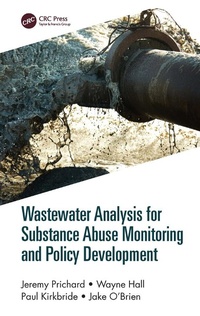
Wastewater Analysis for Substance Abuse Monitoring and Policy Development
1st Edition
Published on 4. November 2020
178 pages
978-0-429-65524-1 (ISBN)
Description

This book addresses how to estimate substance use and thereby evaluate policies intended to reduce the harms caused by drugs and other substances. Wastewater analysis (WWA) can provide efficient, affordable, fine-grained and objective data on population substance use trends on a very large scale.
The authors discuss the potential implications of WWA as a new method for understanding substance use in a variety of settings and ignite a discourse with policy makers, criminologists, epidemiologists and other disciplines about the need for collaboration with WWA scientists. The book also features an explanation of the costs and harms of substance use with academic literature from criminological and epidemiological sources and reports from lead agencies.
Additional features include:
Details on the origin of wastewater analysis in environmental science
Description of analytical chemistry methods for tracing a wide variety of substances, including illicit drugs, alcohol, tobacco and other chemicals
Exploration of the major empirical problems in estimating population consumption of alcohol, tobacco and drugs at the international and national level
Examination of the principles of human research ethics and their application to wastewater analysis
Wastewater Analysis for Substance Abuse Monitoring and Policy Development is a valuable tool for analytical chemists, wastewater scientists and criminologists, as well as researchers and policy makers across disciplines who work in drug sectors.
The authors discuss the potential implications of WWA as a new method for understanding substance use in a variety of settings and ignite a discourse with policy makers, criminologists, epidemiologists and other disciplines about the need for collaboration with WWA scientists. The book also features an explanation of the costs and harms of substance use with academic literature from criminological and epidemiological sources and reports from lead agencies.
Additional features include:
Details on the origin of wastewater analysis in environmental science
Description of analytical chemistry methods for tracing a wide variety of substances, including illicit drugs, alcohol, tobacco and other chemicals
Exploration of the major empirical problems in estimating population consumption of alcohol, tobacco and drugs at the international and national level
Examination of the principles of human research ethics and their application to wastewater analysis
Wastewater Analysis for Substance Abuse Monitoring and Policy Development is a valuable tool for analytical chemists, wastewater scientists and criminologists, as well as researchers and policy makers across disciplines who work in drug sectors.
More details
Edition
1. Auflage
Language
English
Place of publication
London
United Kingdom
Publishing group
Taylor & Francis Ltd
Target group
College/higher education
Product notice
Reflowable
Illustrations
10 Tables, black and white; 1 Line drawings, black and white; 3 Halftones, black and white; 3 Illustrations, color; 1 Illustrations, black and white
ISBN-13
978-0-429-65524-1 (9780429655241)
Copyright in bibliographic data and cover images is held by Nielsen Book Services Limited or by the publishers or by their respective licensors: all rights reserved.
Schweitzer Classification
Other editions
Additional editions
Jeremy Prichard | Wayne Hall | Paul Kirkbride
Wastewater Analysis for Substance Abuse Monitoring and Policy Development
Book
08/2022
1st Edition
CRC Press
€84.30
Shipment within 15-20 days
Jeremy Prichard | Wayne Hall | Paul Kirkbride
Wastewater Analysis for Substance Abuse Monitoring and Policy Development
Book
10/2020
1st Edition
CRC Press
€199.00
Shipment within 15-20 days
Persons
Jeremy Prichard is an Associate Professor of Criminal Law at the University of Tasmania and an Adjunct Associate Professor at the University of Queensland. His earlier professional roles included appointments at the Australian Institute of Criminology, the Queensland Department of the Premier and Cabinet, and the Queensland Department of Communities, Aboriginal and Torres Strait Islander Partnerships.
Wayne Hall is a Professorial Fellow in the Centre for Youth Substance Abuse Research at the University of Queensland. He has Professorial appointments at the London School of Hygiene and Tropical Medicine and the National Drug and Alcohol Research Centre, UNSW. He was: an NHMRC Australia Fellow at the University of Queensland Centre for Clinical Research (2009-2014); Professor of Public Health Policy, School of Population Health, UQ (2005-2009); Director of the Office of Public Policy and Ethics at the Institute for Molecular Bioscience (2001-2005), UQ; and Director of the National Drug and Alcohol Research Centre, UNSW (1994-2001).
Jake O'Brien is a Research Fellow at the Queensland Alliance for Environmental Health Sciences (QAEHS). He has a keen interest in wastewater-based epidemiology and his PhD focussed on refining the uncertainties and expansion of wastewater-based epidemiology for assessing population exposure to chemicals (conferred in 2017, UQ).
Paul Kirkbride is Strategic Professor of Forensic Science at Flinders University in South Australia. Prior to that academic appointment he was for many years an operational forensic scientist and senior manager at Forensic Science SA, Manager of Business Programs at the National Institute of Forensic Science, and Chief Scientist with the Forensic and Data Centres portfolio of the Australian Federal Police.
Wayne Hall is a Professorial Fellow in the Centre for Youth Substance Abuse Research at the University of Queensland. He has Professorial appointments at the London School of Hygiene and Tropical Medicine and the National Drug and Alcohol Research Centre, UNSW. He was: an NHMRC Australia Fellow at the University of Queensland Centre for Clinical Research (2009-2014); Professor of Public Health Policy, School of Population Health, UQ (2005-2009); Director of the Office of Public Policy and Ethics at the Institute for Molecular Bioscience (2001-2005), UQ; and Director of the National Drug and Alcohol Research Centre, UNSW (1994-2001).
Jake O'Brien is a Research Fellow at the Queensland Alliance for Environmental Health Sciences (QAEHS). He has a keen interest in wastewater-based epidemiology and his PhD focussed on refining the uncertainties and expansion of wastewater-based epidemiology for assessing population exposure to chemicals (conferred in 2017, UQ).
Paul Kirkbride is Strategic Professor of Forensic Science at Flinders University in South Australia. Prior to that academic appointment he was for many years an operational forensic scientist and senior manager at Forensic Science SA, Manager of Business Programs at the National Institute of Forensic Science, and Chief Scientist with the Forensic and Data Centres portfolio of the Australian Federal Police.
Content
Preface. Acknowledgements. About the Authors. Chapter 1 Measuring Strategies to Counter the Harms of Substance Use: A Global Overview. Chapter 2 Understanding Wastewater Analysis: How It Works; Its Strengths and Limitations. Chapter 3 Macro Applications of Wastewater Analysis: International Comparisons. Chapter 4 Meso Applications of Wastewater Analysis: National Research. Chapter 5 Micro Applications of Wastewater Analysis: Prisons, Educational Institutions and Workplaces. Chapter 6 Future Directions. Index.
