

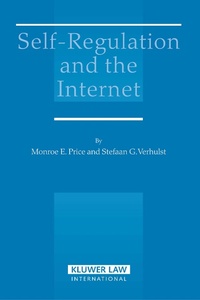
Self-Regulation and the Internet
Published on 21. December 2004
218 pages
978-90-411-7713-1 (ISBN)
Description

Every day, societal demand grows for some form of control or supervision over activities that appear inherently beyond governance: the Internet. The gulf between community aspiration and the perceived limits on government capacity forces each entity, industry, and regulator to conduct a thorough and painstaking search for an appropriate solution. The resolution to this dilemma requires the innovation of regulatory design for the Internet. Without flexibility and responsiveness, traditional law and regulation cannot adequately address the transnational, intangible, and ever-changing Internet space.
Attempts at Internet regulation generally have moved away from direct legal control and toward more flexible variations of what can be termed "self-regulation". This groundbreaking book by two leading authorities in this new field of law concerns the mushrooming growth of institutions and systems of self-regulation on the Internet. Internet self-regulation involves many issues, including e-commerce, technical protocols, and domain names management, but most public concern and debate has been over illegal and harmful content on the Internet.
Self-Regulation and the Internet examines how self-regulatory entities for content relate to other quasi-legal and state institutions, what powers are accorded to or seized by self-regulatory institutions, and how the use of self-regulation can contribute to the more effective and more efficient realization of both economic and societal goals. This book offers:
- a general and theoretical examination of self-regulation, focusing on codes of conduct;
- approaches to the methodology and process for adopting such codes;
- descriptions and evaluations of technical devices as self-regulatory tools; and
- an analysis of Internet self-regulation in a converged and digital environment.
The analysis encompasses a wide spectrum, from technical matters of filters and transmission streams to such important legal issues as the possible interpretations of such frequently used descriptors as "illegal" or "harmful and offensive". Crucial topics include ISP service agreements, anti-spam measures, regulation of hate speech, digital television, defining a common language for metainformation, and a great deal more. The geographic scope is global, with numerous detailed references to developments in Europe, North America, Asia, and Australia.
The breadth and depth of this analysis, and the vast quantity of information that underpins it, give this book an authoritative preeminence not to be found elsewhere. In the coming years, as the material it examines continues to grow and change in ever more dramatic ways, it will be turned to again and again for its invaluable insights and recommendations.
Attempts at Internet regulation generally have moved away from direct legal control and toward more flexible variations of what can be termed "self-regulation". This groundbreaking book by two leading authorities in this new field of law concerns the mushrooming growth of institutions and systems of self-regulation on the Internet. Internet self-regulation involves many issues, including e-commerce, technical protocols, and domain names management, but most public concern and debate has been over illegal and harmful content on the Internet.
Self-Regulation and the Internet examines how self-regulatory entities for content relate to other quasi-legal and state institutions, what powers are accorded to or seized by self-regulatory institutions, and how the use of self-regulation can contribute to the more effective and more efficient realization of both economic and societal goals. This book offers:
- a general and theoretical examination of self-regulation, focusing on codes of conduct;
- approaches to the methodology and process for adopting such codes;
- descriptions and evaluations of technical devices as self-regulatory tools; and
- an analysis of Internet self-regulation in a converged and digital environment.
The analysis encompasses a wide spectrum, from technical matters of filters and transmission streams to such important legal issues as the possible interpretations of such frequently used descriptors as "illegal" or "harmful and offensive". Crucial topics include ISP service agreements, anti-spam measures, regulation of hate speech, digital television, defining a common language for metainformation, and a great deal more. The geographic scope is global, with numerous detailed references to developments in Europe, North America, Asia, and Australia.
The breadth and depth of this analysis, and the vast quantity of information that underpins it, give this book an authoritative preeminence not to be found elsewhere. In the coming years, as the material it examines continues to grow and change in ever more dramatic ways, it will be turned to again and again for its invaluable insights and recommendations.
More details
Other editions
Additional editions
Monroe E. Price | Stefaan G. Verhulst
Self-Regulation and the Internet
Book
12/2004
Kluwer Law International
€159.50
Shipment within 10-20 days
Content
- Cover
- Half Title Page
- Title Page
- Copyright Page
- Table of Contents
- INTRODUCTION
- CHAPTER 1 THE CONCEPT OF SELF-REGULATION AND THE INTERNET
- INTRODUCTION
- 1. GENERAL CONCEPT AND CHARACTERISTICS
- 1.1. Defining Self-Regulation
- 1.2. Regulation and Regulatory Tools
- 1.3. Cost-Benefit Analysis
- 1.4. Taxonomy of Self-Regulation
- 1.5. Lessons from Other Industries
- 2. INTERNET SELF-REGULATION
- 2.1. The "Self" of Internet Self-Regulation
- 2.2 Justifications Behind Internet Self-Regulation
- 2.3. Self-Regulatory Tools
- 2.4. Comparative Practices
- 3. CONCLUSIONS AND RECOMMENDATIONS: SYSTEMATIC SELFREGULATION AS A FOUNDATION
- REFERENCES
- INTERNET RESOURCES
- PRIMARY SOURCES
- LEGAL CASES
- CHAPTER 2 INTERNET CODES OF CONDUCT
- INTRODUCTION
- 1. PROCESS AND METHODOLOGY
- 1.1. Outside Participation and Consultation
- 1.2. Sources of Meaning: Illegal and Harmful Content
- 1.3. Evolutionary Nature of Codes
- 2. COMPARATIVE ANALYSIS OF CODES
- 2.1. Framework: The 4 X C Approach
- 2.2 Comparative Summary
- 3. RECOMMENDATIONS
- REFERENCES
- PRIMARY SOURCES
- CHAPTER 3 INTERNET FILTERS AND RATING MECHANISMS AS SELF-REGULATORY TOOLS
- INTRODUCTION
- 1. PARENTAL-CONTROL DEVICES AND NEW TECHNOLOGIES: CONCEPTUAL AND VALUE CHAIN APPROACH
- 1.1. Filtering Typologies: A Continuum
- 1.2. Functional Elements of Filtering Systems
- 1.3. Overview of Possible Filter Locations along the Content Transmission Stream
- 2. TAKING STOCK: CURRENT MODELS OF PARENTAL CONTROL AND RELEVANT DEVELOPMENTS
- 2.1. Broadcast Filtering and Blocking Techniques: The Analogue to Digital Transition and Changing Possibilities for Child Protection
- 2.2. Internet Filtering Models
- 3. MODELS FOR A CONVERGED WORLD
- 3.1. The Elements of a Parental-Control System
- 3.2. Possible Models for a Parental-Control System
- 4. SUMMARY AND CONCLUSIONS
- REFERENCES
- CHAPTER 4 SHIFTING PARADIGMS: RECONSIDERING REGULATION OF DIGITAL CONTENT
- INTRODUCTION
- THE UNDERPINNINGS OF THE PARADIGM SHIFT
- THE REGULATORY PARADIGM SHIFT
- THE PARADIGM SHIFT REVISITED
- CONCLUSION: NEW SCARCITIES AND NEW INTERMEDIARIES
- REFERENCES
- APPENDIXES
- APPENDIX 1 MODEL CODE: A TOOLKIT FOR PLANNING
- APPENDIX 2 CONTENT FILTERS ON THE INTERNET
- APPENDIX 3 Council Recommendation
- APPENDIX 4 The "Layer Cake Model
- INDEX
- Back Cover
