

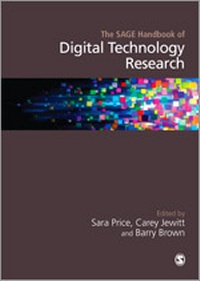
The SAGE Handbook of Digital Technology Research
1st Edition
Published on 6. August 2013
512 pages
978-1-4462-8708-8 (ISBN)
Description

Research on and with digital technologies is everywhere today. This timely, authoritative Handbook explores the issues of rapid technological development, social change, and the ubiquity of computing technologies which have become an integrated part of people's everyday lives.
This is a comprehensive, up-to-date resource for the twenty-first century. It addresses the key aspects of research within the digital technology field and provides a clear framework for readers wanting to navigate the changeable currents of digital innovation.
Main themes include:
- Introduction to the field of contemporary digital technology research
- New digital technologies: key characteristics and considerations
- Research perspectives for digital technologies: theory and analysis
- Environments and tools for digital research
- Research challenges
Aimed at a social science audience, it will be of particular value for postgraduate students, researchers and academics interested in research on digital technology, or using digital technology to undertake research.
This is a comprehensive, up-to-date resource for the twenty-first century. It addresses the key aspects of research within the digital technology field and provides a clear framework for readers wanting to navigate the changeable currents of digital innovation.
Main themes include:
- Introduction to the field of contemporary digital technology research
- New digital technologies: key characteristics and considerations
- Research perspectives for digital technologies: theory and analysis
- Environments and tools for digital research
- Research challenges
Aimed at a social science audience, it will be of particular value for postgraduate students, researchers and academics interested in research on digital technology, or using digital technology to undertake research.
Reviews / Votes
'This Handbook provides a much-needed appraisal of the current state-of-play in social science approaches to the study of digital technologies. Its scope is impressive and it offers informed, comprehensive and critical coverage of the important debates in this key field of study' -- Bella Dicks This handbook is a big, brave synthesis of current research in digital technologies. [...]The book is aimed at social scientists with an existing interest in digital technology research, and goes beyond the usual 'digital/virtual/online methods' books by engaging with the technologies themselves and not just the ways in which social scientists use them. For social scientists who are less familiar with this field, the book provides a fascinating insight into the design and workings of the digital technologies that surround us. -- Jen Tarr This extensive, well-organized work...is not for the faint of heart. The discipline-specific content, highly sophisticated research, and germane terminology will put general readers at a disadvantage and may challenge interested professionals outside the field.... Throughout the text, scholars make projections on the future of digital technology and identify areas of weakness, and challenges and tensions that must be addressed in order to realize digital technology's full potential.... Summing Up: Highly recommended. Graduate students, researchers/faculty, and professionals. -- B.G. Turner * CHOICE *
More details
Language
English
Place of publication
London
United Kingdom
Target group
Professional and scholarly
ISBN-13
978-1-4462-8708-8 (9781446287088)
Copyright in bibliographic data and cover images is held by Nielsen Book Services Limited or by the publishers or by their respective licensors: all rights reserved.
Schweitzer Classification
Other editions
Additional editions
Sara Price | Carey Jewitt | Barry Brown
The SAGE Handbook of Digital Technology Research
Book
08/2013
1st Edition
SAGE Publications Ltd
€201.00
Shipment within 15-20 days
Persons
My research interests centre around three areas of specialization:
1) Research theory and methodologies: Visual and Multimodal research and and Video-based research
2) Technology mediated teaching and learning: notably its affect on classroom practices, and subject knowledge
3) Multimodal school based research: with a focus on urban schooling, identities, policy and curriculum
Recent research project areas include: the development of multimodal methods for researching digital data and environments, the effects of government technology initiatives on learning in the secondary school and the home, and the changing practices of teaching and learning in the classroom.
1) Research theory and methodologies: Visual and Multimodal research and and Video-based research
2) Technology mediated teaching and learning: notably its affect on classroom practices, and subject knowledge
3) Multimodal school based research: with a focus on urban schooling, identities, policy and curriculum
Recent research project areas include: the development of multimodal methods for researching digital data and environments, the effects of government technology initiatives on learning in the secondary school and the home, and the changing practices of teaching and learning in the classroom.
Content
Notes on the Editors and Contributors
INTRODUCTION - Sara Price, Carey Jewitt and Barry Brown
PART ONE: AN INTRODUCTION TO THE FIELD OF CONTEMPORARY DIGITAL TECHNOLOGY RESEARCH
The Historical Context - Paul Ceruzzi: National Air and Space Museum
The Field of Digital Technology Research - Charles Crook, University of Nottingham, UK
PART TWO: NEW DIGITAL TECHNOLOGIES: KEY CHARACTERISTICS AND CONSIDERATIONS
Context, Location and Mobility: A Human Story - Matt Jones: Swansea University
Online Information: Access, Search and Exchange - Gary Hsieh & Nicolas Friederici: MSU, Michigan, USA
Social Media, Human Connectivity and Psychological Well-Being - Sonja Baumer: University of California, San Diego, USA
Engaging Practices: Doing Personalised Media - Heather Horst & Larissa Hjorth: Royal Melbourne Institute of Technology, Australia: University of California, Irvine
Ethics, Phenomenology, and Ontology - Anna Kouppanou & Paul Standish: Institute of Education, London, UK
PART THREE: RESEARCH PERSPECTIVES FOR DIGITAL TECHNOLOGIES: THEORY AND ANALYSIS
Critical Theory of Technology - Sara Grimes & Andrew Feenberg : Simon Fraser University, Canada
Critical and Cultural Approaches to HCI - Jeffrey Bardzell, Indiana University, USA
Theories of Embodiment in HCI - Paul Marshall & Eva Hornecker: University College London/ University of Strathclyde UK
Space and Place in Digital Technology Research: A Theoretical Overview - Luigina Ciolfi: University of Limerick, Ireland
Affect and Experiential Approaches - Kristina Hoeoek: Mobile Life @ KTH, Sweden
Ethnographic Approaches to Digital Research - Barry Brown: Mobile Life, Stockholm, Sweden
The Mediational Perspective on Digital Technology: Understanding the Interplay between Technology, Mind and Action - Victor Kaptelinin: University of Bergen, Norway, and Umea University, Sweden
Ethnomethodology and Conversation Analysis: Empirical Approaches to the Study of Digital Technology in Action - Robert J. Moore: Yahoo Labs, USA
Behavioural Trace Data for Analysing Online Communities - Cliff Lampe: Michigan State University, USA
Multimodal Methods for Researching Digital Technologies - Carey Jewitt: London Knowledge Lab, Institute of Education, UK
Projection, Place and Point-of-View in Research through Design - Steven Dow: Carnegie Mellon University, Wendy Ju: INRIA, France, and Wendy Mackay: Stanford University, USA
Design Research: Observing Critical Design - Laurel Swan & Kirsten Boehner: Royal College of Art, UK/ Goldsmiths
PART FOUR: ENVIRONMENTS AND TOOLS FOR DIGITAL RESEARCH
Tangibles: Technologies and Interaction for Learning - Sara Price: London Knowledge Lab, Institute of Education, UK
Material Computing: Integrating Technology into the Material World - Leah Beuchley: Massachusetts Institute of Technology (MIT), USA
Haptic Interfaces - Eve Hoggan: UNiversity of Helsinki, Finland
Contrasting Lab-Based and in the Wild Studies for Evaluating Multi-User Technologies - Yvonne Rogers, Nicola Yuill & Paul Marshall: UCL; University of Sussex; UCL, UK
Ubiquitous Virtual Reality Environments - Yoosoo Oh: Daegu Univerity, S.Korea & Woontack Woo: Korea Advanced Institute of Science and Technology, S.Korea
Location-Based Environments and Technologies - Ty Hollett & Kevin Leander: Vanderbilt University, USA
Mobile Learning in the Majority World: A Critique of the GSMA's Position - Niall Winters: London Knowledge Lab, Institute of Education, UK
Online and Internet Based Technologies: Gaming - Catherine Beavis: Griffith University, Australia
Online and Internet Based Technologies: Social Networking - Kirsty Young: Sydney University of Technology, Australia
Learner Modelled Environments - Kaska Porayska Pomsta & Sara Bernardini: Institute of Education, UK
The Interplay between Research and Industry: HCI and Grounded Innovation - Lars Erik Holmquist: Principle Scientist, Yahoo Labs
Afterword: Looking to the Future - Sara Price, Carey Jewitt and Barry Brown
Index
INTRODUCTION - Sara Price, Carey Jewitt and Barry Brown
PART ONE: AN INTRODUCTION TO THE FIELD OF CONTEMPORARY DIGITAL TECHNOLOGY RESEARCH
The Historical Context - Paul Ceruzzi: National Air and Space Museum
The Field of Digital Technology Research - Charles Crook, University of Nottingham, UK
PART TWO: NEW DIGITAL TECHNOLOGIES: KEY CHARACTERISTICS AND CONSIDERATIONS
Context, Location and Mobility: A Human Story - Matt Jones: Swansea University
Online Information: Access, Search and Exchange - Gary Hsieh & Nicolas Friederici: MSU, Michigan, USA
Social Media, Human Connectivity and Psychological Well-Being - Sonja Baumer: University of California, San Diego, USA
Engaging Practices: Doing Personalised Media - Heather Horst & Larissa Hjorth: Royal Melbourne Institute of Technology, Australia: University of California, Irvine
Ethics, Phenomenology, and Ontology - Anna Kouppanou & Paul Standish: Institute of Education, London, UK
PART THREE: RESEARCH PERSPECTIVES FOR DIGITAL TECHNOLOGIES: THEORY AND ANALYSIS
Critical Theory of Technology - Sara Grimes & Andrew Feenberg : Simon Fraser University, Canada
Critical and Cultural Approaches to HCI - Jeffrey Bardzell, Indiana University, USA
Theories of Embodiment in HCI - Paul Marshall & Eva Hornecker: University College London/ University of Strathclyde UK
Space and Place in Digital Technology Research: A Theoretical Overview - Luigina Ciolfi: University of Limerick, Ireland
Affect and Experiential Approaches - Kristina Hoeoek: Mobile Life @ KTH, Sweden
Ethnographic Approaches to Digital Research - Barry Brown: Mobile Life, Stockholm, Sweden
The Mediational Perspective on Digital Technology: Understanding the Interplay between Technology, Mind and Action - Victor Kaptelinin: University of Bergen, Norway, and Umea University, Sweden
Ethnomethodology and Conversation Analysis: Empirical Approaches to the Study of Digital Technology in Action - Robert J. Moore: Yahoo Labs, USA
Behavioural Trace Data for Analysing Online Communities - Cliff Lampe: Michigan State University, USA
Multimodal Methods for Researching Digital Technologies - Carey Jewitt: London Knowledge Lab, Institute of Education, UK
Projection, Place and Point-of-View in Research through Design - Steven Dow: Carnegie Mellon University, Wendy Ju: INRIA, France, and Wendy Mackay: Stanford University, USA
Design Research: Observing Critical Design - Laurel Swan & Kirsten Boehner: Royal College of Art, UK/ Goldsmiths
PART FOUR: ENVIRONMENTS AND TOOLS FOR DIGITAL RESEARCH
Tangibles: Technologies and Interaction for Learning - Sara Price: London Knowledge Lab, Institute of Education, UK
Material Computing: Integrating Technology into the Material World - Leah Beuchley: Massachusetts Institute of Technology (MIT), USA
Haptic Interfaces - Eve Hoggan: UNiversity of Helsinki, Finland
Contrasting Lab-Based and in the Wild Studies for Evaluating Multi-User Technologies - Yvonne Rogers, Nicola Yuill & Paul Marshall: UCL; University of Sussex; UCL, UK
Ubiquitous Virtual Reality Environments - Yoosoo Oh: Daegu Univerity, S.Korea & Woontack Woo: Korea Advanced Institute of Science and Technology, S.Korea
Location-Based Environments and Technologies - Ty Hollett & Kevin Leander: Vanderbilt University, USA
Mobile Learning in the Majority World: A Critique of the GSMA's Position - Niall Winters: London Knowledge Lab, Institute of Education, UK
Online and Internet Based Technologies: Gaming - Catherine Beavis: Griffith University, Australia
Online and Internet Based Technologies: Social Networking - Kirsty Young: Sydney University of Technology, Australia
Learner Modelled Environments - Kaska Porayska Pomsta & Sara Bernardini: Institute of Education, UK
The Interplay between Research and Industry: HCI and Grounded Innovation - Lars Erik Holmquist: Principle Scientist, Yahoo Labs
Afterword: Looking to the Future - Sara Price, Carey Jewitt and Barry Brown
Index
