

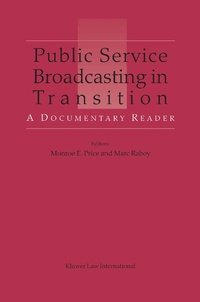
Public Service Broadcasting in Transition
A Documentary Reader
Published on 30. October 2003
218 pages
978-90-411-7712-4 (ISBN)
Description

Few will deny that public service broadcasting - broadcasting that is controlled neither by the state nor by private media corporations - is an essential ingredient in modern democracy. But, as a number of initiatives in transition economies have shown, the inception and development of a strong public broadcasting system is a Herculean task that is easily sidetracked by politics or ideology, or stalled by lack of funding. Especially when state budgets are stretched, the expense is hard to justify.
This collection of documents, comments, and cases brings all the major issues in public service broadcasting policy into focus and sets the problems to be addressed in sharp relief. It draws on white papers from NGOs and broadcasters, legislation from a wide range of countries (and a model law), accounts of public broadcasting efforts in transition states, analyses of evolving policy in established systems, government regulatory guidelines, and a great deal more. Among the matters touched upon are the following:
- the principles of public service broadcasting and their cultural and economic justification;
- limiting state interference;
- the place of public broadcasting in a multi-channel, "market driven" world;
- the appropriate mix of public and private revenues;
- objectivity and impartiality in broadcasting;
- how institutional structures can shape programming strategies;
- the use of competition law to adjust relations between public and private broadcasting;
- EU accession standards for public service broadcasting; and
- the impact of digital broadcasting.
Broadcast professionals, students and teachers in communications and related fields, government officials interested in strengthening public service broadcasting and keeping pace with rapid developments - all will benefit enormously from this thoughtful and informative book. It will allow them to think well beyond the standard formulae about the function of public service broadcasting and its role in society.
This collection of documents, comments, and cases brings all the major issues in public service broadcasting policy into focus and sets the problems to be addressed in sharp relief. It draws on white papers from NGOs and broadcasters, legislation from a wide range of countries (and a model law), accounts of public broadcasting efforts in transition states, analyses of evolving policy in established systems, government regulatory guidelines, and a great deal more. Among the matters touched upon are the following:
- the principles of public service broadcasting and their cultural and economic justification;
- limiting state interference;
- the place of public broadcasting in a multi-channel, "market driven" world;
- the appropriate mix of public and private revenues;
- objectivity and impartiality in broadcasting;
- how institutional structures can shape programming strategies;
- the use of competition law to adjust relations between public and private broadcasting;
- EU accession standards for public service broadcasting; and
- the impact of digital broadcasting.
Broadcast professionals, students and teachers in communications and related fields, government officials interested in strengthening public service broadcasting and keeping pace with rapid developments - all will benefit enormously from this thoughtful and informative book. It will allow them to think well beyond the standard formulae about the function of public service broadcasting and its role in society.
More details
Other editions
Additional editions
Book
10/2003
Kluwer Law International
€190.15
Shipment within 10-20 days
Content
- Cover
- Half Title Page
- Title Page
- Copyright Page
- Table of Contents
- INTRODUCTION
- CHAPTER I PUBLIC SERVICE BROADCASTING: PRINCIPLES AND ISSUES
- 1. GENERAL PRINCIPLES
- World Radio and Television Council, Public Broadcasting, Why? How?, 2000
- 2. FINANCING
- World Radio and Television Council, Public Broadcasting, Why? How?, 2000
- Public Service Broadcasters around the World: McKinsey & Company, 'Public Service Broadcasters around the World: A McKinsey Report for the BBC', 1999*
- 'Towards a Rational Funding System', chapter 11.6.4, in Making Our Voices Heard, Canada, Mandate Review Committee, 1996
- 3. PROGRAM CONTENT
- World Radio and Television Council, Public Broadcasting, Why? How?, 2000
- 4. OBJECTIVITY AND IMPARTIALITY
- Irish Radio and Television Act, 1988
- 5. STRUCTURE AND AUTONOMY
- World Radio and Television Council, Public Broadcasting, Why? How?, 2000
- 6. A MODEL PUBLIC SERVICE BROADCASTING LAW
- 'Model Public Service Broadcasting Law' by Dr. Werner Rumphorst, 1998
- 7. TECHNOLOGY AND THE FUTURE
- World Radio and Television Council, Public Broadcasting, Why? How?
- 8. CONCLUDING OVERVIEW
- 'Public Service Broadcasting: The Challenges of the 21st Century,' by Marc Raboy, Winter 1999-2000
- CHAPTER II THE EUROPEAN UNION, THE COUNCIL OF EUROPE AND TRENDS IN PUBLIC SERVICE BROADCASTING
- 1. THE TREATY OF AMSTERDAM AND THE VALIDATION OF PUBLIC SERVICE BROADCASTING
- Protocol on the System of Public Broadcasting in the Member States, Draft Treaty of Amsterdam, Council of the European Union, Brussels, August 1997
- The Public Service Broadcasting Remit: Today and Tomorrow, European Broadcasting Union, 29 April, 1998
- 2. FUNDING: TREATY OF ROME, COMPETITION AND TRANSPARENCY
- Communication from the Commission on the Application of State Aid Rules to Public Service Broadcasting: Excerpts, Press Release: 233-Nr: 9755/01, Luxembourg, 21 June, 2001
- The Public Service Broadcasting Remit: Today and Tomorrow, European Broadcasting Union, 29 April, 1998
- Association of European Radios Policy Statement Concerning the Financial Transparency and Role of Public Broadcasters, 7 July, 2000
- 3. ACCESSION AND EVALUATION
- The European Parliament in the Enlargement Process: 'Briefing No 47: Audiovisual Policy: applicant countries and the community acquis,' Secretariat Working Party Task Force 'Enlargement'
- Guidelines on the Guarantee of the Independence of Public Service Broadcasting: Recommendation No. R (96) 10 of the Committee of Ministers to Member States, Council of Europe
- 3. PUBLIC SERVICE BROADCASTING IN A DIGITAL AGE
- Green Paper on the Convergence of the Telecommunications, Media and Information Technology Sectors, and the Implications for Regulation, Towards an Information Society, European Commission, Brussels, Belgium, 3 December 1997
- The future of public service television in a multi-channel digital age, Committee on Culture, Youth, Education and the Media, Draftswoman: Ms Carole Tongue, September 1996
- The future of public service television in a multi-channel digital age
- 4. CONCLUDING OVERVIEW
- 'Public Service Broadcasting: No End to the Misunderstandings?,' by Dr. Werner Rumphorst, 1998
- CHAPTER III CHALLENGES TO THE PUBLIC SERVICE BROADCASTING REMIT: THE UNITED KINGDOM, GERMANY AND CANADA
- 1. PURPOSES OF PUBLIC SERVICE BROADCASTING
- GERMANY
- THE UNITED KINGDOM
- 2. PROGRAMME CONTENT
- GERMANY
- THE UNITED KINGDOM
- 3. STRUCTURE AND INDEPENDENCE
- GERMANY
- UNITED KINGDOM
- 4. PUBLIC SERVICE BROADCASTING AND PUBLIC SERVICE OBLIGATIONS OF PRIVATE BROADCASTERS
- GERMANY
- UNITED KINGDOM
- 5. THE EXAMPLE OF CANADA
- 'The Hybridization of Public Broadcasting,' by Marc Raboy, 1997
- 'A Public Purpose' in Making our Voices Heard, Canada, Mandate Review Committee, 1996
- Canada, 'Broadcasting Act', article 3., Excerpt from Canada's Broadcasting Act, Statutes of Canada, Chapter B-9.01 [1991, c.11]
- CHAPTER IV TRANSFORMATIONS, TRANSITIONS, AND PUBLIC SERVICE BROADCASTING
- 1. WHAT PROSPECTS FOR PUBLIC SERVICE BROADCASTING IN CENTRAL AND EASTERN EUROPE
- 'The Enemy Within: Unexpected Barriers to the Development of Public Service Broadcasting' by Karol Jakubowicz, 1996
- 2. VARIATIONS IN APPOINTMENT PROCESSES TO REGULATORY BOARDS AND MANAGEMENT BODIES
- 3. STATUTORY DRAFTING AND REVIEW: THE CROATIAN EXAMPLE
- Report of the Council of Europe Expert Mission on the Draft Law on HRT, Zagreb, Croatia, 26-27 June 2000
- Prime Minister Racan's Press Conference, February 5th 2001
- Draft Law on Croatian Radio and Television (HRT), Zagreb, 11 May 2000 (Sections Dealing with Establishment of the HRT Council)
- Law on Croatian Radio and Television (HRT), Zagreb, 26 February 2001 (Final)
- 4. 'MEDIA WARS'
- HUNGARY AND THE CONFLICT OVER THE GOVERNING BOARD
- THE CZECH REPUBLIC AND THE GOVERNANCE OF CT (CZECH TELEVISION)
- 5. COUNTRY STUDIES: POLAND AND UZBEKISTAN
- 'Media in Transition: The Case of Poland,' by Karol Jakubowicz, in Media Reform: Democratizing the Media, Democratizing the State, 2001
- 'Uzbekistan,' by Lutfulla Kabirov and Scott Smith, Media Reform: Democratizing the Media, Democratizing the State, 2001
- 6. PUBLIC SERVICE IN PEACEKEEPING OPERATIONS: BOSNIA AND HERCEGOVINA
- 'Escalating to Success? The Media Intervention in Bosnia and Herzegovina,' by Mark Thompson and Dan De Luce, in Forging Peace, 2002
- CHAPTER V TOWARDS THE FUTURE: CONCLUDING MATERIALS
- LIST OF DOCUMENTS
- Back Cover
