

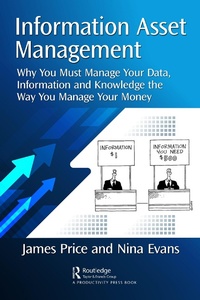
Information Asset Management
Why You Must Manage Your Data, Information and Knowledge the Way You Manage Your Money
1st Edition
Published on 31. January 2024
212 pages
978-1-003-81204-3 (ISBN)
Description

Organisations are using data, information and knowledge as a competitive weapon. Their data, information and knowledge are arguably their most valuable assets. Yet, this fourth asset is managed badly when compared to the other three assets, namely money, people and infrastructure with considerable risk to the organisation. Executives are accountable for the success of their organisations, and those who don't manage this critical resource and business enabler effectively can be regarded as negligent. Information Assets carry enormous risk and value. Most boards and executives don't know how to govern and manage IAs effectively and nobody is held accountable. Given this, organisations should govern and manage their Information Assets the way they manage their Financial Assets. The benefits of managing IAs well are compelling. These benefits include increased efficiency, productivity, employee satisfaction, improved decision-making, mitigating business risk and improving product, protecting corporate reputation and service delivery. Drawing on ground-breaking research, this book explains why Information Assets are so important to organisations and the barriers to managing them well.
This book is unique in the sense that it takes a fresh look at this topic, is based on experience and research, and includes interviews from more than 70 industry leaders. In short, this book is written by executives and explains where to start.
This book is unique in the sense that it takes a fresh look at this topic, is based on experience and research, and includes interviews from more than 70 industry leaders. In short, this book is written by executives and explains where to start.
Reviews / Votes
Price and Evans have produced a ground-breaking, mind-altering book on how organizations and executives need to be thinking about and approaching information in their organizations, but why they regularly fail to do so. This perhaps is the most comprehensively researched and one of the most important books ever published on the topic of managing data as an actual enterprise asset and overcoming the persistent business pathology preventing it. - Douglas B. Laney, Innovation Fellow, West Monroe Partners, and author of Infonomics and Data Juice"If you think money, people, and infrastructure, are your only assets to manage, think again. It is impossible to manage any other asset well without managing the data, information, and knowledge which underly them and are assets in their own right. Price and Evans offer compelling arguments based on experience, the latest research, and industry leaders. Learn from them and put this book to work! - Danette McGilvray, President and Principal, Granite Falls Consulting, Inc. Author of Executing Data Quality Projects: Ten Steps to Quality Data and Trusted Information (TM), 2nd Ed. (Elsevier/Academic Press, 2021)
At a time when everyone seems to have become an instant data expert and AI genius, it's refreshing to read a rigorously researched and pragmatically laid out examination of this fundamentally important topic. In my view, it's a prime example of the Australian MBA culture (minimum bullshit allowed) in action, and needs to be on everyone's reading list. - Daragh O Brien, CEO, Castlebridge and Lecturer in Data Protection and Data Governance, UCD Sutherland School of Law.
Recognizing data, information, and knowledge as assets and treating them as such may be the single most effective way a company can improve its strategic position. And doing so is an absolute necessity for those pursuing AI.- Thomas C. Redman, Ph. D., the Data Doc, Data Quality Solutions, Rumson, NJ USA
More details
Edition
1. Auflage
Language
English
Place of publication
London
United Kingdom
Publishing group
Taylor & Francis Ebooks
Target group
Professional and scholarly
Product notice
Reflowable
Illustrations
15 Tables, black and white; 11 Line drawings, black and white; 11 Illustrations, black and white
ISBN-13
978-1-003-81204-3 (9781003812043)
Copyright in bibliographic data and cover images is held by Nielsen Book Services Limited or by the publishers or by their respective licensors: all rights reserved.
Schweitzer Classification
Other editions
Additional editions
James Price | Nina Evans
Information Asset Management
Why You Must Manage Your Data, Information and Knowledge the Way You Manage Your Money
Book
01/2024
1st Edition
Productivity Press
€206.20
Shipment within 10-20 days
James Price | Nina Evans
Information Asset Management
Why You Must Manage Your Data, Information and Knowledge the Way You Manage Your Money
Book
01/2024
1st Edition
Productivity Press
€50.90
Shipment within 10-20 days
Persons
James Price: James Price has over 30 years' experience in the information industry is internationally recognized as an author and presenter. He is the founder of Experience Matters, a firm that helps organizations protect, and maximize the value of, their data, information and knowledge, to address the problem that, whilst Information Assets are vitally important to organizations, by and large they are very poorly governed and managed. His work with the University of South Australia has been described by Gartner, the world's most influential IT industry advisory firm, as "tremendous" and the research as "ground-breaking." Stuart Hamilton of Aquatic Informatics wrote, "I do believe that you have documented the greatest single barrier to productivity in the 21st Century economy and nobody knows about it." James is passionate about: - creating a business culture of professionalism, humility, teamwork, communication and laughter; - helping clients drive tangible, measurable business outcomes from the efficient and effective management of their Information Assets; and - giving back to the global Information Asset management community through his multinational research, publications and presentations, and his position as Chair of the Leaders Data Organization (www.dataleaders.org).
Professor Nina Evans: Nina Evans has worked in various Higher Education Institutions as Lecturer, Industry Liaison Manager, Associate Head of School, Head of Department and Vice Dean. She started her career as a Chemical Engineer and registered as a professional engineer (PrEng), while completing a Diploma in Education and an Honours degree in Computer Science. Nina also holds a Masters' degree in Information Technology, an MBA, and a PhD. Nina is currently employed as an professorial lead in the STEM academic unit of UniSA). In this role she focuses on line management/mentoring of academic staff, teaching and research. In her teaching and research she focuses on digital business transformation, i.e. the effect of disruptive technologies on both large and small enterprises. Business transformation is achieved through innovation, effective leadership, understanding the disruptive effect of information technology on businesses, promoting fusion between business and IT professionals, effective management of business processes, recognising and managing data, information and knowledge ('information assets') as a business asset, as well as an understanding of human behaviour in organisations. She is also interested in the unique challenges facing Small to Medium Enterprises (SMEs) - especially in regional areas - and how these businesses can use technology and social networks to overcome challenges. Nina is passionate about developing well-rounded graduates for the Connection Economy, where 'who you are' matters as much as 'what you do'. Apart from developing important technology skills in their university courses, IT students should also understand the "people and behavioural aspects" of the technology world. She has supervised more than 10 PhD and Doctoral students to completion and published more than 100 papers in accredited journals and peer-reviewed academic conferences. She teaches Masters' courses in Knowledge Mangement, Information Governance, Business Transformation and Innovation, Business Process Modeling, Security Consulting and ICT Leadership. Nina is also a director of ThinkingFusion (Australia) and trained facilitator of the Thinking Fusion Personal Development and Leadership programs.
Professor Nina Evans: Nina Evans has worked in various Higher Education Institutions as Lecturer, Industry Liaison Manager, Associate Head of School, Head of Department and Vice Dean. She started her career as a Chemical Engineer and registered as a professional engineer (PrEng), while completing a Diploma in Education and an Honours degree in Computer Science. Nina also holds a Masters' degree in Information Technology, an MBA, and a PhD. Nina is currently employed as an professorial lead in the STEM academic unit of UniSA). In this role she focuses on line management/mentoring of academic staff, teaching and research. In her teaching and research she focuses on digital business transformation, i.e. the effect of disruptive technologies on both large and small enterprises. Business transformation is achieved through innovation, effective leadership, understanding the disruptive effect of information technology on businesses, promoting fusion between business and IT professionals, effective management of business processes, recognising and managing data, information and knowledge ('information assets') as a business asset, as well as an understanding of human behaviour in organisations. She is also interested in the unique challenges facing Small to Medium Enterprises (SMEs) - especially in regional areas - and how these businesses can use technology and social networks to overcome challenges. Nina is passionate about developing well-rounded graduates for the Connection Economy, where 'who you are' matters as much as 'what you do'. Apart from developing important technology skills in their university courses, IT students should also understand the "people and behavioural aspects" of the technology world. She has supervised more than 10 PhD and Doctoral students to completion and published more than 100 papers in accredited journals and peer-reviewed academic conferences. She teaches Masters' courses in Knowledge Mangement, Information Governance, Business Transformation and Innovation, Business Process Modeling, Security Consulting and ICT Leadership. Nina is also a director of ThinkingFusion (Australia) and trained facilitator of the Thinking Fusion Personal Development and Leadership programs.
Content
Introduction
Chapter 1: Background/context
Chapter 2: Benefits of Managing IAs Effectively
Chapter 3: Executive Awareness
Chapter 4: Business Environment
Chapter 5: Leadership and Management
Chapter 6: Asset Governance
Chapter 7: Information Systems
Chapter 8: Information Assets Behaviours
Chapter 9: Information Asset Attributes and Quality
Chapter 10: Information Asset Performance/Exploitation
Chapter 11: Justification
Chapter 12: Conclusion and Call to Action
Chapter 1: Background/context
Chapter 2: Benefits of Managing IAs Effectively
Chapter 3: Executive Awareness
Chapter 4: Business Environment
Chapter 5: Leadership and Management
Chapter 6: Asset Governance
Chapter 7: Information Systems
Chapter 8: Information Assets Behaviours
Chapter 9: Information Asset Attributes and Quality
Chapter 10: Information Asset Performance/Exploitation
Chapter 11: Justification
Chapter 12: Conclusion and Call to Action
