

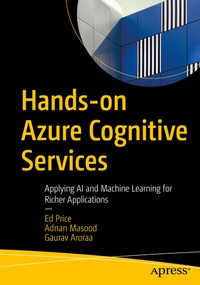
Hands-on Azure Cognitive Services
Description

After reading this book, you will be able to work with datasets that enable applications to process various data in the form of images, videos, and text.
What You Will Learn
- Discover the options for training and operationalizing deep learning models on Azure
- Be familiar with advanced concepts in Azure ML and the Cortana Intelligence Suite architecture
- Understand software development kits (SKDs)
-
Deploy an application to Azure Kubernetes Service
Who This Book Is For
Developers working on a range of platforms, from .NET and Windows to mobile devices, as well as data scientists who want to explore and learn more about deep learning and implement it using the Microsoft AI platform
More details
Other editions
Additional editions
Persons
Ed Price is Senior Program Manager in Engineering at Microsoft, with an MBA degree in technology management. Previously, he led Azure Global's efforts to publish key architectural guidance, ran Microsoft customer feedback programs for Azure Development and Data Services, and was a technical writer at Microsoft for six years, helping lead TechNet Wiki. Ed now leads Microsoft's efforts to publish reference architectures on the Azure Architecture Center (including a strong focus on AI architectures). He is an instructor at Bellevue College, where he teaches design and computer science. At Microsoft, he also helps lead volunteer efforts to teach thousands of students how to code each year, focusing on girls and minorities. Ed is a co-author of six books, including Azure Cloud Native Architecture Mapbook, Cloud Debgging and Profiling in Microsoft Azure (Apress), and Learn to Program with Small Basic.
Adnan Masood, PhD, is an Artificial Intelligence and Machine Learning researcher, Software Engineer, Microsoft regional Director, and Microsoft MVP for Artificial Intelligence. An international speaker and thought leader, Adnan currently works at UST as Chief AI Architect, and collaborates with Stanford Artificial Intelligence Lab and MIT AI Lab on building enterprise solutions. Adnan has authored four books, including Automated Machine Learning and Cognitive Computing Recipes (Apress).
Gaurav Aroraa is a Chief Technology officer at SCL, with Doctorate in Computer Science. Guarav is a Microsoft MVP award recipient. He is a lifetime member of the Computer Society of India (CSI), an advisory member and senior mentor at IndiaMentor, certified as a Scrum trainer and coach, ITIL-F certified, and PRINCE-F and PRINCE-P certified. Guarav is an open-source developer and a contributor to the Microsoft TechNet community. He has authored ten books, including Cloud Debugging and Profiling in Microsoft Azure (Apress).
Content
Chapter 1: The Power of Cognitive Services.- Chapter 2: The Azure Portal for Cognitive Services.- Chapter 3: Vision - Identify and Analyze Images and Videos.- Chapter 4: Language - Understand Unstructured Text and Models.- Chapter 5: Speech - Talk to Your Application.- Chapter 6: Decision - Make Smarter Decisions in Your Applications.- Chapter 7: Search - Add Search Capabilities to Your Application.- Chapter 8: Deploy and Host Services Using Containers.- Chapter 9: Azure Bot Services.- Chapter 10: Azure Machine Learning.
