

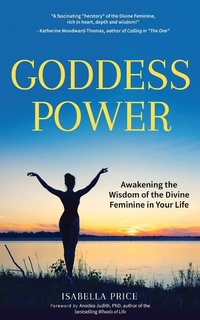
Goddess Power
Awakening the Wisdom of the Divine Feminine in Your Life
Published on 22. July 2022
229 pages
978-1-63353-674-6 (ISBN)
Description

"A fascinating 'herstory' of the Divine Feminine, rich in heart, depth and wisdom... an empowering message of hope and inspiration."
-Katherine Woodward Thomas,
New York Times-bestselling author
At the dawn of religion, God was a Woman. The Divine Feminine is known by innumerable names and symbol-rich manifestations across the world's cultures. Throughout the ages the Goddess has been honored and worshiped as the Virgin Mary, Isis, Inanna, Asherah, Diana, Kuan Yin, Kali, Oshun, Athena, Pele, Sarasvati, Demeter, and White Buffalo Calf Woman, to mention just a few. Goddess Power takes you on a fascinating and, at times, surprising journey into the enduring essence of the Divine Feminine. Inside this book you will learn:
. How the Goddess path offers an empowering message and inspiration
. The importance of re-establishing a healthy balance and integration of both the "masculine" and the "feminine" archetypes
. That the notion of God as archetypal "Sky-Father" is fairly recent in Western culture
. Why the wisdom of the Goddess/Sacred Feminine has been ignored, distorted, and oppressed for centuries
. How archetypes, mythic narratives, and qualities of Goddesses are alive within you and how they reveal intimate truths about yourself and others
. How Goddesses can serve as empowering guides in your personal and professional life
. Why especially black Goddesses/dark-skinned Mothers (e.g., Kali or Black Madonna) are a powerful symbol and catalyst for change in our times, both individually and collectively
. And much, much more!
"An empowering message and inspiration that can be drawn from the Goddess so humanity might evolve toward higher awareness." -Karen Tate, author of Walking an Ancient Path and Goddess 2.0
At the dawn of religion, God was a Woman. The Divine Feminine is known by innumerable names and symbol-rich manifestations across the world's cultures. Throughout the ages the Goddess has been honored and worshiped as the Virgin Mary, Isis, Inanna, Asherah, Diana, Kuan Yin, Kali, Oshun, Athena, Pele, Sarasvati, Demeter, and White Buffalo Calf Woman, to mention just a few. Goddess Power takes you on a fascinating and, at times, surprising journey into the enduring essence of the Divine Feminine. Inside this book you will learn:
. How the Goddess path offers an empowering message and inspiration
. The importance of re-establishing a healthy balance and integration of both the "masculine" and the "feminine" archetypes
. That the notion of God as archetypal "Sky-Father" is fairly recent in Western culture
. Why the wisdom of the Goddess/Sacred Feminine has been ignored, distorted, and oppressed for centuries
. How archetypes, mythic narratives, and qualities of Goddesses are alive within you and how they reveal intimate truths about yourself and others
. How Goddesses can serve as empowering guides in your personal and professional life
. Why especially black Goddesses/dark-skinned Mothers (e.g., Kali or Black Madonna) are a powerful symbol and catalyst for change in our times, both individually and collectively
. And much, much more!
"An empowering message and inspiration that can be drawn from the Goddess so humanity might evolve toward higher awareness." -Karen Tate, author of Walking an Ancient Path and Goddess 2.0
More details
Other editions
Additional editions
Isabella Price
Goddess Power
Awakening the Wisdom of the Divine Feminine in Your Life (Feminine Energy Book, Women Empowerment, Sacred Woman, for Fans of Warrior Goddess)
Book
11/2017
Mango Media
€16.50
Article not available at the moment
Person
Isabella Price, MA, is an international speaker, author, and higher education professional at JFK University where she teaches ?World Spirituality? courses. Isabella is the author of the leading-edge book series ?One Truth, Many Paths? on the world?s wisdom traditions, which includes her book I Am With Her on the Sacred Feminine. For over 25 years, she has been successfully teaching classes and workshops at JFK University, the California College of the Arts, and numerous other educational institutions and religious venues. She has traveled extensively and participated in numerous rituals from diverse wisdom traditions. She holds an MA in the humanities (global history and comparative religion) from the University of Zurich, Switzerland. She is also a certified SQ21 Spiritual Intelligence coach and teaches meditation to veterans suffering from PTSD and other community members. She lives in the San Francisco Bay Area.Anodea Judith, PhD, is the founder and director of Sacred Centers and a groundbreaking thinker, writer, and spiritual teacher. She holds master and doctoral degrees in psychology and human health. Anodea spends much of her time teaching, offering workshops and trainings across North America, Central America, and Europe.
Content
- Intro
- Table of Contents
- Foreword
- Introduction
- Integral Theory
- Incorporating Myth into Integral Philosophy
- Incorporating the Sacred Feminine
- The Three Pillars of One Truth, Many Paths
- Pillar One - Ethical Systems and Precepts
- Pillar Two - The Esoteric-Mystical Core
- Pillar Three - Universal Symbols and Archetypes
- Additional Dimensions
- One Truth, Many Paths
- An Overview of My Journey
- An Overview of Goddess Worship
- Goddess Belief Systems and the Body-Mind Split
- Controversies on the Evolution of Goddess Worship
- Goddess Worship and Integral Theory
- Goddess Worship and Spiritual Visionaries
- What is the Divine Feminine?
- Prehistoric Manifestations of the "Great Goddess"
- The Paleolithic Mother Goddess
- The Neolithic Lady Bird Goddess
- The Neolithic Serpent Goddess
- Goddess-Centered Spiritual Beliefs as a Celebration of Life
- Inanna/Ishtar in Ancient Mesopotamia
- The Sacred Marriage Rite of Inanna and Dumuzi
- Sacred Marriage Rites and "Temple Prostitution"
- Sacred Marriage Rites and the Soul's Union with the Divine
- Male and Female Archetypes and Subtle Energies within Conceptions of the Divine
- The Descent of Inanna to the Underworld
- The Descent of Dumuzi to the Underworld
- Myths of the Sacrificed King, Sacrificial Lamb, Good Shepherd, and Horned God
- The Journey of the Sacrificial God / Consort of the Goddess
- Isis: Goddess of a Thousand Names
- Isis in Egyptian Cosmology
- Isis as the Great Mother and Facilitator of Civilization
- Conceptions of Women in Isis' Egypt
- Symbolic Aspects of the Goddess Isis
- The Mysteries of Isis and Osiris
- Minoan Crete - The Flowering of Goddess Culture
- Minoan Civilization and Culture
- A Peace-Loving Culture and Society
- What Led to the Decline of Minoan Culture?
- Minoan Ceremonial Worship
- Manifestations and Symbols of the Minoan Goddess
- Correspondences Between Minoan Religious Practices and the Greek Oracle at Delphi
- The Double Ax, Tree of Life, Bullhorn, and Other Minoan Religious Iconography
- Symbolic Connotations of the Minoan Bull Dance Ceremony
- The Role and Status of Women in Minoan Civilization
- Was Minoan Civilization a Matriarchy Ruled by a Queen-Priestess?
- Symbolic Connotations of the Labyrinth in Minoan and Classical Greek Mythology
- The Slaying of the Great Goddess in Classical Greek Mythology and Beyond
- The African Goddess Oshun - Dancing River of Life
- Yoruba Civilization and the Ways of Spirit
- Oshun - Goddess of Many Titles, Moods, and Functions
- Oshun's Role in the Cosmological Vision of the Yoruba
- Oshun - River Mother and Fertility Icon
- Oshun Iyalode
- Oshun - The Supreme Enchantress
- Correspondences between Oshun and the Roman Catholic Virgin Mary
- Yoruba Religious Beliefs and the Development of Santeria
- The Sensual and Spiritual Power of Oshun's Dance
- Gender and Power as Expressed in the Worship of Oshun
- The Virgin Mary - Return of the Goddess?
- What Do We Know about the Mother of Jesus?
- The Virgin Birth
- The Assumption
- Mary as the "Queen of Heaven"
- The Black Virgin
- Mary Magdalene: Forgotten Bride of Christianity?
- Mary Magdalene in the Canonical Gospels and in Traditional Christianity
- Mary Magdalene's Portrait in the Noncanonical Gospels of Early Christianity
- Mary Magdalene as Beloved
- Shaktism: The Celebration of Mahadevi in India
- Kali - The Dark-Skinned Mother Adorned with Skulls
- Shiva and Shakti: The Archetypal Union of the Feminine and Masculine
- Conclusion
- Acknowledgments
- Bibliography
- Author Bio
