

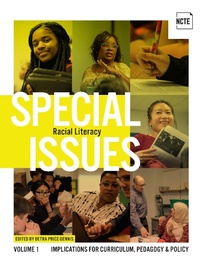
Special Issues, Volume 1: Racial Literacy
Description

Edited by Detra Price-Dennis, this first volume of Special Issues: Racial Literacy gathers some of the most compelling and practical recent articles across NCTE journals, addressing the importance of racial literacy and its implications for curriculum, pedagogy, and policy.
There's a great deal of uncertainty, discord, and increased volatility across a number of critical institutions in our society. Each day on social media and TV news outlets we read, listen to, and/or watch events unfold that are linked to political, economic, health, legal, and educational inequities that can be traced to racist ideologies and practices. Public schools across the country are being subjected to pending state legislation and new laws that seek to limit how race?among other markers of identity?can be taught in K?12 classrooms.
Editor Detra Price-Dennis has curated this collection to show how teaching from a racial literacy perspective is in conversation with antiracist, culturally responsive, equity-oriented frameworks that uplift curriculum design and instructional strategies. These articles can help educators (re)imagine the classroom as a space that supports the development of racial literacy skills and practices with their students.
About the Special Issue series:
Most teachers and students across the country are grappling with several important issues. We hear from many educators who are looking for compelling and engaging approaches racial literacy, critical media literacy, and trauma-informed teaching.
NCTE is responding to these needs with Special Issues, a series of books designed to directly address these pressing topics in K-12 and college classrooms today. The first volumes collect content on these topics from across all of NCTE's journals in one place, to make the most relevant material accessible and practical.
Edited by expert practitioners in the field, each volume contains teaching tips to help implement these approaches in classrooms.
More details
Content
- Intro
- 07 Editor's Introduction
- 11 Policy Statement on Racial Literacy
- 16 Where Do We Go from Here?: Toward a Critical Race English Education
- 31 To Dismantle Racism, We Must Discuss It
- 33 Everyday Colorism: Reading in the Language Arts Classroom
- 40 Centering #BlackLivesMatter to Confront Injustice, Inspire Advocacy, and Develop Literacies
- 47 Reopening Racial Wounds: Whiteness, Melancholia, and Affect in the English Classroom
- 61 Creating Space for Middle School Students to Discuss Race
- 65 Tough Talking: Teaching White Students about Race and Responsibility
- 69 Antiracist Language Arts Pedagogy Is Incomplete without Black Joy
- 71 Revealing the Human and the Writer: The Promise of a Humanizing Writing Pedagogy for Black Students
- 85 Reading Representations of Race: Critical Literacy and Ferguson
- 92 "The creative aspect woke me up": Awakening to Multimodal Essay Composition as a Fugitive Literacy Practice
- 107 (W)rites of Passage: Black Girls' Journaling and Podcast Script Writing as Counternarratives
- 112 Brown Girls Dreaming: Adolescent Black Girls' Futuremaking through Multimodal Representations of Race, Gender, and Career Aspirations
- 128 "My Color of My Name": Composing Critical Self-Celebration with Girls of Color through a Feminist of Color Writing Pedagogy
- 144 Disrupting Race-Evasive Practices in Literacy Teacher Education: Reflections on Research and Implications for Policy
- 154 "I know you don't live in Detroit, right?" An Attempt at Racial Literacy in English Education
- 161 In Dialogue: Solidarity
- 170 Call for Manuscripts: Volume 2
