

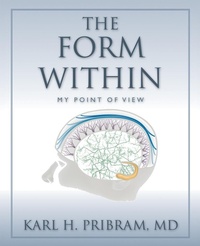
The Form Within
Description

More details
Other editions
Additional editions
Person
Born in Vienna in 1919, Pribram received his medical degree from the University of Chicago at the age of twenty three, becoming one of the first three hundred certified brain surgeons in the world. During his next decade as a neurosurgeon in Memphis and Jacksonville, he joined Karl Lashley at the Yerkes Primate Center, became its director, and pioneered the field of neuropsychology-a term that Pribram invented.
He spent the following sixty years leading groundbreaking research into the interrelations of the brain, behavior, and the mind: ten years at Yale University, thirty years at Stanford University, and twenty years as distinguished professor at Radford and George Mason Universities and (simultaneously) as distinguished professor of psychology and cognitive neuroscience at Georgetown University, where he still serves today.
Pribram is the author of more than 700 books and scientific publications, including Plans and the Structure of Behavior (with George Miller and Eugene Galanter, 1960), which is credited with launching the Cognitive Revolution in Psychology; Languages of the Brain (1971); Freud's "Project” Re-assessed(with Merton Gill, 1976); and Brain and Perception (1989). He is the recipient of more than sixty major awards and honors, including a lifetime grant from the U.S. Office of Naval Research; a Lifetime Research Career Award from the National Institute of Health; a Lifetime Achievement Award from the Society of Experimental Psychology and from the Washington Academy of Sciences; honorary doctorates in psychology and neuroscience from the Universities of Montreal and Bremen, Germany; and an Outstanding Contributions Award from the American Board of Medical Psychotherapists. He was the first recipient of the Dagmar and Vaclav Havel Award for uniting the sciences and the humanities.
Content
- Intro
- Titlepage
- Copyright
- Washngton Academy of Sciences
- Contents
- Prologue
- Preface
- Formulations
- Chapter 1: Correlations
- Chapter 2: Metaphors and Models
- Chapter 3: A Biological Imperative
- Chapter 4: Features and Frequencies
- Navigating Our World
- Chapter 5: From Receptor to Cortex and Back Again
- Chapter 6: Of Objects and Images
- Chapter 7: The Spaces We Navigate and Their Horizons
- Chapter 8: Means to Action
- A World Within
- Chapter 9: Pain and Pleasure
- Chapter 10: The Frontolimbic Forebrain: Initial Forays
- Chapter 11: The Four Fs
- Chapter 12: Freud's Project
- Choice
- Chapter 13: Novelty: The Capturing of Attention
- Chapter 14: Values
- Chapter 15: Attitude
- Chapter 16: The Organ of Civilization
- Chapter 17: Here Be Dragons
- Re-Formulations
- Chapter 18: Evolution and Inherent Design
- Chapter 19: Remembrance of Things Future
- Chapter 20: Coordination and Transformation
- Chapter 21: Minding the Brain
- Applications
- Chapter 22: Talk and Thought
- Chapter 23: Consciousness
- Chapter 24: Mind and Matter
- Chapter 25: Meaning
- Appendix A
- Appendix B
- Index
- Acknowldgements
