

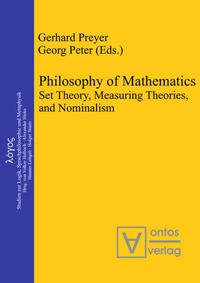
Philosophy of Mathematics
Description

One main interest of philosophy is to become clear about the assumptions, premisses and inconsistencies of our thoughts and theories. And even for a formal language like mathematics it is controversial if consistency is acheivable or necessary like the articles in the firt part of the publication show. Also the role of formal derivations, the role of the concept of apriority, and the intuitions of mathematical principles and properties need to be discussed. The second part is a contribution on nominalistic and platonistic views in mathematics, like the "indispensability argument" of W. v. O. Quine H. Putnam and the "makes no difference argument" of A. Baker. Not only in retrospect, the third part shows the problems of Mill, Frege's and the unity of mathematics and Descartes's contradictional conception of mathematical essences. Together, these articles give us a hint into the relationship between mathematics and world, that is, one of the central problems in philosophy of mathematics and philosophy of science.
More details
Other editions
Additional editions
Content
2 - Preface [Seite 7]
3 - Part I: Set Theory, Inconsistency, and Measuring Theories [Seite 9]
3.1 - Representationalism and Set-Theoretic Paradox [Seite 11]
3.2 - Who's Afraid of Inconsistent Mathematics? [Seite 28]
3.3 - Logical and Semantic Puritiy [Seite 40]
3.4 - On Using Measuring Numbers according to Measuring Theories [Seite 53]
4 - Part II The Challenge of Nominalism [Seite 71]
4.1 - The Compulsion to Believe: Logical Inference and Normativity [Seite 73]
4.2 - Nominalism and Mathematical Intuition [Seite 93]
4.3 - Jobless Objects: Mathematical Posits in Crisis [Seite 112]
4.4 - Is Indispensability Still a Problem for Fictionalism? [Seite 132]
5 - Part III: Historical Background [Seite 145]
5.1 - Mill, Frege and the Unity of Mathematics [Seite 147]
5.2 - Descartes on Mathematical Essences [Seite 164]
6 - Editors and Contributors [Seite 183]
