

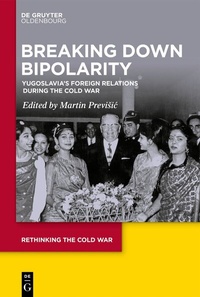
Breaking Down Bipolarity
Yugoslavia's Foreign Relations during the Cold War
1st Edition
Published on 4. October 2021
XI, 286 pages
978-3-11-065897-2 (ISBN)
Description

This book is aimed at presenting fresh views, interpretations, and reinterpretations of some already researched issues relating to the Yugoslav foreign policy and international relations up to year 1991. Yugoslavia positioned itself as a communist state that was not under the heel of the Soviet diplomacy and policy and as such was perceived by the West as an acceptable partner and useful tool in counteracting the Soviet influence.
Reviews / Votes
"With highly interesting insights into new and old topics of Yugoslavia's foreign policy, the book provides an important contribution to the research on the non-aligned and socialist country while historians wait for more archival documents from its final days to be accessible and analysed to further complete the "puzzle" that was Yugoslavia." Nedzad Kuc in: Connections. A Journal for Historians and Area Specialists, 19.05.2022, www.connections.clio-online.net/publicationreview/id/reb-113506More details
Other editions
Additional editions
Book
10/2021
1st Edition
De Gruyter Oldenbourg
€124.95
Shipment within 5-7 days
E-Book
10/2021
1st Edition
De Gruyter Oldenbourg
€124.95
Available for download
Person
Martin Previsic, University of Zagreb, Croatia.
Content
- Intro
- Table of Contents
- Abbreviations
- Preface and Acknowledgments
- Socialist Yugoslavia: A Cold War Crossroads
- Soviet Perceptions and Evaluations of Yugoslav Domestic and Foreign Policy during the Years of the Soviet-Yugoslav Conflict
- A Cold War in the Neighbourhood: Yugoslav-Albanian Relations after World War II
- Coping with the Regional Cold War: The Yugoslav-Greek Connection, 1944-1980
- Shaping Afro-Asia and Non-Alignment: The Sino-Yugoslav Struggle for Leadership in the Third World during the 1950s and 1960s
- In the Shadow of Transition: U.S.-Yugoslav Relations, 1966 to 1980
- In the Aftermath of the Prague Spring: Yugoslavia and Czechoslovakia 1969-1973
- Austria and Yugoslavia in the Cold War, 1945-1991: From Postwar Cold War to Détente and Dissolution
- The Adriatic Section of the Iron Curtain: Italy, Yugoslavia, and the Question of Trieste during the Cold War
- The Path to Interregional Cooperation in Cold War Europe: The Alps-Adriatic Region
- In Search of Modus Vivendi: Yugoslavia and the Holy See 1963-1971
- Cooperation despite Stark Scepticism: The European Economic Community and Socialist Yugoslavia in the 1970s
- A Failed Transition: Ante Markovic, the European Commission, and the End of the Cold War (1989-1990)
- Yugoslavia in the Cold War: Afterword
- Notes on Contributors
- Name Index
