

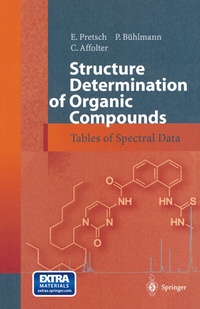
Structure Determination of Organic Compounds
Tables of Spectral Data
3rd Edition
Published on 9. March 2013
XV, 421 pages
978-3-662-04201-4 (ISBN)
Description

While modem techniques of nuclear magnetic resonance and mass spectrometry changed the ways of data acquisition and greatly extended the capabilities of these methods, the basic parameters, such as chemical shifts, coupling constants, and fragmentation pathways remain the same. This explains the ongoing success of the earlier editions of this book. However, since the amount of available data has considerably increased over the years, we decided to prepare an entirely new manuscript. It follows the same basic concepts, i. e. , it provides a representative, albeit limited set of reference data for the interpretation of 13C NMR, 1 H NMR, IR, mass, and UV Nis spectra. On the other hand, the book has undergone a number of changes. The amount of reference data has been doubled at least (especially for MS and IR) and the order and selection of data for the various spectroscopic methods is now arranged strictly in the same way. In addition, the the enclosed compact disc contains programs for estimating NMR chemical shifts and generating isomers based on structural information. Unfortunately, our teachers and colleagues, Prof. Wilhelm Simon and Prof. Thomas Clerc are no longer among us, and Prof. Joseph Seibl has retired years ago. Their contributions to developing the concept and the earlier editions of this work cannot be overemphasized. We also thank numerous colleagues who helped us in many different ways to complete the manuscript. Weare particularly indebted to Dr.
Reviews / Votes
The book begins with correlation tables for H and C NMR, IR, UV, and MS. The mass spectrometry sections includes common fragments, absolute masses, isotopes and isotope patterns of all the natural elements and halogen combinations. The next section contains combinations. The next section contains combination tables, based on functional group, which list the characteristic spectral values for each spectral method, with useful comments. This section would be a very valuable introduction for beginning students. The book comes with a CD which has programs for molecular drawing, all structures possible for a given formula, and estimation of H and C NMR chemical shifts, limited to 15 heavy atoms. R. Gary Amiet, Dept. of Appl. Chemistry, RMIT University Chemistry in Australia, Magazine of the Royal Australian Chemical Institute, 2001, Vol. 68, Issue 5, p. 36 This book is intended as a short textbook and a hands-on guide for interpreting experimental spectral data and elucidating the chemical structure of the compound behind it. This is the third, and completely revised, edition of the book whose earlier editions were highly successful. The new edition follows the same basic concepts as earlier editions, in that it provides a representative set of reference data for the interpretation of C NMR, H NMR, IR, mass and UV/Vis spectra. The amount of reference data has been doubled (especially for MS and IR) and the order and selection of data for the various spectroscopic methods is now arranged strictly in the same way. The CD-ROM supplied with the book contains programs for estimating NMR chemical shifts and generating isomers based on structural information. An extensive hypertext-based tutorial describes the main features of the programs. The book should be considered as a supplement to textbooks and reference words dealing with the particular spectroscopic techniques which generate the data included in the book. The use of the book to interpret spectra only requires the knowledge of basic principles of the techniques, but the contents are structured in such a way that it will serve as a reference book also to specialists. LabPlus International (Belgium), 2001, Vol. 15, Issue 1 This volume continues a long-standing series of compilations of spectroscopic data and empirical rules to calculate spectroscopic parameters. These have never been arranged in a classical textbook fashion but were restricted to supplying a data body for comparison with experimental values. Although much work has been done over the years to develop experimental techniques avoiding the input of empirical data, data systems such as Pretsch's books are still of great importance. They often allow problem solutions without sophisticated techniques, specialized knowledge and additional spectrometer time beyond routine measurements. Practically all teachers in spectroscopy and countless students know these books and work continuously with them. The present volume, now authored by E. Pretsch, P. Bühlmann and C. Affolter, is the latest in this series and has been greatly updated and enlarged. The size has mor or less doubled but the data arrangement has been retained according to the spectroscopic methods (C and H NMR, IR, MS, UV/Vis; Chapters 4-8) so that readers who are familiar with previous editions will find immediate access. Helmut Duddeck, Inst. of Org. Chemistry, Hannover/Germany Magnetic Resonance in Chemistry, 2002, Vol. 40, Issue 3, p. 247More details
Other editions
New editions
Ernö Pretsch | Philippe Bühlmann | Martin Badertscher
Structure Determination of Organic Compounds
Tables of Spectral Data
E-Book
04/2009
4th Edition
Springer
€69.54
Available for download
Additional editions
E. Pretsch | P. Bühlmann | C. Affolter
Structure Determination of Organic Compounds
Tables of Spectral Data
Book
03/2003
3rd Edition
Springer
€85.59
Article exhausted; check for reprint
Content
1 Introduction.- 2 Summary Tables.- 3 Combination Tables.- 4 13C NMR Spectroscopy.- 5 1H NMR Spectroscopy.- 6 IR Spectroscopy.- 7 Mass Spectrometry.- 8 UV/Vis Spectroscopy.
