

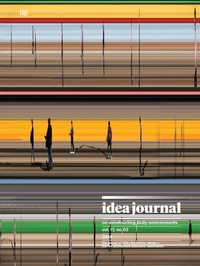
idea journal: co-constructing body-environment
vol. 17 no. 02 2020
17th Edition
Published on 9. December 2020
362 pages
978-3-88778-822-3 (ISBN)
Description

This special guest-edited issue extends the current discussions of art (inclusive of interior/ spatial design and architecture) as a process of social cognition and to address the gap between descriptions of embodied cognition and the co-construction of lived experience.
Papers and exhibitions presented at the 2019 Bodies of Knowledge Conference have been advanced significantly as research articles and visual essays to focus on interdisciplinary connections across research practices that involve art and theories of cognition. These contributions emphasise how spatial art and design research approaches have enabled the articulation of a complex understanding of environments, spaces and experiences, including the spatial distribution of cultural, organizational and conceptual structures and relationships, as well as surrounding design features.
Contributions address the following questions:
. How do art and spatial practices increase the potential for knowledge transfer and celebrate diverse forms of embodied expertise?
. How the examination of cultures of practice, Indigenous knowledges and cultural practices offer perspectives on inclusion, diversity, neurodiversity, disability and social justice issues?
. How the art and spatial practices may contribute to research perspectives from contemporary cognitive neuroscience and the philosophy of mind?
. The dynamic between an organism and its surroundings for example: How does art and design shift the way knowledge and thinking processes are acquired, extended and distributed?
. How do art and design practices demonstrate the ways different forms of acquiring and producing knowledge intersect?
Papers and exhibitions presented at the 2019 Bodies of Knowledge Conference have been advanced significantly as research articles and visual essays to focus on interdisciplinary connections across research practices that involve art and theories of cognition. These contributions emphasise how spatial art and design research approaches have enabled the articulation of a complex understanding of environments, spaces and experiences, including the spatial distribution of cultural, organizational and conceptual structures and relationships, as well as surrounding design features.
Contributions address the following questions:
. How do art and spatial practices increase the potential for knowledge transfer and celebrate diverse forms of embodied expertise?
. How the examination of cultures of practice, Indigenous knowledges and cultural practices offer perspectives on inclusion, diversity, neurodiversity, disability and social justice issues?
. How the art and spatial practices may contribute to research perspectives from contemporary cognitive neuroscience and the philosophy of mind?
. The dynamic between an organism and its surroundings for example: How does art and design shift the way knowledge and thinking processes are acquired, extended and distributed?
. How do art and design practices demonstrate the ways different forms of acquiring and producing knowledge intersect?
