

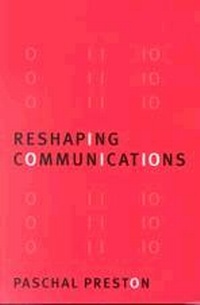
Reshaping Communications
Technology, Information and Social Change
1st Edition
Published on 5. February 2001
320 pages
978-1-84787-666-9 (ISBN)
Description

`It is a clich [ac]e but this book is timely, welcome and indeed a breath of fresh air....It is of particular value for people concerned with public communications, political economy, economics and the relationship between society and technology. Moreover, this book powerfully dispels the tacit assumption, prevalent in business, politics, media and academia that a combination of technical fixes and the free market can right all social problems' - Irish Journal of Sociology
Thirty years ago, one writer complained that 'to admire technology is all out of fashion'. Today excited claims are made for the impact that these technologies are having on social, political and economic life. But how are we to assess these claims? This book critically interrogates many of the prevailing ideas offers a fresh perspective on this new`digital age'.
Reshaping Communications:
? Provides an alternative and more grounded account of the complex interplay between new technology and information structures and changes in society
? Illuminates the fundamental continuities as well as changes in socioeconomic and political processes
? Draws on an interdisciplinary perspective and original empirical research.
The book will be essential reading for all those concerned with the new communication technologies, including students of media and communications as well as policy-makers.
Thirty years ago, one writer complained that 'to admire technology is all out of fashion'. Today excited claims are made for the impact that these technologies are having on social, political and economic life. But how are we to assess these claims? This book critically interrogates many of the prevailing ideas offers a fresh perspective on this new`digital age'.
Reshaping Communications:
? Provides an alternative and more grounded account of the complex interplay between new technology and information structures and changes in society
? Illuminates the fundamental continuities as well as changes in socioeconomic and political processes
? Draws on an interdisciplinary perspective and original empirical research.
The book will be essential reading for all those concerned with the new communication technologies, including students of media and communications as well as policy-makers.
Reviews / Votes
`This is a stimulating, well argued book on an important contemporary subject and based, as is rare in this field, on up-to-date empirical data' - Nicholas Garnham, University of Westminster "Given the controversies and discursive excesses surrounding the (new) media, a pragmatic voice was long overdue. Reshaping Communications definitely fits in this slot in the discursive universe surrounding new and mature media and communications. . . . Passionately and persuasively argued, the book presents not only a sobering voice in the midst of either excessively eulogizing or apocalyptic ones; it furthermore moves in the direction of making concrete proposals for policy changes that address pressing issues, and initiates a debate on information, technology, communication, and questions social justice." * Communications: The European Journal of Communication Research *All prices
More details
Edition
First Edition
Language
English
Place of publication
London
United Kingdom
Target group
College/higher education
Professional and scholarly
ISBN-13
978-1-84787-666-9 (9781847876669)
Copyright in bibliographic data and cover images is held by Nielsen Book Services Limited or by the publishers or by their respective licensors: all rights reserved.
Schweitzer Classification
Other editions
Additional editions
Book
02/2001
1st Edition
SAGE Publications Inc
€232.14
Shipment within 15-20 days
Book
02/2001
1st Edition
SAGE Publications Inc
€105.10
Shipment within 15-20 days
Person
Paschal Preston holds a research professorship in the School of Communications in Dublin City University.
Paschal Preston is the founding director of the COMTEC research unit. Founded in 1991, COMTEC was one of the first social science research centres in the Irish university sector. COMTEC now has a distinguished 20-year record of successful collaborative and multi-country research projects. For more on COMTEC, click here.
Paschal Preston is also a member of the Society, Information and Media (SIM) research centre. SIM was established in 2005 to embrace the broad research interests of staff in the School of Communication, including those engaged in media practice as well as academic research on media production, policy and consumption issues.
Paschal Preston is the founding director of the COMTEC research unit. Founded in 1991, COMTEC was one of the first social science research centres in the Irish university sector. COMTEC now has a distinguished 20-year record of successful collaborative and multi-country research projects. For more on COMTEC, click here.
Paschal Preston is also a member of the Society, Information and Media (SIM) research centre. SIM was established in 2005 to embrace the broad research interests of staff in the School of Communication, including those engaged in media practice as well as academic research on media production, policy and consumption issues.
Content
PART ONE: INTRODUCTION AND OVERVIEW
Information Superhighways or Super-Hypeways
PART TWO: COMPETING THEORIES OF THE CONTEMPORARY
Third Wave Visions
Technology as Social Transformer
An Archeology of Imformation (Sector) Matters
'Information Society' Theories
Culture and Information
Postmodernisms and the Public Sphere
PART THREE: MAPPING A NEW MILLENNIUM AND MULTIMEDIA ORDER
Changes, Continuities and Cycles
Towards a More Realist(ic) Theory
The 'Atoms and Bits' of Informational Capitalism
Polarities
New Modes of Work, Consumption and State Regimes
'Content Is King'?
New Media and 'Mature' Media Innovations
Information as New Frontier
Commofication and Consumption Stakes
PART FOUR: ALTERNATIVE PROSPECTS AND POSSIBILITIES
Beyond Technological Fetishism
Towards a New Social and Media Order @Y2K+
Information Superhighways or Super-Hypeways
PART TWO: COMPETING THEORIES OF THE CONTEMPORARY
Third Wave Visions
Technology as Social Transformer
An Archeology of Imformation (Sector) Matters
'Information Society' Theories
Culture and Information
Postmodernisms and the Public Sphere
PART THREE: MAPPING A NEW MILLENNIUM AND MULTIMEDIA ORDER
Changes, Continuities and Cycles
Towards a More Realist(ic) Theory
The 'Atoms and Bits' of Informational Capitalism
Polarities
New Modes of Work, Consumption and State Regimes
'Content Is King'?
New Media and 'Mature' Media Innovations
Information as New Frontier
Commofication and Consumption Stakes
PART FOUR: ALTERNATIVE PROSPECTS AND POSSIBILITIES
Beyond Technological Fetishism
Towards a New Social and Media Order @Y2K+
