Nature, Value, Duty
Description

Gifford Lecturer and Templeton Prize winner Holmes Rolston, III is widely known as the father of environmental ethics. His writings range between natural philosophy and theology and include detailed presentations of an interlocking position that includes aesthetics, value theory, natural resource policy, wilderness advocacy, and sustainable development.
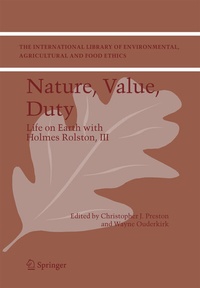
"Nature Value and Duty: Life on Earth with Holmes Rolston, III" is a collection of contemporary writings on the work of Holmes Rolston, III. The authors contributing to this volume are a mixture of senior scholars in environmental ethics and new voices in philosophy and in literature. Together they provide an in depth evaluation of many of the topics discussed by Rolston. They probe the strengths and weaknesses of his work and suggest valuable correctives. Rolston himself, in a detailed reply to each of his critics at the end of the volume, reveals where some of these criticisms sting him the most and in the process provides one of the most detailed and articulate defenses of his position ever offered.
Reviews / Votes
From the reviews:
"This is a collection of thirteen original essays about the environmental philosophy of Holmes Rolston, III, with a fourteenth chapter by Rolston in response. . any new work that discusses his philosophy will be of interest to anyone connected to the subject. . Any student of environmental philosophy will find the book a pleasure to read-a delightful immersion into the thought of Rolston. . this volume is an excellent contribution to environmental philosophy, and should be read and discussed by everyone in the field." (Eric Katz, Environmental Ethics, Vol. 30, 2008)
"This volume of essays authored by luminaries and interesting new thinkers in the fields of applied and environmental ethics . . Each essay is a rigorous, occasionally jargon-filled, engagement with Rolston's thinking. . he perceived environmental ethics as a forum where voices from philosophy could converse with scientists, park rangers, organizers, and other non-philosophers. . his most attentive audience, those who read and think about his work, is composed of philosophers and ethicists." (Christopher C. Robinson, Journal of Agricultural and Environmental Ethics, Vol. 21, 2008)
More details
Other editions
Additional editions