

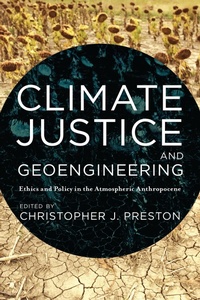
Climate Justice and Geoengineering
Ethics and Policy in the Atmospheric Anthropocene
1st Edition
Published on 21. September 2016
1 pages
979-8-216-23604-7 (ISBN)
Description

It is already clear that climate engineering raises numerous troubling ethical issues. The pertinent question yet to be addressed is how the ethical issues raised by climate engineering compare to those raised by alternative proposals for tackling climate change.
This volume is the first to put the ethical issues raised by climate engineering into a comprehensive, comparative context so that the key ethical challenges of these technologies can be better measured against those of alternative climate policies . Addressing the topic specifically through the lens of justice, contributors include both advocates of climate intervention research and its sceptics. The volume includes a helpful blend of the theoretical and the practical, with contributions from authors in philosophy, engineering, public policy, social science, geography, sustainable development studies, economics, and climate studies. This cross-disciplinary collection provides the start of an important and more contextualized "second generation" analysis of climate engineering and the difficult public policy decisions that lie ahead.
This volume is the first to put the ethical issues raised by climate engineering into a comprehensive, comparative context so that the key ethical challenges of these technologies can be better measured against those of alternative climate policies . Addressing the topic specifically through the lens of justice, contributors include both advocates of climate intervention research and its sceptics. The volume includes a helpful blend of the theoretical and the practical, with contributions from authors in philosophy, engineering, public policy, social science, geography, sustainable development studies, economics, and climate studies. This cross-disciplinary collection provides the start of an important and more contextualized "second generation" analysis of climate engineering and the difficult public policy decisions that lie ahead.
More details
Edition
1. Auflage
Language
English
Place of publication
United States
Publishing group
Bloomsbury Publishing Plc
Illustrations
9 b/w illustrations; 5 tables
ISBN-13
979-8-216-23604-7 (9798216236047)
Copyright in bibliographic data and cover images is held by Nielsen Book Services Limited or by the publishers or by their respective licensors: all rights reserved.
Schweitzer Classification
Other editions
Additional editions
Christopher J. Preston
Climate Justice and Geoengineering
Ethics and Policy in the Atmospheric Anthropocene
Book
09/2016
Rowman & Littlefield International
€61.00
Shipment within 3-4 weeks
Person
Christopher J. Preston is Professor of Philosophy and a Fellow at the Mansfield Center's Program on Ethics and Public Affairs at the University of Montana.
Contributors:
Christian Baatz, research assistant, Department of Philosophy, Christian-AlbrechtsUniversität, Kiel, Germany; Patrik Baard, doctoral candidate, Royal Institute of Technology, Stockholm, Sweden; Matthew Cotton, Lecturer, Department of Town and Regional Planning, University of Sheffield, UK; Johannes Emmerling, Senior Researcher in Climate Change and Sustainable Development, Fondazione Eni Enrico Mattei, Milan, Italy; Allen Habib, Assistant Professor of Philosophy, University of Calgary, Canada; Joshua Horton, Post-doctoral Research Fellow, Belfer Center for Science and International Affairs, Harvard University, USA; Marion Hourdequin, Associate Professor of Philosophy, Colorado College, USA; Frank Jankunis, doctoral student in philosophy, University of Calgary, Canada; David Keith, Gordon McKay Professor of Applied Physics and Professor of Public Policy, Kennedy School, Harvard University; Teea Kortetmäki, doctoral student, University of Jyväskylä, Finland; Penehuro Fatu Lefale, International Climate and Policy Analyst, Bodeker Scientific, Wellington, New Zealand; Jane Long, retired Principle Director at Large, Lawrence Livermore National Laboratory, Berkeley, USA, and contributing scientist for the Environmental Defence Fund; Duncan McClaren, director of McLaren Environmental Research Consultancy and Scientific Advisory Committee of the RCUK UK Energy Programme; Cush Luwesi Ngozo, Lecturer, Department of Geography, University of Kenyatta, Kenya; Konrad Ott, Professor for Philosophy and Ethics of the Environment, Kiel University, Germany; Andrew Parker, Research Fellow, Institute for Advanced Sustainability Studies, Potsdam, Germany; Tina Sikka, Postdoctoral Fellow and Lecturer, School of Communication, Simon Fraser University, Canada; Toby Svoboda, Assistant Professor of Philosophy, Fairfield University, USA; Massimo Tavoni, Fellow, Center for Advanced Studies in Behavioural Science, Stanford University, and Climate Change and Sustainable Development Deputy Coordinator, Fondazione Eni Enrico Mattei, Milan, Italy; Michael Thompson, Managing Director, Forum for Climate Engineering Assessment, School of International Service, American University, Washington DC, USA; Richard Tol, Professor of the Economics of Climate Change, Institute for Environmental Studies and Department of Spatial Economics in Vrije Universiteit, Netherlands and Professor of Economics, University of Sussex, UK; Per Wikman-Svahn, scientist, Swedish Defence Research Agency, Stockholm, Sweden
Contributors:
Christian Baatz, research assistant, Department of Philosophy, Christian-AlbrechtsUniversität, Kiel, Germany; Patrik Baard, doctoral candidate, Royal Institute of Technology, Stockholm, Sweden; Matthew Cotton, Lecturer, Department of Town and Regional Planning, University of Sheffield, UK; Johannes Emmerling, Senior Researcher in Climate Change and Sustainable Development, Fondazione Eni Enrico Mattei, Milan, Italy; Allen Habib, Assistant Professor of Philosophy, University of Calgary, Canada; Joshua Horton, Post-doctoral Research Fellow, Belfer Center for Science and International Affairs, Harvard University, USA; Marion Hourdequin, Associate Professor of Philosophy, Colorado College, USA; Frank Jankunis, doctoral student in philosophy, University of Calgary, Canada; David Keith, Gordon McKay Professor of Applied Physics and Professor of Public Policy, Kennedy School, Harvard University; Teea Kortetmäki, doctoral student, University of Jyväskylä, Finland; Penehuro Fatu Lefale, International Climate and Policy Analyst, Bodeker Scientific, Wellington, New Zealand; Jane Long, retired Principle Director at Large, Lawrence Livermore National Laboratory, Berkeley, USA, and contributing scientist for the Environmental Defence Fund; Duncan McClaren, director of McLaren Environmental Research Consultancy and Scientific Advisory Committee of the RCUK UK Energy Programme; Cush Luwesi Ngozo, Lecturer, Department of Geography, University of Kenyatta, Kenya; Konrad Ott, Professor for Philosophy and Ethics of the Environment, Kiel University, Germany; Andrew Parker, Research Fellow, Institute for Advanced Sustainability Studies, Potsdam, Germany; Tina Sikka, Postdoctoral Fellow and Lecturer, School of Communication, Simon Fraser University, Canada; Toby Svoboda, Assistant Professor of Philosophy, Fairfield University, USA; Massimo Tavoni, Fellow, Center for Advanced Studies in Behavioural Science, Stanford University, and Climate Change and Sustainable Development Deputy Coordinator, Fondazione Eni Enrico Mattei, Milan, Italy; Michael Thompson, Managing Director, Forum for Climate Engineering Assessment, School of International Service, American University, Washington DC, USA; Richard Tol, Professor of the Economics of Climate Change, Institute for Environmental Studies and Department of Spatial Economics in Vrije Universiteit, Netherlands and Professor of Economics, University of Sussex, UK; Per Wikman-Svahn, scientist, Swedish Defence Research Agency, Stockholm, Sweden
Content
Introduction: Climate Justice and Geoengineering, Christopher J. Preston / Part I: Geoengineering Justice in Theory / 1.Solar Radiation Management and Comparative Climate Justice, Toby Svoboda / 2. Why Geoengineering is Not 'Plan B', Augustin Fragnière and Stephen M. Gardiner / 3. Justice, Recognition, and Climate Geoengineering, Marion Hourdequin / 4. Do We Have a Residual Obligation to Engineer the Climate, as a Matter of Justice? Patrik Baard and Per Wikman-Svahn / 5. Paying it Forward: Geo-engineering and Compensation for the Further Future, Frank Jankunis and Allen Habib / Part II: Geoengineering Justice in Practice / 6. Solar Geoengineering and Obligations to the Global Poor, Joshua Horton and David Keith / 7. Why Aggressive Mitigation Must be Part of Any Pathway to Climate Justice, Christian Baatz and Konrad Ott / 8. Bringing Geoengineering in the Mix of Climate Change Tools, Jane Long / 9. Food Systems and Climate Engineering: A Plate Full of Risks or Promises?, Teea Kortetmäkiand Markku Oksanen / Part III: Geoengineering Justice in Frames, Scenarios, and Models / 10. Framing out Justice: The Post-politics of Climate Engineering Discourses, Duncan McLaren / 11. Solar Geoengineering: Technology-Based Climate Intervention or Compromising Social Justice in Africa?, Cush Ngozo Luwesi, Dzigbodi Adzo Doke, and David R. Morrow / 12. Geoengineering and Climate Change Mitigation: Trade-offs and Synergies as Foreseen by Integrated Assessment Models, Johannes Emmerling and Massimo Tavoni / 13. Distributional Implications of Geoengineering, Richard S.J. Tol / Index / Notes on Contributors
