

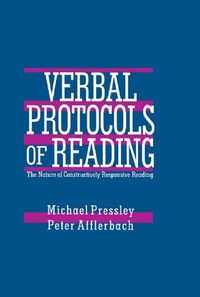
Verbal Protocols of Reading
The Nature of Constructively Responsive Reading
Published on 6. December 2012
168 pages
978-1-136-48302-8 (ISBN)
Description

Researchers from a variety of disciplines have collected verbal protocols of reading as a window on conscious reading processes. Because such work has occurred in different disciplines, many who have conducted verbal protocol analyses have been unaware of the research of others. This volume brings together the existing literature from the various fields in which verbal protocols of reading have been generated. In so doing, the authors provide an organized catalog of all conscious verbal processes reported in studies to date -- the most complete analysis of conscious reading now available in the literature.
When the results of all of the studies are considered, there is clear support for a number of models of reading comprehension including reader response theories, schema perspectives, executive processing models, and bottom-up approaches such as the one proposed by van Dijk and Kintsch. The summary of results also demonstrates that none of the existing models goes far enough. Thus, a new framework -- constructively responsive reading -- is described. This new model encompasses reader response, schematic and executive processing, and induction from word- and phrase-level comprehension to higher-order meaning. The important concept in this new model is that readers respond to bits and pieces of text as they are encountered, all as part of the overarching goal of constructing meaning from text.
This volume also includes a critical review of the thinking aloud methodology as it has been used thus far. This examination suggests that it continues to be an immature methodology, and that much work is needed if a complete theory of conscious processing during reading is to be developed via verbal protocol analysis. Finally, after reviewing what has been accomplished to date, the authors provide extensive discussion of the work that remains to be done and the adequacy of the verbal protocol methodology for permitting telling conclusions about text processing.
When the results of all of the studies are considered, there is clear support for a number of models of reading comprehension including reader response theories, schema perspectives, executive processing models, and bottom-up approaches such as the one proposed by van Dijk and Kintsch. The summary of results also demonstrates that none of the existing models goes far enough. Thus, a new framework -- constructively responsive reading -- is described. This new model encompasses reader response, schematic and executive processing, and induction from word- and phrase-level comprehension to higher-order meaning. The important concept in this new model is that readers respond to bits and pieces of text as they are encountered, all as part of the overarching goal of constructing meaning from text.
This volume also includes a critical review of the thinking aloud methodology as it has been used thus far. This examination suggests that it continues to be an immature methodology, and that much work is needed if a complete theory of conscious processing during reading is to be developed via verbal protocol analysis. Finally, after reviewing what has been accomplished to date, the authors provide extensive discussion of the work that remains to be done and the adequacy of the verbal protocol methodology for permitting telling conclusions about text processing.
Reviews / Votes
"I was impressed by the way the authors generated the description of constructively responsive reading -- that is, by adopting relevant previous studies as documents and putting them through an elaborate analysis. Such a method, with its strong validity and efficient use of evidence from multiple sources, should receive more attention among researchers....I am pleased to recommend this book to all those who are interested in the theory of reading and improvement of methods for gaining knowledge about the cognitive processes involved in reading."-European Journal of Cognitive Psychology
More details
Language
English
Place of publication
London
United Kingdom
Publishing group
Taylor & Francis Ltd
Target group
Professional and scholarly
Product notice
Reflowable
File size
0,70 MB
ISBN-13
978-1-136-48302-8 (9781136483028)
Copyright in bibliographic data and cover images is held by Nielsen Book Services Limited or by the publishers or by their respective licensors: all rights reserved.
Schweitzer Classification
Other editions
Additional editions
Michael Pressley | Peter Afflerbach
Verbal Protocols of Reading
The Nature of Constructively Responsive Reading
Book
01/1995
1st Edition
Routledge
€205.90
Shipment within 10-20 days
Michael Pressley | Peter Afflerbach
Verbal Protocols of Reading
The Nature of Constructively Responsive Reading
Book
01/1995
1st Edition
Routledge
€62.80
Shipment within 10-20 days
Persons
Michael Pressley, Peter Afflerbach
Content
Contents: Preface. An Introduction to Protocol Analysis of Reading. Methods Employed to Construct a Summary of Conscious Processes During Skilled Reading. What Readers Can Do When They Read: A Summary of the Results from the On-Line Self-Report Studies of Reading. Text Processing in Light of Think-Aloud Analyses of Reading: Constructively Responsive Reading. The Future of Reading Protocol Analyses: Addressing Methodological Concerns in Order to Advance Conceptual Understanding.
