

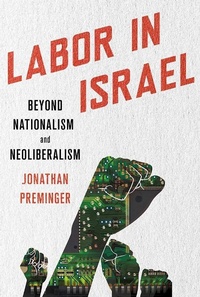
Labor in Israel
Beyond Nationalism and Neoliberalism
Published on 15. April 2018
252 pages
978-1-5017-1714-7 (ISBN)
Description

Using a comprehensive analysis of the wave of organizing that swept the country starting in 2007, Labor in Israel investigates the changing political status of organized labor in the context of changes to Israel's political economy, including liberalization, the rise of non-union labor organizations, the influx of migrant labor, and Israel's complex relations with the Palestinians. Through his discussion of organized labor's relationship to the political community and its nationalist political role, Preminger demonstrates that organized labor has lost the powerful status it enjoyed for much of Israel's history. Despite the weakening of trade unions and the Histadrut, however, he shows the ways in which the fragmentation of labor representation has created opportunities for those previously excluded from the labor movement regime.
Organized labor is now trying to renegotiate its place in contemporary Israel, a society that no longer accepts labor's longstanding claim to be the representative of the people. As such, Preminger concludes that organized labor in Israel is in a transitional and unsettled phase in which new marginal initiatives, new organizations, and new alliances that have blurred the boundaries of the sphere of labor have not yet consolidated into clear structures of representation or accepted patterns of political interaction.
Organized labor is now trying to renegotiate its place in contemporary Israel, a society that no longer accepts labor's longstanding claim to be the representative of the people. As such, Preminger concludes that organized labor in Israel is in a transitional and unsettled phase in which new marginal initiatives, new organizations, and new alliances that have blurred the boundaries of the sphere of labor have not yet consolidated into clear structures of representation or accepted patterns of political interaction.
Reviews / Votes
The volume informatively covers an immense amount of ground, including disputes involving doctors, cleaners, journalists, social workers, cellphone industry workers, railway workers, and port workers-and the changing roles of Palestinian workers.(Choice) Charting the tensions between the waning corporatism of the 'old guard' and a new wave of worker activism, Jonathan Preminger's accessible book contributes an insightful examination of legitimacy and democracy in Israel's labour movement.
(British Journal of Industrial Relations)
More details
Language
English
Place of publication
New York
United States
Publishing group
Cornell University Press
Product notice
Reflowable
Illustrations
1 chart - 1 Charts
ISBN-13
978-1-5017-1714-7 (9781501717147)
Copyright in bibliographic data and cover images is held by Nielsen Book Services Limited or by the publishers or by their respective licensors: all rights reserved.
Schweitzer Classification
Other editions
Additional editions
Book
04/2018
ILR Press
€91.80
Shipment within 15-20 days
Person
Jonathan Preminger is a lecturer in employment and labor relations at Cardiff Business School, Cardiff University.
