

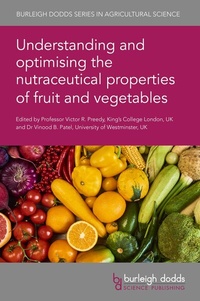
Understanding and optimising the nutraceutical properties of fruit and vegetables
Published on 30. August 2022
478 pages
978-1-78676-852-0 (ISBN)
Description

As populations in many developed countries age and the burden of chronic disease increases, there remains a need to establish effective preventative measures. Fruit and vegetables are a natural source of vitamins and minerals which can contribute to good health.
Understanding and optimising the nutraceutical properties of fruit and vegetables reviews the associated health benefits of key horticultural crops, including apples, broccoli and cranberries. The book provides authoritative discussions on the nutraceutical properties of the major phytochemical compounds, including antioxidants and flavonoids, and how these properties can be optimised to prevent the onset of chronic diseases.
By providing a comprehensive insight into the human health benefits of fruit and vegetables, the book highlights the emergence of a more sustainable, alternative method to preventing the onset of disease with less reliance on overburdened healthcare systems.
Understanding and optimising the nutraceutical properties of fruit and vegetables reviews the associated health benefits of key horticultural crops, including apples, broccoli and cranberries. The book provides authoritative discussions on the nutraceutical properties of the major phytochemical compounds, including antioxidants and flavonoids, and how these properties can be optimised to prevent the onset of chronic diseases.
By providing a comprehensive insight into the human health benefits of fruit and vegetables, the book highlights the emergence of a more sustainable, alternative method to preventing the onset of disease with less reliance on overburdened healthcare systems.
More details
Series
Language
English
Place of publication
Cambridge
United Kingdom
Publishing group
Burleigh Dodds
Target group
University and other researchers in food science;nutritionists working in the human healthcare sector;as well as governments;NGOs; and private sector agencies supporting the horticulture industry
Illustrations
Color tables, photos and figures
ISBN-13
978-1-78676-852-0 (9781786768520)
DOI
10.19103/AS.2022.0101
Schweitzer Classification
Other editions
Additional editions
Victor R. Preedy | Vinood Patel
Understanding and Optimising the Nutraceutical Properties of Fruit and Vegetables
Book
08/2022
Burleigh Dodds Science Publishing Limited
€244.80
Shipment within 3-4 weeks
Persons
Editor
King's College London (United Kingdom)
Dr Victor R. Preedy is Professor of Clinical Biochemistry and Pathology at King's College Hospital and Emeritus Professor of Nutritional Biochemistry at King's College London, UK. Amongst many honours, Professor Preedy is a Fellow of the Royal Society of Biology, the Royal Society of Public Health, the Royal College of Pathologists and the Royal Society of Chemistry. He has published over 750 articles which includes numerous books on a wide range of topics related to the impact of nutrition on health and disease.
Dr Victor R. Preedy is Professor of Clinical Biochemistry and Pathology at King's College Hospital and Emeritus Professor of Nutritional Biochemistry at King's College London, UK. Amongst many honours, Professor Preedy is a Fellow of the Royal Society of Biology, the Royal Society of Public Health, the Royal College of Pathologists and the Royal Society of Chemistry. He has published over 750 articles which includes numerous books on a wide range of topics related to the impact of nutrition on health and disease.
University of Westminster (United Kingdom)
Dr Vinood B. Patel is Reader in Clinical Biochemistry in the School of Life Sciences at the University of Westminster and a fellow of the Royal Society of Chemistry. Dr Patel is internationally-known for his research on nutrition, biomarkers and liver disease, and has published over 150 articles and edited numerous books on diet, nutrition and health.
Dr Vinood B. Patel is Reader in Clinical Biochemistry in the School of Life Sciences at the University of Westminster and a fellow of the Royal Society of Chemistry. Dr Patel is internationally-known for his research on nutrition, biomarkers and liver disease, and has published over 150 articles and edited numerous books on diet, nutrition and health.
Contributions
School of Food Science and Environmental Health, Technological University Dublin - City Campus (Ireland)
School of Food Science and Environmental Health, Technological University Dublin - City Campus (Ireland)
School of Food Science and Environmental Health, Technological University Dublin - City Campus (Ireland)
Environmental Sustainability and Health Institute, Technological University Dublin - City Campus (Ireland)
School of Food Science and Environmental Health, Technological University Dublin - City Campus (Ireland)
São Paulo State University (UNESP) (Brazil)
University of Padua (UNIPD) (Italy)
University of São Paulo (USP) (Brazil)
São Paulo State University (UNESP) (Brazil)
MGM Institute of Biosciences & Technology, Mahatma Gandhi Mission University (India)
Dr A D Diwan is former Assistant Director General (ADG) in the Fisheries Division of the Indian Council of Agricultural Research (ICAR), Ministry of Agriculture, Govt of India, New Delhi. Before assuming this position, he was Professor and Head, Fish Genetics & Biotechnology Division and also as a Dean (Faculty of Fishery Science) at the Central Institute of Fisheries Education (CIFE) a Deemed University, Mumbai. He is a fellow of National Academy of Environmental Biology, National Academy of Nature Conservator and the Bioved Research Society. Presently, he is Emeritus Professor at the Mahatma Gandhi Mission (MGM) University of Health Sciences.
Dr A D Diwan is former Assistant Director General (ADG) in the Fisheries Division of the Indian Council of Agricultural Research (ICAR), Ministry of Agriculture, Govt of India, New Delhi. Before assuming this position, he was Professor and Head, Fish Genetics & Biotechnology Division and also as a Dean (Faculty of Fishery Science) at the Central Institute of Fisheries Education (CIFE) a Deemed University, Mumbai. He is a fellow of National Academy of Environmental Biology, National Academy of Nature Conservator and the Bioved Research Society. Presently, he is Emeritus Professor at the Mahatma Gandhi Mission (MGM) University of Health Sciences.
MGM Institute of Biosciences & Technology, Mahatma Gandhi Mission University (India)
MGM Institute of Biosciences & Technology, Mahatma Gandhi Mission University (India)
School of Food Science and Environmental Health, Technological University Dublin - City Campus (Ireland)
School of Food Science and Environmental Health, Technological University Dublin - City Campus (Ireland)
School of Food Science and Environmental Health, Technological University Dublin - City Campus (Ireland)
School of Food Science and Environmental Health, Technological University Dublin - City Campus (Ireland)
Graduate Program in Food Science and Technology, State University of Ponta Grossa (Brazil)
Bolu Abant Izzet Baysal University (Turkey)
Royal Botanic Gardens Kew (United Kingdom)
Royal Botanic Gardens Kew (United Kingdom)
State University of Ponta Grossa (Brazil)
Institute of Urban Agriculture, Chinese Academy of Agricultural Sciences, Chengdu National Agricultural Science and Technology Center (China)
Institute of Urban Agriculture, Chinese Academy of Agricultural Sciences, Chengdu National Agricultural Science and Technology Center (China)
Institute of Urban Agriculture, Chinese Academy of Agricultural Sciences, Chengdu National Agricultural Science and Technology Center (China)
Institute of Urban Agriculture, Chinese Academy of Agricultural Sciences, Chengdu National Agricultural Science and Technology Center (China)
Institute of Urban Agriculture, Chinese Academy of Agricultural Sciences, Chengdu National Agricultural Science and Technology Center (China)
Institute of Urban Agriculture, Chinese Academy of Agricultural Sciences, Chengdu National Agricultural Science and Technology Center (China)
McGill University
McGill University
McGill University
McGill University
Church & Dwight Inc (United States)
Biofortis Research, Merieux NutriSciences (United States)
Universidad de Buenos Aires
Lia Noemi Gerschenson is the Director of the Laboratory of Optimization of the Quality of Preserved Food Products (LOCAP) of the Industry Department of the Natural and Exact Sciences School of the Buenos Aires University (UBA), Argentina. She has researched in the area of food science and technology for more than 30 years publishing over 120 papers in refereed journals and over 35 chapters in books of international publishers.
Lia Noemi Gerschenson is the Director of the Laboratory of Optimization of the Quality of Preserved Food Products (LOCAP) of the Industry Department of the Natural and Exact Sciences School of the Buenos Aires University (UBA), Argentina. She has researched in the area of food science and technology for more than 30 years publishing over 120 papers in refereed journals and over 35 chapters in books of international publishers.
CONICET
Universidad de Buenos Aires
GeoBioTec - Geobiociências, Geoengenharias e Geotecnologias, Faculdade de Ciências e Tecnologia, Universidade Nova de Lisboa (Portugal)
Dr. Elsa M. Gonçalves is a Researcher at the Instituto Nacional de Investigação Agrária e Veterinária, Portugal. She is responsible for the Sensory Testing Laboratories, implementing a range of sensory analysis techniques, to evaluate different food products and applied statistical analysis, allowing products to be grouped, and their similarities and differences quantified. She is a member of the Competence Centre of the Mediterranean diet. She has been the national delegate of the Codex Committee on Methods of Analysis and Sampling (CCMAS) since 2019.
Dr. Elsa M. Gonçalves is a Researcher at the Instituto Nacional de Investigação Agrária e Veterinária, Portugal. She is responsible for the Sensory Testing Laboratories, implementing a range of sensory analysis techniques, to evaluate different food products and applied statistical analysis, allowing products to be grouped, and their similarities and differences quantified. She is a member of the Competence Centre of the Mediterranean diet. She has been the national delegate of the Codex Committee on Methods of Analysis and Sampling (CCMAS) since 2019.
SFCOLAB - Associação Smart Farm COLAB Laboratório Colaborativo para a Inovação Digital na Agricultura, Rua Cândido dos Reis nº1, Espaço SFCOLAB (Portugal)
GeoBioTec - Geobiociências, Geoengenharias e Geotecnologias, Faculdade de Ciências e Tecnologia, Universidade Nova de Lisboa (Portugal)
Unidade de Tecnologia e Inovação, Instituto Nacional de Investigação Agrária e Veterinária (Portugal)
Content
Part 1 Phytochemical compounds in fruits and vegetables: polyphenols
1.Advances in understanding the nutraceutical properties of antioxidants in fruits and vegetables: Ugunujhie Agbaje, Mallaidh Hyndman and Soraeya Kharaty, School of Food Science and Environmental Health, Technological University Dublin - City Campus, Ireland; and Swarna Jaiswal and Amit K. Jaiswal, School of Food Science and Environmental Health, Technological University Dublin - City Campus and Environmental Sustainability and Health Institute, Technological University Dublin - City Campus, Ireland;
2.Advances in understanding the nutraceutical properties of phenolic compounds in fruits and vegetables: Cristine Vanz Borges, São Paulo State University (UNESP), Brazil; Fabio Vianello, University of Padua (UNIPD), Italy; Ricardo Alfredo Kluge, University of São Paulo (USP), Brazil; and Giuseppina Pace Pereira Lima, São Paulo State University (UNESP), Brazil;
3.Understanding the nutraceutical properties of flavonoids in fruits and vegetables: chemical structure and groups: A. D. Diwan, S. N. Harke and A. N. Panche, MGM Institute of Biosciences & Technology, Mahatma Gandhi Mission University, India;
4.Understanding the nutraceutical properties of flavonoids in fruits and vegetables: mechanisms of action: A. D. Diwan, S. N. Harke and A. N. Panche, MGM Institute of Biosciences & Technology, Mahatma Gandhi Mission University, India;
Part 2 Phytochemicals in fruits and vegetables: glucosinolates and organosulfur compounds
5.Health-promoting effects of glucosinolates and their breakdown products: Ella O'Grady, Greta Pileckaite, Almha Gilheany and Endrita Kucana, School of Food Science and Environmental Health, Technological University Dublin - City Campus, Ireland; and Swarna Jaiswal and Amit K. Jaiswal, School of Food Science and Environmental Health, Technological University Dublin - City Campus and Environmental Sustainability and Health Institute, Technological University Dublin - City Campus, Ireland;
6.Nutraceutical potential of glucosinolates: Ella O'Grady and Greta Pileckaite, School of Food Science and Environmental Health, Technological University Dublin - City Campus, Ireland; Aline Alberti, Graduate Program in Food Science and Technology, State University of Ponta Grossa, Brazil; and Swarna Jaiswal and Amit K. Jaiswal, School of Food Science and Environmental Health, Technological University Dublin - City Campus and Environmental Sustainability and Health Institute, Technological University Dublin - City Campus, Ireland;
7.Understanding the health benefits and nutraceutical properties of organosulphur compounds in vegetables: Greta Pileckaite and Ella O'Grady, School of Food Science and Environmental Health, Technological University Dublin - City Campus, Ireland; and Swarna Jaiswal and Amit K. Jaiswal, School of Food Science and Environmental Health, Technological University Dublin - City Campus and Environmental Sustainability and Health Institute, Technological University Dublin - City Campus, Ireland;
Part 3 Phytochemicals and the prevention of disease
8.Advances in understanding the role of plant phytochemicals in preventing cancer: Gulsun Akdemir Evrendilek, Bolu Abant Izzet Baysal University, Turkey;
9.Advances in understanding the role of plant phytochemicals in preventing cardiovascular disease: Nicholas J. Sadgrove and Monique S. J. Simmonds, Royal Botanic Gardens - Kew, UK;
Part 4 Analysing and optimising phytochemical compounds in fruits and vegetables
10.Advances in screening/analysis of phytochemical compounds in fruits and vegetables: Alessandro Nogueira, State University of Ponta Grossa, Brazil; Amit K. Jaiswal, School of Food Science and Environmental Health, Technological University Dublin - City Campus and Environmental Sustainability and Health Institute, Technological University Dublin - City Campus, Ireland; and Aline Alberti, State University of Ponta Grossa, Brazil;
11.Agronomic factors affecting phytochemical compounds in fruits and vegetables: Jiangtao Hu, Li Zhang, Zheng Wang, Jie Peng, Xiao Yang and Qichang Yang, Institute of Urban Agriculture, Chinese Academy of Agricultural Sciences, Chengdu National Agricultural Science and Technology Center, China;
12.Understanding processing of phytochemical compounds in fruits and vegetables in the gut: Stan Kubow, Lucas Roldos, Kailee Wark and Michèle M. Iskandar, McGill University, Canada;
13.Advances in understanding and improving the nutraceutical properties of cranberries: Oliver Chen, Biofortis Research, Merieux NutriSciences and Tufts University, USA; and Eunice Mah, Biofortis Research, Merieux NutriSciences, USA;
1Advances in understanding and improving the nutraceutical properties of apples: Lia Noemi Gerschenson, Eliana Noemi Fissore and Carolina Bélen Gómez Vargas, Universidad de Buenos Aires and CONICET, Argentina;
15.Advances in understanding and improving the nutraceutical properties of broccoli and other Brassicas: Elsa M. Gonçalves, Unidade de Tecnologia e Inovação, Instituto Nacional de Investigação Agrária e Veterinária and GeoBioTec - Geobiociências, Geoengenharias e Geotecnologias, Faculdade de Ciências e Tecnologia, Universidade Nova de Lisboa, Portugal; Carla Alegria, SFCOLAB - Associação Smart Farm COLAB Laboratório Colaborativo para a Inovação Digital na Agricultura, Rua Cândido dos Reis nº1, Espaço SFCOLAB and cE3c - Centre for Ecology, Evolution and Environmental Changes, Faculdade de Ciências, Universidade de Lisboa, Portugal; Ana Cristina Ramos, Unidade de Tecnologia e Inovação, Instituto Nacional de Investigação Agrária e Veterinária and GeoBioTec - Geobiociências, Geoengenharias e Geotecnologias, Faculdade de Ciências e Tecnologia, Universidade Nova de Lisboa, Portugal; and Marta Abreu, Unidade de Tecnologia e Inovação, Instituto Nacional de Investigação Agrária e Veterinária and LEAF, Linking Landscape, Environment, Agriculture and Food, School of Agriculture, Universidade de Lisboa, Portugal;
1.Advances in understanding the nutraceutical properties of antioxidants in fruits and vegetables: Ugunujhie Agbaje, Mallaidh Hyndman and Soraeya Kharaty, School of Food Science and Environmental Health, Technological University Dublin - City Campus, Ireland; and Swarna Jaiswal and Amit K. Jaiswal, School of Food Science and Environmental Health, Technological University Dublin - City Campus and Environmental Sustainability and Health Institute, Technological University Dublin - City Campus, Ireland;
2.Advances in understanding the nutraceutical properties of phenolic compounds in fruits and vegetables: Cristine Vanz Borges, São Paulo State University (UNESP), Brazil; Fabio Vianello, University of Padua (UNIPD), Italy; Ricardo Alfredo Kluge, University of São Paulo (USP), Brazil; and Giuseppina Pace Pereira Lima, São Paulo State University (UNESP), Brazil;
3.Understanding the nutraceutical properties of flavonoids in fruits and vegetables: chemical structure and groups: A. D. Diwan, S. N. Harke and A. N. Panche, MGM Institute of Biosciences & Technology, Mahatma Gandhi Mission University, India;
4.Understanding the nutraceutical properties of flavonoids in fruits and vegetables: mechanisms of action: A. D. Diwan, S. N. Harke and A. N. Panche, MGM Institute of Biosciences & Technology, Mahatma Gandhi Mission University, India;
Part 2 Phytochemicals in fruits and vegetables: glucosinolates and organosulfur compounds
5.Health-promoting effects of glucosinolates and their breakdown products: Ella O'Grady, Greta Pileckaite, Almha Gilheany and Endrita Kucana, School of Food Science and Environmental Health, Technological University Dublin - City Campus, Ireland; and Swarna Jaiswal and Amit K. Jaiswal, School of Food Science and Environmental Health, Technological University Dublin - City Campus and Environmental Sustainability and Health Institute, Technological University Dublin - City Campus, Ireland;
6.Nutraceutical potential of glucosinolates: Ella O'Grady and Greta Pileckaite, School of Food Science and Environmental Health, Technological University Dublin - City Campus, Ireland; Aline Alberti, Graduate Program in Food Science and Technology, State University of Ponta Grossa, Brazil; and Swarna Jaiswal and Amit K. Jaiswal, School of Food Science and Environmental Health, Technological University Dublin - City Campus and Environmental Sustainability and Health Institute, Technological University Dublin - City Campus, Ireland;
7.Understanding the health benefits and nutraceutical properties of organosulphur compounds in vegetables: Greta Pileckaite and Ella O'Grady, School of Food Science and Environmental Health, Technological University Dublin - City Campus, Ireland; and Swarna Jaiswal and Amit K. Jaiswal, School of Food Science and Environmental Health, Technological University Dublin - City Campus and Environmental Sustainability and Health Institute, Technological University Dublin - City Campus, Ireland;
Part 3 Phytochemicals and the prevention of disease
8.Advances in understanding the role of plant phytochemicals in preventing cancer: Gulsun Akdemir Evrendilek, Bolu Abant Izzet Baysal University, Turkey;
9.Advances in understanding the role of plant phytochemicals in preventing cardiovascular disease: Nicholas J. Sadgrove and Monique S. J. Simmonds, Royal Botanic Gardens - Kew, UK;
Part 4 Analysing and optimising phytochemical compounds in fruits and vegetables
10.Advances in screening/analysis of phytochemical compounds in fruits and vegetables: Alessandro Nogueira, State University of Ponta Grossa, Brazil; Amit K. Jaiswal, School of Food Science and Environmental Health, Technological University Dublin - City Campus and Environmental Sustainability and Health Institute, Technological University Dublin - City Campus, Ireland; and Aline Alberti, State University of Ponta Grossa, Brazil;
11.Agronomic factors affecting phytochemical compounds in fruits and vegetables: Jiangtao Hu, Li Zhang, Zheng Wang, Jie Peng, Xiao Yang and Qichang Yang, Institute of Urban Agriculture, Chinese Academy of Agricultural Sciences, Chengdu National Agricultural Science and Technology Center, China;
12.Understanding processing of phytochemical compounds in fruits and vegetables in the gut: Stan Kubow, Lucas Roldos, Kailee Wark and Michèle M. Iskandar, McGill University, Canada;
13.Advances in understanding and improving the nutraceutical properties of cranberries: Oliver Chen, Biofortis Research, Merieux NutriSciences and Tufts University, USA; and Eunice Mah, Biofortis Research, Merieux NutriSciences, USA;
1Advances in understanding and improving the nutraceutical properties of apples: Lia Noemi Gerschenson, Eliana Noemi Fissore and Carolina Bélen Gómez Vargas, Universidad de Buenos Aires and CONICET, Argentina;
15.Advances in understanding and improving the nutraceutical properties of broccoli and other Brassicas: Elsa M. Gonçalves, Unidade de Tecnologia e Inovação, Instituto Nacional de Investigação Agrária e Veterinária and GeoBioTec - Geobiociências, Geoengenharias e Geotecnologias, Faculdade de Ciências e Tecnologia, Universidade Nova de Lisboa, Portugal; Carla Alegria, SFCOLAB - Associação Smart Farm COLAB Laboratório Colaborativo para a Inovação Digital na Agricultura, Rua Cândido dos Reis nº1, Espaço SFCOLAB and cE3c - Centre for Ecology, Evolution and Environmental Changes, Faculdade de Ciências, Universidade de Lisboa, Portugal; Ana Cristina Ramos, Unidade de Tecnologia e Inovação, Instituto Nacional de Investigação Agrária e Veterinária and GeoBioTec - Geobiociências, Geoengenharias e Geotecnologias, Faculdade de Ciências e Tecnologia, Universidade Nova de Lisboa, Portugal; and Marta Abreu, Unidade de Tecnologia e Inovação, Instituto Nacional de Investigação Agrária e Veterinária and LEAF, Linking Landscape, Environment, Agriculture and Food, School of Agriculture, Universidade de Lisboa, Portugal;
