

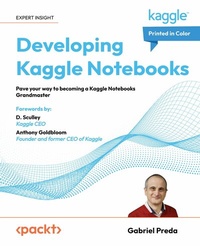
Developing Kaggle Notebooks
Pave your way to becoming a Kaggle Notebooks Grandmaster
1st Edition
Published on 21. May 2024
370 pages
978-1-80512-571-6 (ISBN)
Description

Printed in Color Develop an array of effective strategies and blueprints to approach any new data analysis on the Kaggle platform and create Notebooks with substance, style and impact Leverage the power of Generative AI with Kaggle Models Purchase of the print or Kindle book includes a free PDF eBookKey Features - Master the basics of data ingestion, cleaning, exploration, and prepare to build baseline models
- Work robustly with any type, modality, and size of data, be it tabular, text, image, video, or sound
- Improve the style and readability of your Notebooks, making them more impactful and compelling
Book DescriptionDeveloping Kaggle Notebooks introduces you to data analysis, with a focus on using Kaggle Notebooks to simultaneously achieve mastery in this fi eld and rise to the top of the Kaggle Notebooks tier. The book is structured as a sevenstep data analysis journey, exploring the features available in Kaggle Notebooks alongside various data analysis techniques. For each topic, we provide one or more notebooks, developing reusable analysis components through Kaggle's Utility Scripts feature, introduced progressively, initially as part of a notebook, and later extracted for use across future notebooks to enhance code reusability on Kaggle. It aims to make the notebooks' code more structured, easy to maintain, and readable. Although the focus of this book is on data analytics, some examples will guide you in preparing a complete machine learning pipeline using Kaggle Notebooks. Starting from initial data ingestion and data quality assessment, you'll move on to preliminary data analysis, advanced data exploration, feature qualifi cation to build a model baseline, and feature engineering. You'll also delve into hyperparameter tuning to iteratively refi ne your model and prepare for submission in Kaggle competitions. Additionally, the book touches on developing notebooks that leverage the power of generative AI using Kaggle Models.What you will learn - Approach a dataset or competition to perform data analysis via a notebook
- Learn data ingestion and address issues arising with the ingested data
- Structure your code using reusable components
- Analyze in depth both small and large datasets of various types
- Distinguish yourself from the crowd with the content of your analysis
- Enhance your notebook style with a color scheme and other visual effects
- Captivate your audience with data and compelling storytelling techniques
Who this book is forThis book is suitable for a wide audience with a keen interest in data science and machine learning, looking to use Kaggle Notebooks to improve their skills and rise in the Kaggle Notebooks ranks. This book caters to: Beginners on Kaggle from any background Seasoned contributors who want to build various skills like ingestion, preparation, exploration, and visualization Expert contributors who want to learn from the Grandmasters to rise into the upper Kaggle rankings Professionals who already use Kaggle for learning and competing
- Work robustly with any type, modality, and size of data, be it tabular, text, image, video, or sound
- Improve the style and readability of your Notebooks, making them more impactful and compelling
Book DescriptionDeveloping Kaggle Notebooks introduces you to data analysis, with a focus on using Kaggle Notebooks to simultaneously achieve mastery in this fi eld and rise to the top of the Kaggle Notebooks tier. The book is structured as a sevenstep data analysis journey, exploring the features available in Kaggle Notebooks alongside various data analysis techniques. For each topic, we provide one or more notebooks, developing reusable analysis components through Kaggle's Utility Scripts feature, introduced progressively, initially as part of a notebook, and later extracted for use across future notebooks to enhance code reusability on Kaggle. It aims to make the notebooks' code more structured, easy to maintain, and readable. Although the focus of this book is on data analytics, some examples will guide you in preparing a complete machine learning pipeline using Kaggle Notebooks. Starting from initial data ingestion and data quality assessment, you'll move on to preliminary data analysis, advanced data exploration, feature qualifi cation to build a model baseline, and feature engineering. You'll also delve into hyperparameter tuning to iteratively refi ne your model and prepare for submission in Kaggle competitions. Additionally, the book touches on developing notebooks that leverage the power of generative AI using Kaggle Models.What you will learn - Approach a dataset or competition to perform data analysis via a notebook
- Learn data ingestion and address issues arising with the ingested data
- Structure your code using reusable components
- Analyze in depth both small and large datasets of various types
- Distinguish yourself from the crowd with the content of your analysis
- Enhance your notebook style with a color scheme and other visual effects
- Captivate your audience with data and compelling storytelling techniques
Who this book is forThis book is suitable for a wide audience with a keen interest in data science and machine learning, looking to use Kaggle Notebooks to improve their skills and rise in the Kaggle Notebooks ranks. This book caters to: Beginners on Kaggle from any background Seasoned contributors who want to build various skills like ingestion, preparation, exploration, and visualization Expert contributors who want to learn from the Grandmasters to rise into the upper Kaggle rankings Professionals who already use Kaggle for learning and competing
All prices
More details
Other editions
Additional editions
Book
12/2023
Packt Publishing
€86.80
Shipment within 3-4 weeks
Persons
Preda Gabriel :
Dr. Gabriel Preda is a Principal Data Scientist for Endava, a major software services company. He has worked on projects in various industries, including financial services, banking, portfolio management, telecom, and healthcare, developing machine learning solutions for various business problems, including risk prediction, churn analysis, anomaly detection, task recommendations, and document information extraction. In addition, he is very active in competitive machine learning, currently holding the title of a three-time Kaggle Grandmaster and is well-known for his Kaggle Notebooks.
Dr. Gabriel Preda is a Principal Data Scientist for Endava, a major software services company. He has worked on projects in various industries, including financial services, banking, portfolio management, telecom, and healthcare, developing machine learning solutions for various business problems, including risk prediction, churn analysis, anomaly detection, task recommendations, and document information extraction. In addition, he is very active in competitive machine learning, currently holding the title of a three-time Kaggle Grandmaster and is well-known for his Kaggle Notebooks.
Content
Table of Contents - Introducing Kaggle and Its Basic Functions
- Getting Ready for Your Kaggle Environment
- Starting Our Travel - Surviving the Titanic Disaster
- Take a Break and Have a Beer or Coffee in London
- Get Back to Work and Optimize Microloans for Developing Countries
- Can You Predict Bee Subspecies?
- Text Analysis Is All You Need
- Analyzing Acoustic Signals to Predict the Next Simulated Earthquake
- Can You Find Out Which Movie Is a Deepfake?
- Unleash the Power of Generative AI with Kaggle Models
- Closing Our Journey: How to Stay Relevant and on Top
- Getting Ready for Your Kaggle Environment
- Starting Our Travel - Surviving the Titanic Disaster
- Take a Break and Have a Beer or Coffee in London
- Get Back to Work and Optimize Microloans for Developing Countries
- Can You Predict Bee Subspecies?
- Text Analysis Is All You Need
- Analyzing Acoustic Signals to Predict the Next Simulated Earthquake
- Can You Find Out Which Movie Is a Deepfake?
- Unleash the Power of Generative AI with Kaggle Models
- Closing Our Journey: How to Stay Relevant and on Top
