

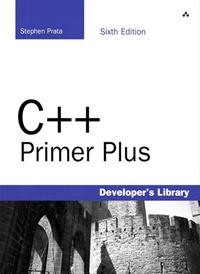
C++ Primer Plus
6th Edition
Published on 18. October 2011
1440 pages
978-0-13-278117-6 (ISBN)
Description

C++ Primer Plus, Sixth Edition
New C++11 Coverage
C++ Primer Plus is a carefully crafted, complete tutorial on one of the most significant and widely used programming languages today. An accessible and easy-to-use self-study guide, this book is appropriate for both serious students of programming as well as developers already proficient in other languages.
The sixth edition of C++ Primer Plus has been updated and expanded to cover the latest developments in C++, including a detailed look at the new C++11 standard.
Author and educator Stephen Prata has created an introduction to C++ that is instructive, clear, and insightful. Fundamental programming concepts are explained along with details of the C++ language. Many short, practical examples illustrate just one or two concepts at a time, encouraging readers to master new topics by immediately putting them to use.
Review questions and programming exercises at the end of each chapter help readers zero in on the most critical information and digest the most difficult concepts.
In C++ Primer Plus, you'll find depth, breadth, and a variety of teaching techniques and tools to enhance your learning:
A new detailed chapter on the changes and additional capabilities introduced in the C++11 standard
Complete, integrated discussion of both basic C language and additional C++ features
Clear guidance about when and why to use a feature
Hands-on learning with concise and simple examples that develop your understanding a concept or two at a time
Hundreds of practical sample programs
Review questions and programming exercises at the end of each chapter to test your understanding
Coverage of generic C++ gives you the greatest possible flexibility
Teaches the ISO standard, including discussions of templates, the Standard Template Library, the string class, exceptions, RTTI, and namespaces
Table of Contents
1: Getting Started with C++
2: Setting Out to C++
3: Dealing with Data
4: Compound Types
5: Loops and Relational Expressions
6: Branching Statements and Logical Operators
7: Functions: C++'s Programming Modules
8: Adventures in Functions
9: Memory Models and Namespaces
10: Objects and Classes
11: Working with Classes
12: Classes and Dynamic Memory Allocation
13: Class Inheritance
14: Reusing Code in C++
15: Friends, Exceptions, and More
16: The string Class and the Standard Template Library
17: Input, Output, and Files
18: The New C++11 Standard
A Number Bases
B C++ Reserved Words
C The ASCII Character Set
D Operator Precedence
E Other Operators
F The stringTemplate Class
G The Standard Template Library Methods and Functions
H Selected Readings and Internet Resources
I Converting to ISO Standard C++
J Answers to Chapter Reviews
New C++11 Coverage
C++ Primer Plus is a carefully crafted, complete tutorial on one of the most significant and widely used programming languages today. An accessible and easy-to-use self-study guide, this book is appropriate for both serious students of programming as well as developers already proficient in other languages.
The sixth edition of C++ Primer Plus has been updated and expanded to cover the latest developments in C++, including a detailed look at the new C++11 standard.
Author and educator Stephen Prata has created an introduction to C++ that is instructive, clear, and insightful. Fundamental programming concepts are explained along with details of the C++ language. Many short, practical examples illustrate just one or two concepts at a time, encouraging readers to master new topics by immediately putting them to use.
Review questions and programming exercises at the end of each chapter help readers zero in on the most critical information and digest the most difficult concepts.
In C++ Primer Plus, you'll find depth, breadth, and a variety of teaching techniques and tools to enhance your learning:
A new detailed chapter on the changes and additional capabilities introduced in the C++11 standard
Complete, integrated discussion of both basic C language and additional C++ features
Clear guidance about when and why to use a feature
Hands-on learning with concise and simple examples that develop your understanding a concept or two at a time
Hundreds of practical sample programs
Review questions and programming exercises at the end of each chapter to test your understanding
Coverage of generic C++ gives you the greatest possible flexibility
Teaches the ISO standard, including discussions of templates, the Standard Template Library, the string class, exceptions, RTTI, and namespaces
Table of Contents
1: Getting Started with C++
2: Setting Out to C++
3: Dealing with Data
4: Compound Types
5: Loops and Relational Expressions
6: Branching Statements and Logical Operators
7: Functions: C++'s Programming Modules
8: Adventures in Functions
9: Memory Models and Namespaces
10: Objects and Classes
11: Working with Classes
12: Classes and Dynamic Memory Allocation
13: Class Inheritance
14: Reusing Code in C++
15: Friends, Exceptions, and More
16: The string Class and the Standard Template Library
17: Input, Output, and Files
18: The New C++11 Standard
A Number Bases
B C++ Reserved Words
C The ASCII Character Set
D Operator Precedence
E Other Operators
F The stringTemplate Class
G The Standard Template Library Methods and Functions
H Selected Readings and Internet Resources
I Converting to ISO Standard C++
J Answers to Chapter Reviews
More details
Series
Edition
6th edition
Language
English
Place of publication
Boston
United States
Publishing group
Pearson Education (US)
Target group
College/higher education
File size
95,15 MB
ISBN-13
978-0-13-278117-6 (9780132781176)
Copyright in bibliographic data and cover images is held by Nielsen Book Services Limited or by the publishers or by their respective licensors: all rights reserved.
Schweitzer Classification
Other editions
Additional editions
Stephen Prata
C++ Primer Plus
Book
11/2011
6th Edition
Addison Wesley
€55.07
Article not available at the moment
Person
Stephen Prata taught astronomy, physics, and computer science at the College of Marin in Kentfield, California. He received his B.S. from the California Institute of Technology and his Ph.D. from the University of California, Berkeley. He has authored or coauthored more than a dozen books on programming topics including New C Primer Plus, which received the Computer Press Association's 1990 Best How-to Computer Book Award, and C++ Primer Plus, nominated for the Computer Press Association's Best How-to Computer Book Award in 1991.
Content
Chapter 1: Getting Started with C++
Chapter 2: Setting Out to C++
Chapter 3: Dealing with Data
Chapter 4: Compound Types
Chapter 5: Loops and Relational Expressions
Chapter 6: Branching Statements and Logical Operators
Chapter 7: Functions: C++'s Programming Modules
Chapter 8: Adventures in Functions
Chapter 9: Memory Models and Namespaces
Chapter 10: Objects and Classes
Chapter 11: Working with Classes
Chapter 12: Classes and Dynamic Memory Allocation
Chapter 13: Class Inheritance
Chapter 14: Reusing Code in C++
Chapter 15: Friends, Exceptions, and More
Chapter 16: The string Class and the Standard Template Library
Chapter 17: Input, Output, and Files
Chapter 18: Visiting with the New C++ Standard
Chapter 2: Setting Out to C++
Chapter 3: Dealing with Data
Chapter 4: Compound Types
Chapter 5: Loops and Relational Expressions
Chapter 6: Branching Statements and Logical Operators
Chapter 7: Functions: C++'s Programming Modules
Chapter 8: Adventures in Functions
Chapter 9: Memory Models and Namespaces
Chapter 10: Objects and Classes
Chapter 11: Working with Classes
Chapter 12: Classes and Dynamic Memory Allocation
Chapter 13: Class Inheritance
Chapter 14: Reusing Code in C++
Chapter 15: Friends, Exceptions, and More
Chapter 16: The string Class and the Standard Template Library
Chapter 17: Input, Output, and Files
Chapter 18: Visiting with the New C++ Standard
