

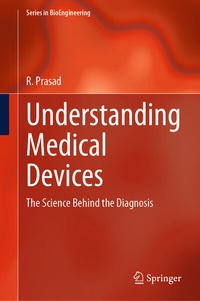
Understanding Medical Devices
Description

This book provides an accessible and comprehensive exploration of the principles and mechanisms behind widely used medical diagnostic tools. Written in clear, simple language, it offers a deep understanding of these instruments, their functionality, and the underlying science, making it ideal for a broad audience, including medical professionals, educators, and curious readers.
The book begins with foundational concepts such as electromagnetic radiation, analog and digital signals, and binary systems, before diving into detailed discussions of key diagnostic tools like the stethoscope, thermometer, and pulse oximeter. Advanced imaging technologies such as X-rays, CT scans, MRI, and PET scans are thoroughly explained, along with non-invasive tools like ultrasound scanners and glucometers. Each chapter emphasizes the real-world applications and significance of these devices, with simple explanations supported by illustrative examples and figures.
Designed for mixed readership, this book provides insights into the science behind diagnostic tools while also fostering a deeper appreciation for their practical impact on healthcare.
More details
Other editions
Additional editions
Person
Professor R. Prasad is Emeritus Professor of Physics and a distinguished academic with over 40 years of teaching and research experience. Formerly Dean of the Faculty of Science and Chair of the Department of Physics at Aligarh Muslim University, India, he has guided numerous postgraduate and doctoral students in fields like nuclear physics, electronics, and thermal physics.
Professor Prasad has an extensive publication record, with more than 150 research papers in high-impact international journals. His research group remains active, contributing to advancements in experimental nuclear physics. He is also an accomplished author of several academic books.
Content
0.Basics.- 1.THE STETHOSCOPE.- 2.THE THERMOMETER.- 3.THE PULSE OXIMETER.- 4.THE SPHYGMOMANOMETER.- 5.X-RAY IMAGING.- 6.COMPUTED TOMOGRAPHY (CT) or CAT SCAN.- 7.MAGNETIC RESONANCE IMAGING (MRI).- 8.POSITRON EMISSION TOMOGRAPHY (PET SCAN).- 9.ULTRASOUND SCAN.- 10.GLUCOMETER.
