

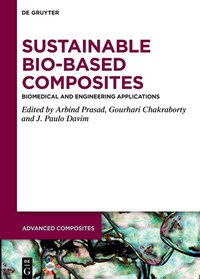
Sustainable Bio-Based Composites
Description

The sustainability of any process lies in the eco-friendly and economical production of products for applications. Bio-based materials are emerging as raw materials for different products and applications. The book covers cellulose, chitosan, silk, collagen and gelatin bio-based materials. It describes their use in biomedical applications, such as orthopaedic implant, drug delivery, tissue culture, biosensor and engineering applications such as fuel cells, energy storage and packaging. It concludes with the use of bio-based materials as precursors for biorefinery, biolubricants, membranes and adsorbents.
More details
Other editions
Additional editions
Persons
Dr. Arbind Prasad has completed his Ph.D. (Mechanical Engineering) from Indian Institute of Technology Guwahati , Assam, India. He has earned gold medal in his M. Tech. He is currently working as an Assistant Professor and Head (Mechanical Engineering) in the Department of Science and Technology, Government of Bihar, Posted at Katihar Engineering College, Katihar, Bihar, India. He has one granted patent and filled 3 patents out of his research work. He has 15 SCI international Journal papers, edited 06 books (Wiley Scrivener Publishing and CRC Press (Taylor & Francis) USA), 17 book chapters and 15 reputed international conference papers to his credit. Dr. Arbind Prasad has obtained various prestigious awards such as Sponsored Research Industrial Consultancy (SRIC) award from IIT Kanpur, Best Oral presentation from American Chemical Society , Best paper awards from IIT Guwahati during Research Conclave. He has completed numerous projects funded by state Government. He is an associate editor for International Journal of Materials, Manufacturing and Sustainable Technologies (IJMMST) and early career editor for International Journal of Mathematical, Engineering and Management Sciences (IJMEMS) Indexed in ESCI/Scopus and DOAJ. He is editorial board member of various international journals and acts as active review board member of 10 prestigious (Indexed in SCI/SCIE/Scopus) international journals with high impact factor i.e., Bioengineering, Journal of design, Materials, Journal of functional materials, Polymer, Materials, Molecules etc. He has been invited to deliver talks at various organizations of repute. He has coordinated various faculty development programmes, short term courses, symposium, national seminars and completed research projects sponsored under various Government schemes in India. His main areas of research include resorbable polymer, processing and characterizations, scaffolds, hydrogels, manufacturing, composites, biomaterials, nano materials processing, internal fixation devices, bioimplants etc. He is also a lifetime member of Society of Polymer Science India , Material Research Society of India , Society of Biomaterials and Artificial Organs of India , Asian Polymer Association , and Indian Society of Technical Education .
Dr. Gourhari Chakraborty received his B. Tech. in Chemical Engineering from the University of Calcutta (West Bengal) and his Ph.D. in Chemical Engineering from the Indian Institute of Technology Guwahati , Assam, India. He also worked as a post-doctoral fellow at CoE-SusMat, IIT Guwahati on an industry-academia project. He has published 15 articles in reputable national and international journals, books, and conference proceedings. He has a lot of experience organizing workshops and seminars. He is currently employed by the National Institute of Technology Andhra Pradesh, Tadepalligudem, Andhra Pradesh, India, as an assistant professor in the Department of Chemical Engineering from July 2021. Polymers, Nanomaterial, Composite, Bio-degradable materials, Magnetic materials, Carbon, Dispersion techniques, Electrochemical Sensors, Bio-sensor, Vapor sensors, Catalysis, Rheology, and Hydrogel are among his research interests. He is a member of several professional organizations, including the Institution's innovation council (IIC), NIT Andhra Pradesh, and the Society of Polymer Science(SPS), India.
Prof. J. Paulo Davim
Prof. J. Paulo Davim is professor in Mechanical Engineering Department. He is currently affliated with University of Aveiro, Department of Mechanical Engineering, Campus Universitário de Santiago, 3810-193 AVEIRO (PORTUGAL). He earned his D.Sc. - Doctor of Science (Higher Doctorate) from London Metropolitan University.He is associated with Fellow (FIET), The Institution of Engineering and Technology "IET",Specialist titles, Portuguese Institution of Engineers "OE",Eur Ing title, European Federation of National Engineering Associations "FEANI", Senior Chartered Engineer, Portuguese Institution of Engineers "OE".he is chief editor in international journals like The Journal of Engineering (Section Editor- Mechanical Engineering),Advances in Mechanical Engineering (Topic Editor),International Journal of Surface Science and Engineering,International Journal of Machining and Machinability of Materials,International Journal of Materials Engineering Innovation,International Journal of Higher Education and Sustainability,International Journal of Manufacturing, Materials and Mechanical Engineering,International Journal of Surface Engineering and Interdisciplinary Materials Science,International Journal of Applied Management Sciences and Engineering.He is also the book series editor of many prestigious book from various publishing house of international repute.More details about him can be found in this link. http://machining.web.ua.pt/pers-davim.htm
Content
- Intro
- Aim and Scope
- Acknowledgment
- Preface
- List of Contributing Authors
- Contents
- 1 Bio-based materials: origin, synthesis, and properties
- 2 Bio-based polymers: processing and applications
- 3 Cellulose: biomedical and engineering applications
- 4 Chitosan in orthopedics: current advancements and future prospects
- 5 Bio-based materials in drug delivery
- 6 Prospects of functional nano-manufactured scaffolds in tissue engineering applications
- 7 Additive manufacturing in fabrication of orthopedic implants
- 8 Analysis of surface acoustic wave in a polymer-coated piezo-electro-magnetic structure with micro-inertia effect
- 9 Biodegradable polymers-based proton exchange membrane for fuel cells
- 10 Bio-based carbon materials for applications in supercapacitors: an energy storage system
- 11 Bio-based materials in advanced packaging applications
- 12 Biorefinery development feedstocks derived and possible solutions for a sustainable environment
- 13 Biolubricants and its application in engineering
- 14 Bio-based materials in advance separation processes
- 15 The influence of imperfect interface of shear wave propagation on layered bio-based plate material: computational study of bio-based systems
- 16 Bio-based materials for adsorption and catalysis
- About the editors
- Index
