

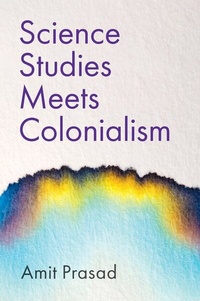
Science Studies Meets Colonialism
Description

The field of science and technology studies has long critiqued the idea that there is such a thing as a universal and singular "Science" that exists independently of human society, interpretation, and action. However, the multiple significant ways in which colonial legacies impact and shape this project have often remained out of sight at the edges of the discipline.
In this important book, Amit Prasad seeks to rectify this erasure, demonstrating that problematic idealized imaginaries of science, scientists, and the scientific realm can be traced back to the birth of "modern science" during European colonialism. Such visions of science and technology have undergirded the imagination of the West (and thus of its others), constructing hierarchies of technological innovation and scientific value, but also unexpectedly leaving society vulnerable to contemporary threats of misinformation and conspiracy theories, as has been strikingly evident during the COVID-19 pandemic.
Far from being an indictment of STS, this rigorous book seeks to highlight such concerns to make STS engage more carefully with issues of colonialism and thus to enable readers to understand the rapidly changing global topography of science and technology today and into the future.
More details
Other editions
Additional editions
Person
Amit Prasad is Associate Professor of Sociology at Georgia Tech University.
Content
CHAPTER 1 - COVID-19, Science versus Anti-Science, and the Colonial Present
CHAPTER 2 - Historicism without History: The Scientific Revolution, Reimagining the European Past, and Postcolonial Futures
CHAPTER 3 - Colonialism, & Euro/West-centrism: Postcolonial Desires, Colonial Entrapments
CONCLUSION - Modern Science & European Colonialism: A Conversation with J. P. S. Uberoi and Bruno Latour
1
COVID-19, Science versus Anti-Science, and the Colonial Present
I think facts died a long time ago, and it's taken people quite a while to notice.
Mary Poovey, author of A History of the Modern Fact, in an interview with NPR, April 29, 20121
Public trust in science and evidence is essential for overcoming COVID-19.
Dr Tedros Adhanom Ghebreyesus, Director-General of the World Health Organization, 20212
In March 2021, when spikes in COVID-19 infections and deaths in different parts of the world were continuing to disrupt any possibility of the pandemic ending soon, an article in the Scientific American forcefully reiterated another "escalating" concern - the "anti-science movement."3 The author, "a vaccine scientist and a parent of an adult daughter with autism," claimed that "antiscience is causing mass deaths . in this COVID-19 pandemic" and characterized anti-science "as a dominant and highly lethal force, and one that threatens global security, as much as do terrorism and nuclear proliferation."4 The Scientific American article's claim may seem a little over the top. However, similar concerns have been raised very frequently during the pandemic. PLOS Biology, for example, published an article whose title starts with the phrase "Anti-science kills."5 In fact, in June, 2020, when the pandemic was ravaging the United States, Dr Anthony Fauci, who has been the Director of the National Institute of Allergy and Infectious Diseases (NIAID) from 1984 and advised eight US presidents, had warned that there was an "alarmingly large percentage of people" with "anti-science . feeling."6
Concerns about anti-science attitudes impacting COVID-19 responses has not been unique to the United States. In a news report in Nature, Brazilian scientists bemoaned "that the [Brazilian] government's failure to follow science-based guidance in responding to the pandemic has made the crisis much worse" and blamed "President Jair Bolsonaro's administration" for having "publicly undermined science."7 On the other side of the globe, in India, news headlines such as "The Rise of Anti-Science as Covid-19 Cases Exploding" or "The Rise of India's 'Covid Quack'" have been common.8 An editorial in Nature called on India and Brazil to highlight "the human cost of sidelining science."9
The concern with anti-science claims and activities, and more broadly with the spread of misinformation, during the COVID-19 pandemic are not unfounded. In February 2020, when COVID-19 infection cases were relatively low (with total confirmed cases only around 15,000) and largely limited to China, the World Health Organization (WHO) had already warned against the accompanying "massive 'infodemic' - an overabundance of information - some accurate some not," adding "that makes it hard for people to find trustworthy sources and reliable guidance when they need it."10 The situation became progressively worse. COVID-19 has been widely argued to have also spawned a "pandemic of misinformation" (Islam et al. 2020; Li, Bailey, Huynh, and Chan 2020; Moran 2020). There have been widespread protests against mask wearing and vaccination, presentation of different quack therapies, and considerable misinformation and conspiracies have gone viral. The growing global concern with misinformation and conspiracies that are commonly argued to have been fueled by anti-science attitudes has further accentuated the existing disquiet in relation to post-truth.
The Oxford English Dictionary defines post-truth as "relating to or denoting circumstances in which objective facts are less influential in shaping public opinion than appeals to emotion and personal belief."11 Post-truth has at least three decades of history, as the Oxford English Dictionary noted while christening it as the word of the year in 2016 in light of the pro-Brexit vote in the United Kingdom. It "seems to have been first used in this meaning in a 1992 essay by the late Serbian-American playwright Steve Tesich in The Nation magazine."12 Initial concerns with the emerging era of post-truth were largely in relation to politics and news. Even when societal positions against the theory of evolution or climate science were discussed, often the argument was that such positions were not about science. For example, an article published in Nature, while affirming that "science teaching worldwide treats evolution as routine," argued that the "controversy [over the theory of evolution] is not really about science but about religion and politics" (Lerner 2000: 287). I am not suggesting that beliefs in creationism or opposition to climate change research were not characterized as anti-science. Rather, COVID-19 seems to have further coalesced and sharpened the concerns in relation to "anti-science" attitudes and activities.13
At this juncture, when anti-science and post-truth concerns are so widespread, is making a case for colonial entanglements of science and as such for post/decolonial science studies, as I am doing in this book, worthwhile or even possible? The "science warriors" of the 1990s had accused science and technology studies (STS), and more broadly what they called the "academic left," of "aiding right-wing efforts to obfuscate well established scientific evidence" (Lynch 2020: 52). The "science wars," fortunately, passed.14 Nevertheless, STS efforts in showing the situatedness of scientific knowledge and practice continued to be questioned and resurfaced again as concerns with post-truth gained momentum. For example, in 2019, a year before COVID-19 and with it the pandemic of misinformation and conspiracies that hit the world, Donna Haraway was asked during an interview with the Guardian: "We are often told we are living in a time of 'post-truth.' Some critics have blamed philosophers like yourself for creating the environment of 'relativism' in which 'post-truth' flourishes. How do you respond to that?" Haraway replied: "Our view was never that truth is just a question of which perspective you see it from" (emphasis in the original).15
More recently, Michael Lynch, another of the founders of the field of STS, responding to concerns about the role of STS in relation to post-truth, argued that "symmetry [in relation to true and false claims] and relativism in STS were circumscribed" (Lynch 2020: 53). Lynch added that the STS principle of "symmetry does not purport to be a 'post-truth' that applies in the same way in all the cases" (2020: 54).16 Indeed, both Haraway and Lynch are right in presenting the nuanced position of STS in relation to scientific knowledge and practice. Nonetheless, these responses also highlight the impact of persisting concerns in relation to the field of STS itself. Post/decolonial science studies adds another layer to the arguments about situatedness and construction of scientific knowledge - the imbrication of science(s) within colonial discourses and practices and its continued impact in postcolonial contexts. Postcolonial approaches, as Warwick Anderson pointed out, have not gained very significant traction within STS.17 Even when mainstream STS scholarship has engaged with postcolonial issues, often it has either bypassed postcolonial analytics and concerns or, at times, even replicated colonial tropes, as I show in chapter 3.
In short, engagement with colonial entanglements of science is particularly fraught at this time of widespread concerns with anti-science attitudes and activities. Any call to critically investigate socio-historical entanglements of scientific knowledge and practices can be seen as providing fodder to anti-science beliefs. However, as STS scholars have argued for more than two decades, "'facts' cannot stand apart from wider social, economic, and moral questions even if rhetorically they are often put forward as if this were the case" (Irwin and Wynne 1996: 3). As this book, building on a long line of STS work on public understanding of science, argues, it is not only important but also urgent to engage with post/ decolonial concerns in relation to science. COVID-19 misinformation and conspiracies have commonly utilized idealized constructions of science that have been entangled with colonial imaginaries and practices (see chapter 2 for a detailed discussion on the emergence of an idealized science). Moreover, misinformation and conspiracies, even though they are false, are often interpreted through genealogies of colonial experiences and draw on colonial tropes (Prasad 2022).
Ironically, responses towards anti-science claims are often no different in this regard. The result is a dualist construction of self/other (through science/anti-science) that inhibits proper understanding of what is going on and thereby limits effective action against misinformation and conspiracies. In the following, I critically investigate three aspects of COVID-19 misinformation and conspiracies, namely, deployment of an idealized imaginary of science to frame...
