

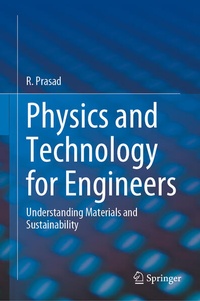
Physics and Technology for Engineers
Description

This textbook covers the physics of engineering materials and the latest technologies used in modern engineering projects. It has been designed for use as a reference book and course material for undergraduate engineering students. The book was born out of the need for a comprehensive, balanced, and up-to-date guide for teaching physics to beginning undergraduate engineering students and creating examination papers for technical boards and institutes. The text is divided into ten chapters, each with its specific objectives and features. The topics covered include the classification of engineering materials, atomic structure, electrical and magnetic behavior of solids, quantum mechanics, laser technology, nanomaterials, and sustainable development.
Authored by a physicist with over 40 years of teaching experience, this richly-illustrated textbook features an abundance of self-assessment questions, solved examples, and a variety of chapter-end questions with detailed answers. The textbook starts from the very basics and is developed to the desired level, thus making it ideal as standalone course material.
More details
Other editions
Additional editions
Person
R. Prasad is an emeritus professor of physics, formerly Dean of the Faculty of Science and Chairman of the Department of Physics, Aligarh Muslim University (AMU), India. He has more than 40 years of experience teaching nuclear physics, thermal physics, and electronics to upper-level university students. He has supervised around a dozen Ph.D thesises and has published more than 100 peer-reviewed research papers in renowned international journals and is author of several books spanning the disciplines of classical, quantum, thermal and nuclear physics.
Content
Chapter 1. Engineering Materials, Atomic Structure and Bounding.- Chapter 2. Electrical behaviour of condensed matter.- Chapter 3. Magnetic materials.- Chapter 4. X-rays, Dual nature of Matter, Failure of Classical Physics and Success of quantum approach.- Chapter 5. Introduction to Quantum Mechanics.- Chapter 6. Quantum Statistics.- Chapter 7. Optical Fiber Communication.- Chapter 8. Laser Technology and its Applications.- Chapter 9. Nanomaterials.- Chapter 10. Sustainability and Sustainable energy options.
