

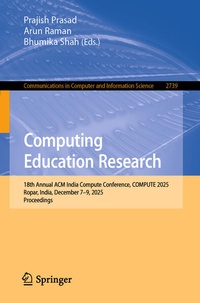
Computing Education Research
Description

This book constitutes the refereed proceedings of the 18th Annual ACM India Compute Conference on COMPUTE 2025, held in Ropar, India, during December 7-9, 2025.
The 12 full papers and 5 short papers included in this book were carefully reviewed and selected from 79 submissions. They were organized in topical sections as follows: AI and Responsible Computing in Education; Pedagogical Innovations and Interdisciplinary Approaches; Accessibility, Inclusion, and Equity in CS Education; and Tools and Interventions for Core Computing Concepts.
More details
Other editions
Additional editions
Content
.- AI and Responsible Computing in Education
.- Teaching Explainable Machine Learning to Interdisciplinary Learners: A Pedagogical Model for Responsible AI Education.
.- Kaushalya AI: Understanding Computational Skills Progression and Overlap with other Foundational Skills in Schooling.
.- PustakAI: Curriculum-Aligned and Interactive Textbooks Using Large Language Models.
.- Educators as Creators: Enabling CS Faculty to Build Educational Interventions with Sustainable AI Models.
.- A Novel Fairness Accountability Integrity and Responsibility (FAIR) Model for Holistic Quality Education.
.- AI Ethics Education in India: A Syllabus-Level Review of Computing Courses.
.- Pedagogical Innovations and Interdisciplinary Approaches
.- BOOP: Write Right Code.
.- Teaching Algorithmic Thinking in a Liberal STEM Curriculum: An Experience Report.
.- VedicViz: Towards Visualizing Vedic Principles in Mental Arithmetic.
.- Accessibility, Inclusion, and Equity in CS Education
.- CS Educator challenges and their solutions: A systematic mapping study.
.- Accessibility Beyond Accommodations: A Systematic Redesign of Introduction to Computer Science for Students with Visual Impairments.
.- Scaling Accessibility Education: Reflections from a Workshop Targeting CS Educators and Software Professionals.
.- Tools and Interventions for Core Computing Concepts
.- RA-Viz: An Interactive Relational Algebra Interpreter and Visualization Tool.
.- A Study of Teaching Tools for Parsing.
.- SLIM: A Simplified LLVM IR Abstraction for Compiler Design Courses.
.- CyberNiriksha: Bridging Root Cause Analysis Gaps in Indian Cybersecurity Education through a Progressive Log-Based Learning Environment.
.- Early Results from Teaching Modelling for Software Comprehension in New-Hire Onboarding.
