

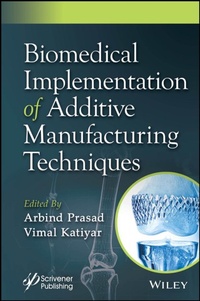
Biomedical Implementation of Additive Manufacturing Techniques
Description

Unlock the potential of the intersection of additive manufacturing and biomedicine with this essential guide, which provides a comprehensive look at the applications, challenges, and industrial advancements of biomaterials for industrial processes.
The sustainability of any process lies in how eco-friendly and economical its products are. Bio-based materials of different origins are emerging as a sustainable option for raw materials for different products with diverse applications. The book highlights the fabrication of implants, scaffolds, and biomedical devices based on naturally sourced biobased materials, with coverage that includes: Emerging biobased composites for orthopedic, soft tissue, and hard tissue engineering; An in-depth study of the latest emerging manufacturing process and resorbable materials for biomedical applications; Biological and degradation studies, along with challenges associated with resorbable implants; Special chapters on artificial organ development through additive manufacturing and their processing; Challenges in additive manufacturing related to processing and cost-effectiveness of resorbable polymeric implants.
Readers will find the volume:
- Focuses on the practical application of 3D printing in medicine, covering areas like implants, prosthetics, drug delivery, and tissue engineering;
- Explores the crucial aspects of materials science and process optimization necessary for successful biomedical additive manufacturing;
- Addresses the growing trend of personalized medicine enabled by patient-specific 3D-printed scaffolds and implants;
- Provides detailed studies on chitosan, PCL, alginate, and cellulose biomaterials as feedstock for additive manufacturing using composites;
- Discusses the challenges and industrial advancements driving the adoption of additive manufacturing in the biomedical sector.
Audience
Academics, practitioners, polymer scientists, biomedical and mechanical engineers, materials scientists, and researchers working in the areas of additive manufacturing in biomedical applications.
More details
Other editions
Additional editions
Persons
Arbind Prasad, PhD is an Assistant Professor and the Head of Mechanical Engineering Department, Katihar Engineering College (Under Department of Science, Technology and?Technical Education, Government of Bihar), Katihar, Bihar, India. He has published 20+ journal articles, 16 books, 48 book chapters, and 15 conference papers. His research spans resorbable polymers, biomaterials, and nanomaterials processing.
Vimal Katiyar, PhD is a Professor in the Chemical Engineering Department at the Indian Institute of Technology, Guwahati, Assam, India. He has published more than 180 articles in reputed international journals, edited six books, and holds 29 patents. His research focuses on nanocomposites and polymerization.
