

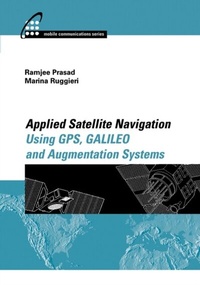
Applied Satellite Navigation Using GPS, GALILEO, and Augmentation Systems
1st Edition
Published on 1. January 2004
298 pages
978-1-58053-815-2 (ISBN)
Description

This authoritative work brings you a timely, unified analysis of the various satellite navigation technologies, applications, and services in operation or development, and of the challenges that lie ahead in this rapidly evolving field. It describes the segments, signal characteristics, performance, and securities aspects of the GPS system, including the advances anticipated in the next-generation GPS-III, and brings you up to speed on the developing European GALILEO system and its innovative characteristics, services, and potential. A look at ground-based and satellite-based augmentation systems (GBAS and SBAS) highlights their performance-improving features and how these systems may serve as connection rings between GPS and future networks like GALILEO.
More details
Other editions
Additional editions
Ramjee Prasad | Marina Ruggieri
Applied Satellite Navigation Using GPS, GALILEO, and Augmentation Systems
Book
05/2005
Artech House Publishers
€104.18
Shipment within 10-20 days
Content
- Applied Satellite Navigation Using GPS, GALILEO, and Augmentation Systems
- Contents vii
- Preface xi
- Acknowledgments xiii
- Chapter 1 Introduction 1
- 1.1 Introduction to Navigation: A Historical Perspective 1
- 1.2 Evolution of Satellite Navigation 4
- 1.3 Preview of the Book 11
- References 12
- Chapter 2 Navigation Basics 15
- 2.1 Coordinate Systems 17
- 2.2 Time Systems 24
- 2.3 Navigation Equations 25
- 2.4 Required Navigation Performance (RNP) 34
- References 35
- Chapter 3 The Global Positioning System 39
- 3.1 Introduction 39
- 3.2 GPS System Architecture 39
- 3.3 GPS Signals 46
- 3.4 Signal Propagation Effects 51
- 3.5 GPS Performance 53
- References 56
- Chapter 4 Augmentation Systems 61
- 4.1 Introduction 61
- 4.2 Integrity Monitoring 62
- 4.3 Differential GPS 65
- 4.4 Satellite-Based Augmentation Systems (SBAS) 70
- 4.5 Ground-Based Augmentation Systems (GBAS) 82
- 4.6 Aircraft-Based Augmentation Systems (ABAS) 84
- References 85
- Chapter 5 GALILEO 91
- 5.1 Introduction 91
- 5.2 The GALILEO Program 92
- 5.3 GALILEO Services 96
- 5.4 The GALILEO System 103
- 5.5 Interoperability 112
- 5.6 Security Aspects 115
- References 116
- Chapter 6 GPS Modernization Toward GPS III 119
- 6.1 Introduction 119
- 6.2 Space Segment Modernization 120
- 6.3 Control Segment Modernization 122
- 6.4 GPS Modernization Signals 122
- 6.5 GPS Modernization Performance and Signal Capabilities 127
- 6.6 GPS III Features 129
- References 131
- Chapter 7 Legal and Market Policy of Satellite Navigation 133
- 7.1 Introduction 133
- 7.2 GPS 135
- 7.3 Augmentation Systems
- 7.4 GALILEO 142
- References 151
- Chapter 8 Layer Issues 153
- 8.1 Introduction 153
- 8.2 Land/Water Layer 154
- 8.3 Air Layer 190
- 8.4 Space Layer 197
- References 202
- Chapter 9 Integration with Existing and Future Systems 209
- 9.1 Introduction 209
- 9.2 Integration with Other Navigation Systems 210
- 9.3 Integration with Communications Systems 233
- References 247
- Chapter 10 Open Issues and Perspectives 253
- 10.1 A Step Ahead for Aviation: The Free Flight 253
- 10.2 HAP-Based Integrated Networks 255
- 10.3 B3G Mobile Networks 257
- 10.4 Digital Divide 259
- 10.5 B2G GNSS 259
- 10.6 Navigation Services Penetration 261
- 10.7 Conclusions 264
- References 264
- List of Acronyms 267
- About the Authors 277
- Index 281
