

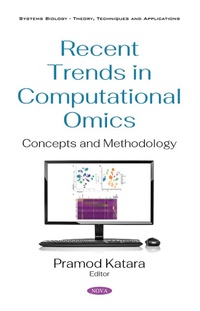
Recent Trends in 'Computational Omics: Concepts and Methodology'
Published on 26. June 2020
478 pages
978-1-5361-7942-2 (ISBN)
Description

The last decade has witnessed various technological advances in life sciences, especially high throughput technologies. These technologies provide a way to perform parallel scientific studies in a very short period of time with low cost. High throughput techniques, mainly, next generation sequencing, microarray and mass spectrometry, have strengthened the omics vision in the last decades (study of complete system) and now resulted in well-developed branches of omics i.e., genomics, transcriptomics, proteomics and metabolomics, which deal with almost every level of central dogma of life. Practice of high throughput techniques throughout the world with different aims and objectives resulted in a voluminous data, which required computational applications, i.e., database, algorithm and software to store, process and get biological interpretation from primary raw data. Researchers from different fields are looking to analyze these raw data for different purposes, but lacking of proper information and knowledge in proper documented form creates different kinds of hurdles and raises the challenges. This book contains thirteen chapters that deal with different computational biology/bioinformatics resources and concepts which are already in practice by the scientific community or can be utilized to handle various aspects of different classes of omics data. It includes different computational concepts, algorithm, resources and recent trends belonging to the four major branches of omics (i.e., genomics, transcriptomics, proteomics and metabolomics), including integrative omics. It will help all scholars who are working in any branch of computational omics and bioinformatics field as well as those who would like to perform research at a systemic biology through computational approaches.
More details
Other editions
Additional editions
Book
07/2020
Nova Science Publishers Inc
€303.55
Shipment within 15-20 days
Content
- Intro
- Contents
- Preface
- Chapter 1
- Integrative Omics: Current Status and Future Directions
- Abstract
- 1. Introduction
- 1.1. Omics
- 1.1.1. Genomics
- 1.1.2. Transcriptomics
- 1.1.3. Proteomics
- 1.1.4. Metabolomics
- 2. From Omics to Multi/Integrative Omics
- 2.1. First Step Towards Multi-Omics
- 2.2. Integrative Omics
- 2.3. Potential of Integrative Omics
- 3. Integration of Multi-Omics Data Resources
- 4. Data Mining for Omics Data
- 5. Data Mining Techniques
- 5.1. Data Mining Language/Tools
- 5.1.1. R-Language: As a Data Mining Tool
- 5.1.2. Weka
- 6. Integrative Data Mining Challenges and Opportunities
- 6.1. Bioinformatics Challenges
- 6.2. Data Challenges
- 7. Future Direction
- 7.1. Artificial Intelligence
- 7.1.1. Machine Learning
- 7.1.2. Deep Learning
- 7.1.3. Data Dependencies
- 7.1.4. Feature Learning
- 7.1.5. Problem-Solving Approach
- 7.2. Big Data Analytics
- 7.2.1. Big Data Analytics Technologies and Tools
- Conclusion
- Conflict of Interest
- References
- Chapter 2
- Database Resources for Computational Omics
- Abstract
- Introduction
- Human Health/Disease Related Omic Databases
- Kyoto Encyclopedia of Genes and Genomes (KEGG)
- Human Metabolome Database (HMDB)
- Small Molecule Pathway database (SMPDB)
- WikiPathways
- Proteomics Identifications Database (PRIDE)
- Human Ethnic and Region Specific Omics Database (HEROD)
- Cardiovascular Disease Database (C/VDdb)
- LinkedOmics
- Multi-Omics Breast Cancer Database (MOBCdb)
- Pancreatic Cancer Database (PCD)
- Lnc2Cancer
- Crops/Plants Related Omic Databases
- OryzaExpress
- RiceSRTFDB
- TAIR Database
- PhosPhAt
- MCENet
- MODEM
- GourdBase
- TOMATOMICS
- Cotton Functional Genomics Database (CottonFGD)
- Gramene Database
- CoP
- GabiPD
- SoyFN
- UniVIO
- Other Omic Databases
- BioCyc
- Integrated Microbial Genomes (IMG) System
- KaPPA-View4
- CyanOmics
- The CyberCell Database (CCDB)
- Chinese Hamester Genome Database
- Yeast Metabolome Database (YMDB)
- PATRIC
- Central Carbon Metabolic Flux Database (CeCaFDB)
- Ciona Intestinalis Protein Database (CIPRO)
- Newt-Omics
- Conclusion
- Conflict of Interest
- Acknowledgments
- References
- Chapter 3
- Algorithms in Bioinformatics
- Abstract
- Introduction
- Algorithm Basics and Mechanisms
- Definition
- Types of Algorithms Often Used in Bioinformatics
- Combinatorial Pattern Matching
- Machine Learning
- Dynamic Programming Algorithms
- Divide and Conquer Algorithms
- Clustering Algorithms
- Randomized Algorithms
- Exhaustive Searching or Brute-Force Algorithms
- Greedy Algorithms
- Graph Algorithms
- Hidden Markov Models
- Branch and Bound Algorithm
- Conclusion
- Conflict of Interest
- References
- Chapter 4
- Recent Trends in 'Computational Transcriptomics'
- Abstract
- 1. Introduction
- 2. cDNA Microarray Technology
- 2.1. Representation of Gene Expression Data
- 2.2. Microarray Database
- 2.3. Microarray Data Analysis
- 2.3.1. Data Preprocessing and Normalization (Quality Control)
- 2.3.2. Differential Gene Expression
- 3. RNA-Seq
- 3.1. RNA-Seq Database
- 3.1.1. Sequence Retrieval Archives (SRA)
- 3.2. RNA-Seq Pipeline
- 3.3. RNA-Seq Data Analysis
- 3.3.1. Data Preprocessing
- 3.3.2. Read Mapping
- 3.3.2.1. Challenges and Possible Solution
- 3.3.3. Quantification
- 3.3.3.1. Challenges and Possible Solution
- 3.3.4. Normalization
- 3.3.5. Differential Gene Expression
- 4. Clustering
- 4.1. Clustering for Transcriptome Analysis
- 5. Computational Transcriptomics through Bioconductor
- 6. Scope of Transcriptomics
- 7. cDNA Microarray versus RNA-Seq
- 8. Selection of Technique for Transcriptome Analysis
- Conclusion
- Conflict of Interest
- References
- Chapter 5
- Single-Cell RNA Sequencing Technologies and Computational Analysis
- Abstract
- 1. Introduction
- 2. Isolation of Single-Cells
- 3. Single-Cell Sequencing Technologies
- 4. Computational Pipeline to Analyze scRNA-seq Data
- 4.1. Quality Control and Filtering of the Data
- 4.2. Normalization of Data
- 4.3. Correcting for Confounding Factors
- 4.4. Batch Effects Correction and Data Integration in scRNA-seq Data
- 4.5. Feature Selection
- 4.6. Dimensionality Reduction
- 4.7. Clustering of the scRNA-seq Data
- 4.8. Cluster Annotation
- 4.9. Trajectory Inference
- 5. Applications of scRNA-seq
- Conclusion and Outlook
- Conflict of Interest
- References
- Chapter 6
- Computational Analysis of Metabol(om)ic Networks
- Abstract
- Introduction
- Metabolic Network Modelling and Analysis
- Top-Down Approach
- Bottom-Up Approach
- Databases, Tools and Resources for Metabolomics
- Metabolic Networks as Graphs
- Chemical Graphs
- Metabolic Pathways as a Graph
- Mathematical Representations
- Adjacency Matrix
- Stoichiometric Matrix
- The Elemental Space
- The Fundamental features of Stoichiometric matrix
- The Stoichiometric Matrix as a Connectivity Matrix
- Reaction Maps, Open and Closed Networks
- The Stoichiometry of Metabolites
- Pathway Analysis
- Metabolic Fluxes for Drug Target Identification
- Metabolic Control Analysis (MCA)
- Drug Target Identification Using MCA
- Differential Control Analysis for Drug Selectivity
- Cancer Control
- Metabol(om)ic Networks
- The Signalling and Gene Regulatory Space
- Gene-Protein-Reaction-Metabolite Association Network
- The Future of Computation and Metabolomics
- Conflict of Interest
- Acknowledgments
- References
- Chapter 7
- Immuno-Informatics: Computational Trends in Immuno-Oncogenomics
- Abstract
- 1. Introduction
- 1.1. Introduction to Cancer Immunotherapy and Concepts
- 1.2. Informatics in Cancer
- 1.2.1. Sample Heterogeneity
- 1.2.2. Somatic Mutation Calling
- 1.2.3. Annotation
- 1.2.4. Mutational Signatures
- 1.2.5. Molecular Subtypes
- 1.2.6. Pathway Analysis
- 1.3. Immuno-Informatics
- 1.3.1. HLA Typing
- 1.3.2. Prediction of Epitopes
- 1.3.3. Sample Heterogeneity
- 1.3.4. Pathway Analysis
- 1.3.5. Adaptive Immune Receptor Repertoire Sequencing
- 1.4. Interactions between Cancer and the Immune System
- 1.4.1. Cancer Antigens
- 1.4.2. Tumor-Intrinsic Immune Escape
- 1.4.3. Local Immune Response
- 1.4.4. Tumor-Extrinsic Immune Escape
- 1.4.5. Systemic Immune Response
- 2. Data Sources
- 2.1. Cancer Databases
- 2.2. Cancer Immunology Related Databases and Web Servers
- 2.3. Epitope Databases
- 3. Tools
- 4. Discussion
- Conflict of Interest
- Acknowledgement
- References
- Chapter 8
- OMICS in Cancer: From Diagnostics
- to Therapeutics
- Abstract
- Introduction
- Genomics
- Therapeutic Approach Using Genomics
- Whole Genome Sequencing
- Identifying Therapeutic Targets
- Genome Instability
- Pharmacogenomics
- Cancer Immunology
- Epigenomics
- Therapeutic Approach Using Epigenomics
- Transcriptomics
- Microarray
- Gene-Chip Microarray
- RNA-Seq
- Therapeutic Approach Using Transcriptomics
- Lipidomics
- Therapeutic Approach Using Lipidomics
- Proteomics
- Conclusion
- References
- Chapter 9
- Role of Network Biology in Cancer Research
- Abstract
- 1. Introduction
- 2. Cancer Biomarkers
- 3. Biological Networks
- 3.1. Protein-protein Interaction Network
- 3.2. Gene Regulatory Network
- 3.3. Gene Co-expression Network
- 3.4. Metabolic Network
- 4. Properties of a Biological Network and Their Significance
- 4.1. Degree and Degree Distribution
- 4.2. Scale-free Network, Hubs and Their Attributes
- 4.3. Clustering Coefficients and Module
- 4.4. Shortest and Average Path Lengths
- 4.5. Diameter
- 4.6. Betweenness Centrality and Bottleneck
- 4.7. Network Density
- 5. Different Levels of Omics Data
- 6. Bioinformatics Resources (Databases, Software and Web Servers) for Cancer Research
- 6.1. Cancer Specific Gene/Protein/Mirna Interaction Databases
- 6.2. Other Protein-Protein and Protein-Chemical Interaction Databases Used for Cancer Research
- 6.3. Tools and Software for Network Construction, Visualization and Analysis
- 7. Challenges of Network-Based Biomarker Discovery
- Conclusion
- Conflict of Interest
- Acknowledgments
- References
- Chapter 10
- Bioinformatics Resources for the Prediction of Cancer Prognosis and Its Recurrence
- Abstract
- Introduction
- Artificial Intelligence
- Role of Artificial Intelligence in the Development of Computational Tools and Algorithms for Cancer Prognosis and Its Recurrence
- Machine Learning, Deep Learning and Neural Networks
- Tools for Cancer Prediction
- Pegasus and Other Gene Fusion Prediction Tools
- PREDICT (www.predict.nhs.uk/)
- CancerMath (www.lifemath.net/cancer/breastcancer/therapy/)
- Neoadjuvant Therapy Outcomes Tool
- The Breast Cancer Risk Assessment Tool (BCRAT, bcrisktool.cancer.gov/)
- NeoMutate (omictools.com/neomutate-tool)
- MutSigCV
- DrGap (omictools.com/drgap-tool)
- ACPred (server.malab.cn/ACPred-FL/)
- Outdated Tools
- CanPredict (omictools.com/canpredict-tool)
- Algorithms for Cancer Prediction
- Breast and Ovarian Analysis of Disease Incidence and Carrier Estimation Algorithm (BOADICEA) Models
- DeepSurv (pypi.org/project/deepsurv/)
- DriverML (github.com/HelloYiHan/DriverML)
- IntOGen Mutation (www.intogen.org/search)
- Tools for Cancer Recurrence
- CTS5 (www.cts5-calculator.com/)
- Adjuvant! (www.adjuvantonline.com)
- Oncotype DX recurrence scoring tools (online.genomichealth.com/Login.aspx)
- CORE (rdrr.io/cran/CORE/man/CORE.html)
- Algorithms for Cancer Recurrence
- RECUR algorithm (www.ncbi.nlm.nih.gov/pmc/articles/ PMC4732933/)
- Conclusion
- Conflict of Interest
- Acknowledgment
- References
- Chapter 11
- Computational Metagenomics: Current Status and Challenges
- Abstract
- Introduction
- Next Generation Sequencing (NGS) Methods
- Illumina Sequencing Technology
- Roche 454 Sequencing
- Ion Torrent Platform
- PacBio Sequencing
- Oxford Nanopore Technologies
- Evaluation of Sequencing Libraries and Quality Check
- Taxonomic Classification
- Taxonomic Binning
- Metagenomic Assembly
- Gene Prediction and Function Assignment
- Metabolic Pathway Reconstruction
- Metagenomics Data Analysis Pipeline
- Microbial Genome Resources
- Conclusion
- References
- Chapter 12
- Integrated Omics for Dissecting Host-Pathogen Interaction: Challenges and Opportunities
- Abstract
- Introduction
- Approaches for Generation of Multi-Omics Data with Respect to Host-Pathogen Interaction
- Genomics
- Transcriptomics
- Proteomics
- Metabolomics
- Other Omics Approches
- Data Types for Integrated Omics
- Genetic Variation
- Epigenetics
- Gene Expression
- Proteomics and Metabolomics
- Microbiome
- Opportunities in Integrated Omics Approches for Dissecting Host-Pathogen Interaction
- Genome and Transcriptome Assembly
- Gene Expression Data Analysis
- Gene Set Enrichment Analysis
- Pathway Modeling and Simulation
- Metabolic Flux Analysis
- Network Generation and Analysis
- Protein Modeling
- Molecular Docking
- Pharmacokinetics and Pharmacodynamics
- Molecular Dynamics Simulation
- Computational Resources for Integrated Omics
- Development of Databases for Storage of Big Data
- Development of Tools for Integration of Multi-Omics Data
- Challenges in Integrated Omics
- Data Issues
- Biological Knowledge
- Individual Omics Data Sets
- Integration Issues
- Experimental Challenges
- Future Outlook
- Conclusion
- References
- Chapter 13
- Development and Analysis of Simple Sequence Repeats in Chloroplast Genomes of Genus Saccharum: A Computational Study
- Abstract
- Introduction
- Data and Methodes
- Mining of SSRs in Chloroplast Genomes of Genus Saccharum
- Identification of Common, Polymorphic, and Unique SSRs
- Results
- Frequency and Distribution of cpSSRs in Genus Saccharum
- Common, Polymorphic, and Unique cpSSRs
- Conclusion
- Acknowledgment
- References
- About the Editor
- Index
- Blank Page
