

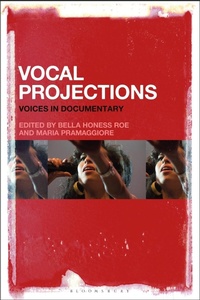
Vocal Projections
Voices in Documentary
1st Edition
Published on 18. October 2018
320 pages
978-1-5013-3127-5 (ISBN)
Description

Vocal Projections: Voices in Documentary examines a previously neglected topic in the field of documentary studies: the political, aesthetic, and affective functions that voices assume. On topics ranging from the celebrity voice over to ventriloquism, from rockumentary screams to feminist vocal politics, these essays demonstrate myriad ways in which voices make documentary meaning beyond their expository, evidentiary and authenticating functions.
The international range of contributors offers an innovative approach to the issues relating to voices in documentary. While taking account of the existing paradigm in documentary studies pioneered by Bill Nichols, in which voice is equated with political rhetoric and subjective representation, the contributors move into new territory, addressing current and emerging research in voice, sound, music and posthumanist studies.
The international range of contributors offers an innovative approach to the issues relating to voices in documentary. While taking account of the existing paradigm in documentary studies pioneered by Bill Nichols, in which voice is equated with political rhetoric and subjective representation, the contributors move into new territory, addressing current and emerging research in voice, sound, music and posthumanist studies.
Reviews / Votes
A book that performs a double and much needed breakthrough. It manages to transfer much of the cutting research in fiction cinema to the field of documentary film. But it also succeeds in making room for a type of reading that gives priority to the materiality of the voice ... [there is] great diversity of the topics under scrutiny ... systematic articulation of specific analyses and broader theoretical schemes and patterns ... [and] careful close-reading of the chosen movies, which are not only judiciously described (quite an achievement in the case of a work in print that is not accompanied by oral documents) but also patiently examined so that the limits of traditional ways of analyzing voice and sound become clear. * Leonardo Reviews * A timely introduction to brave new waves of thinking about the documentary tongues and tones that tune our listening. * Jonathan Kahana, author of Intelligence Work: The Politics of American Documentary (2008) and editor of The Documentary Film Reader: History, Theory, Criticism (2016) * The plurality of voices contributing to this extraordinary and much needed volume is nothing short of inspiring. Extending and in many cases upending Bill Nichols' association between voice and rhetoric, the essays in this book propose entirely new paradigms through which to think about the qualities and implications of the voice-linguistic and non-linguistic, human and otherwise-in documentary. The range of issues raised and perspectives developed here on the subject of the voice in documentary will echo for years to come. * Alisa Lebow, Reader in Film Studies, University of Sussex, UK * At a moment when documentary forms abound, not only in cinema, but television, contemporary art, and social media, Vocal Projections offers an important and much needed reflection on the voice in documentary. Against the authoritative, voice-of-God narration and logocentrism of conventional documentary-where the voice is merely the vehicle for meaning and information-the wide-ranging essays in this collection consider its sonic, textural, and often prelinguistic manifestations across media and national contexts. The many voices examined here are anything but straightforward: they slip and sound, often destabilizing the images to which they are attached. Throughout, the contributors maintain a keen ear for vocal resonances in places where they have not been typically heard. * Genevieve Yue, Assistant Professor of Culture and Media, The New School, USA *More details
Edition
1. Auflage
Language
English
Place of publication
New York
United States
Publishing group
Bloomsbury Publishing PLC (Digital)
Target group
Professional and scholarly
Illustrations
20 bw illus
ISBN-13
978-1-5013-3127-5 (9781501331275)
Copyright in bibliographic data and cover images is held by Nielsen Book Services Limited or by the publishers or by their respective licensors: all rights reserved.
Schweitzer Classification
Other editions
Additional editions
Book
10/2018
Bloomsbury Academic USA
€178.27
Shipment within 15-20 days
Persons
Maria Pramaggiore is Head of Media Studies at the National University of Ireland at Maynooth. She has published four books, two on Irish cinema, and one a co-authored textbook, Film: A Critical Introduction (2011; with Tom Wallis), now in its third edition.
Bella Honess Roe is a lecturer at the University of Surrey, UK, where she is the programme director for Film Studies. Her scholarship and teaching focuses on animation, documentary and popular culture more broadly. She is the author of Animated Documentary (2013). Her work on animation, documentary, genre and British cinema appears in publications such as The Journal of British Cinema and Television and Animation: An Interdisciplinary Journal.
Bella Honess Roe is a lecturer at the University of Surrey, UK, where she is the programme director for Film Studies. Her scholarship and teaching focuses on animation, documentary and popular culture more broadly. She is the author of Animated Documentary (2013). Her work on animation, documentary, genre and British cinema appears in publications such as The Journal of British Cinema and Television and Animation: An Interdisciplinary Journal.
Content
I. Voices, Bodies and Power
1.Playing God: Film stars as documentary narrators
Annabelle Honess Roe
2.Auditing the Call Centre Voice: Accented Speech and Listening in Sonali Gulati's Nalini by Day, Nancy by Night (2005)
Pooja Rangan
3.The Fundamental Lie: Lip Sync, Dubbing, Ventriloquism and the Othering of Voice in Documentary Media
Patrik Sjoeberg
II. Voices Beyond Language
4.Hearing Voices in Singer-Songwriter Music Documentaries
Maria Pramaggiore
5.'The Voice' and Sound in Indian Documentary Film: Listen to Surabhi Sharma's Bidesia in Bambai (2013)
Deborah Matzner
6.Hum, Buzz, Gurgle: Ecological Soundscapes in Poetic Ecodocs
Shilyh Warren
7.Literally Documenting her Voice: Valie Export's Vocal-Visual Experiments with Screen Media
Helen Hughes
III. Gender, Sexuality and Species
8.The Voice of Mockumentary
Sarah Kessler
9.Fabulous Thinking, Chimeric Voice: Kathy High's Lily Does Derrida: A Dog's Video (2010)
Brenda Hollweg
10.Animating Voices, Onscreen and Off, in Kathleen Shannon's Working Mothers (1974-5)
Jean Walton
IV. Documentary Modes and Techniques
11.The Voice in Documentary Sound Design: A Digital Revolution
Chris Cagle
12.Kazuhiro Soda's Migrant Voices
Luke Robinson
13.Vocal Hierarchy in Documentary
James Nicholson
V. Time, Testimony and History
14.Crime Documentary's Confessing Voice.
Kristen Fuhs
15.Sounds of Disillusionment and Discord: When Pasolini and Sontag Visited Israel
Ohad Landesman
16.Beyond Words: Speech, Ethical Time and the Politics of the Local in Nicholas Philibert's Retour en Normandie (2007)
Rhiannon Harries
1.Playing God: Film stars as documentary narrators
Annabelle Honess Roe
2.Auditing the Call Centre Voice: Accented Speech and Listening in Sonali Gulati's Nalini by Day, Nancy by Night (2005)
Pooja Rangan
3.The Fundamental Lie: Lip Sync, Dubbing, Ventriloquism and the Othering of Voice in Documentary Media
Patrik Sjoeberg
II. Voices Beyond Language
4.Hearing Voices in Singer-Songwriter Music Documentaries
Maria Pramaggiore
5.'The Voice' and Sound in Indian Documentary Film: Listen to Surabhi Sharma's Bidesia in Bambai (2013)
Deborah Matzner
6.Hum, Buzz, Gurgle: Ecological Soundscapes in Poetic Ecodocs
Shilyh Warren
7.Literally Documenting her Voice: Valie Export's Vocal-Visual Experiments with Screen Media
Helen Hughes
III. Gender, Sexuality and Species
8.The Voice of Mockumentary
Sarah Kessler
9.Fabulous Thinking, Chimeric Voice: Kathy High's Lily Does Derrida: A Dog's Video (2010)
Brenda Hollweg
10.Animating Voices, Onscreen and Off, in Kathleen Shannon's Working Mothers (1974-5)
Jean Walton
IV. Documentary Modes and Techniques
11.The Voice in Documentary Sound Design: A Digital Revolution
Chris Cagle
12.Kazuhiro Soda's Migrant Voices
Luke Robinson
13.Vocal Hierarchy in Documentary
James Nicholson
V. Time, Testimony and History
14.Crime Documentary's Confessing Voice.
Kristen Fuhs
15.Sounds of Disillusionment and Discord: When Pasolini and Sontag Visited Israel
Ohad Landesman
16.Beyond Words: Speech, Ethical Time and the Politics of the Local in Nicholas Philibert's Retour en Normandie (2007)
Rhiannon Harries
