

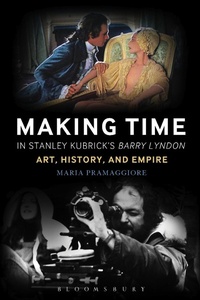
Making Time in Stanley Kubrick's Barry Lyndon
Art, History, and Empire
1st Edition
Published on 18. December 2014
224 pages
978-1-4411-4741-7 (ISBN)
Description

Considered by critics to be Stanley Kubrick's masterpiece, Barry Lyndon has suffered from scholarly and popular neglect. Maria Pramaggiore argues that one key reason that this film remains unappreciated, even by Kubrick aficionados, is that its transnational and intermedial contexts have not been fully explored. Taking a novel approach, she looks at the film from a transnational perspective -- as a foreign production shot in Ireland and an adaptation of a British novel by an American director about an Irish subject. Pramaggiore argues that, in Barry Lyndon, Kubrick develops his richest philosophical mediation on cinema's capacity to mediate the real and foregrounds film's relationship to other technologies of visuality, including painting, photography, and digital media.
By combining extensive research into the film's source novel, production and reception with systematic textual analysis and an engagement with several key issues in contemporary academic debate, this work promises not only to make a huge impact in the field of Kubrick studies, but also in 1970s filmmaking, cultural history and transnational film practice.
By combining extensive research into the film's source novel, production and reception with systematic textual analysis and an engagement with several key issues in contemporary academic debate, this work promises not only to make a huge impact in the field of Kubrick studies, but also in 1970s filmmaking, cultural history and transnational film practice.
Reviews / Votes
The book brings together a breadth of scholarship and an innovative reading of the film to offer new insights ... [which] will benefit and inspire serious scholars in their research. * Historical Journal of Film, Radio and Television * Not only a welcome addition to the already bountiful field of Kubrick studies; it is also the sole monograph specifically addressing Barry Lyndon ... The publication is also a demonstration of the value of taking a wide-ranging approach to film research; it explicates in a clear and practical way how different perspectives and methodologies can be integrated to build a provocative and challenging analysis. The great strength of the book is the way the author weaves a web or network of interrelated elements-history, novel, biography, culture, colonialism, identity, gender. * Alphaville: Journal of Film and Screen Media * A significant contribution to the Kubrick literature. Impeccably researched and eminently readable, Pramaggiore's book gives Barry Lyndon the full and detailed attention it deserves. * Robert Kolker, Emeritus Professor of English, University of Maryland, USA, and author of A Cinema of Loneliness, The Altering Eye, and The Cultures of American Film * A serious piece of academic study giving in-depth analysis of a film which has rarely been given this level of (well deserved attention). Both intensive and expansive, full of interesting commentary and analysis, this book highlights unconsidered aspects of the film, showing Barry Lyndon to be on a par with Kubrick's other films-a thoughtful, philosophical film, rather than just a series of pretty pictures. * Richard Daniels, Stanley Kubrick Archivist, University of the Arts London, UK * The critical promise that imbues this book-to make time as visible as the shape of the frame or the colors of the tableau-is brilliantly fulfilled in this superb work. A breakthrough in film analysis, and in the study of Stanley Kubrick. * Robert Burgoyne, Professor of Film Studies, University of St Andrews, UK, and author of The Hollywood Historical Film * Whilst Pramaggiore is very good at illustrating and discussing the portraits and paintings that might have inspired Kubrick's compositions, she appreciates more importantly what is behind these civilised surfaces, and how Kubrick, like Thackeray in his novel, is delivering a lethal critique of social hierarchy and hypocrisy ... Forty years on, Barry Lyndon, she proposes, 'still has something important to say about image-making, culture and power.' Over the book's succeeding pages, she proceeds to demonstrate that importance with eloquence and authority * www.neilsinyard.britishtelevisiondrama.org.uk * Based on research carried out at the Stanley Kubrick Archive at London College of Communication, Making Time is important because it is the only monograph specifically focused upon Barry Lyndon. The publication is also a demonstration of the value of taking a wide-ranging approach to film research; it explicates in a clear and practical way how different perspectives and methodologies can be integrated to build a provocative and challenging analysis. The great strength of the book is the way the author weaves a web or network of interrelated elements-history, novel, biography, culture, colonialism, identity, gender-which together make up Barry Lyndon. * Alphaville *More details
Edition
1. Auflage
Language
English
Place of publication
New York
United States
Publishing group
Bloomsbury Publishing PLC (Digital)
Illustrations
30 illus
ISBN-13
978-1-4411-4741-7 (9781441147417)
Copyright in bibliographic data and cover images is held by Nielsen Book Services Limited or by the publishers or by their respective licensors: all rights reserved.
Schweitzer Classification
Other editions
Additional editions
Book
02/2015
Bloomsbury Academic USA
€44.50
Shipment within 15-20 days
Book
02/2015
Bloomsbury Academic USA
€134.20
Shipment within 15-20 days
Person
Maria Pramaggiore is Head of Media Studies at the National University of Ireland at Maynooth. She has published four books, two on Irish cinema, and one a co-authored textbook, Film: A Critical Introduction (2011; with Tom Wallis), now in its third edition.
Content
Acknowledgements
Introduction
Chapter One: Barry Lyndon and Aesthetic Time
Chapter Two: Adapting Barry Lyndon: A Tale of Two Auteurs
Chapter Three: Paternal Crisis, or: History as Succession
Chapter Four: Transnational Topographies: Barry Lyndon as Irish Odyssey
Chapter Five: The Rhythm and the Rest: Painting, Cinema, Stillness
Chapter Six: Untimely Cinema: Barry Lyndon and the 1970s
Bibliography
Index
Introduction
Chapter One: Barry Lyndon and Aesthetic Time
Chapter Two: Adapting Barry Lyndon: A Tale of Two Auteurs
Chapter Three: Paternal Crisis, or: History as Succession
Chapter Four: Transnational Topographies: Barry Lyndon as Irish Odyssey
Chapter Five: The Rhythm and the Rest: Painting, Cinema, Stillness
Chapter Six: Untimely Cinema: Barry Lyndon and the 1970s
Bibliography
Index
