

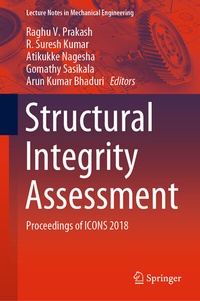
Structural Integrity Assessment
Description

This volume contains selected papers from the Second Quadrennial International Conference on Structural Integrity (ICONS-2018). The papers cover important topics related to structural integrity of critical installations, such as power plants, aircrafts, spacecrafts, defense and civilian components. The focus is on assuring safety of operations with high levels of reliability and structural integrity. This volume will be of interest to plant operators working with safety critical equipment, engineering solution providers, software professionals working on engineering analysis, as well as academics working in the area.
More details
Other editions
Additional editions
Persons
Raghu Prakash
is a Professor in the Department of Mechanical Engineering, Indian Institute of Technology Madras (IIT Madras) where he specializes in new product design and the assessment of structural integrity and remaining life prediction of critical components used in transportation and energy sectors. He has developed test systems for use in academia, R&D and industry during his tenure as Technical Director at BiSS Research, Bangalore and teaches courses relating to product design and structural integrity assessment at IIT Madras. He serves in the editorial boards of multiple journals including the Journal of Structural Longevity, Frattura ed Integrità Strutturale (IGF Journal), Journal of Life Cycle Reliability and Safety Engineering, and is a member of several technical societies. He has won several prestigious awards and recognition for his work, including the Binani Gold Medal (Indian Institute of Metals).
Suresh Kumar R . is currently affiliated with the Indira Gandhi Centre For Atomic Research (IGCAR). His research focuses on the theoretical and experimental aspects of structural integrity assessment and life extension of power plants. He has received his Bachelor's in Mechanical Engineering from Kerala University and Master's from the Department of Applied Mechanics, Indian Institute of Technology Madras, Chennai. He is a life time member of several technical societies, and is a recipient of numerous awards including the DAE Scientific and Technical Excellence Award (2013).
A. Nagesha currently heads the Fatigue Studies Section in the Metallurgy and Materials Group at IGCAR and is an Associate Professor in the Homi Bhabha National Institute. Dr Nagesha published more than 80 papers in journals and conference proceedings. He received the DAE Science and Technology Excellence award for his contributions to understanding the thermomechanical fatigue and creep-fatigue interaction behavior of reactor structural materials, as well as for his contribution towards the development of India-specific reduced activation ferritic-martensitic (IN-RAFM) steel and nitrogen-enhanced 316LN SS for reactor applications.
G. Sasikala is currently the Head of the Materials Development and Technology Division at IGCAR and a Professor in the Homi Bhabha National Institute, Mumbai. Prof Sasikala's research interests lie in understanding deformation, damage and fracture under creep and fatigue, fracture mechanics, fatigue crack growth, creep crack growth. She has published more than 230 research articles in reputed journals and proceedings, 7 chapters to edited books, and edited two books. She is a life member of several professional societies, and has served as an editor of Transactions of the Indian Institute of Metals and has been recognized for her outstanding contributions as a reviewer to several international journals.
Arun Kumar Bhaduri is the Director of IGCAR and a senior Professor at Homi Bhabha National Institute. He pilots the design and technology development of sodium-cooled fast reactors and its associated fuel cycle for the second stage of India's nuclear power programme, and anchors the development of materials and their fabrication technologies for Indian programmes on sodium-cooled fast reactors, fusion reactors and advanced ultra-supercritical thermal power. He specializes in the field of materials joining, and has published more than 650 research articles in reputed journals and conferences and holds 2 international patents. He has received numerous awards and recognitions, including the Jaeger Lecture Award (International Institute of Welding), the GD Birla Gold Medal (Indian Institute of Metals); Carl von Bach Commemorative Medal (MPA University of Stuttgart, Germany) and the Metallurgist of the Year Award (Ministry of Steel, Government of India).
