

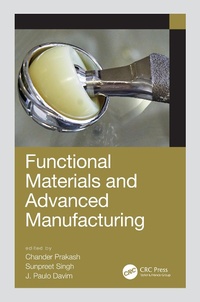
Functional Materials and Advanced Manufacturing
3-Volume Set
1st Edition
Published on 6. January 2021
680 pages
978-1-000-19320-6 (ISBN)
Description

This three-volume set addresses a new knowledge of function materials, their processing, and their characterizations. "Functional and Smart Materials", covered the synthesis and fabrication route of functional and smart materials for universal applications such as material science, mechanical engineering, manufacturing, metrology, nanotechnology, physics, chemical, biology, chemistry, civil engineering, and food science. "Advanced Manufacturing and Processing Technology" covers the advanced manufacturing technologies includes coating, deposition, cladding, nanotechnology, surface finishing, precision machining, processing, and emerging advanced manufacturing technologies for processing of materials for functional applications. "Characterization, Testing, Measurement and Metrology" covered the application of new and advanced characterization techniques to investigate and analysis the processed materials.
More details
Series
Edition
1. Auflage
Language
English
Place of publication
London
United Kingdom
Publishing group
Taylor & Francis Ltd
Target group
Professional and scholarly
Illustrations
87 Tables, black and white; 350 Illustrations, black and white
ISBN-13
978-1-000-19320-6 (9781000193206)
Copyright in bibliographic data and cover images is held by Nielsen Book Services Limited or by the publishers or by their respective licensors: all rights reserved.
Schweitzer Classification
Other editions
Additional editions
Chander Prakash | Sunpreet Singh | J. Paulo Davim
Functional Materials and Advanced Manufacturing
3-Volume Set
Book
10/2024
1st Edition
CRC Press
€252.51
Shipment within 15-20 days
Chander Prakash | Sunpreet Singh | J. Paulo Davim
Functional Materials and Advanced Manufacturing
3-Volume Set
Book
10/2020
1st Edition
CRC Press
€730.41
Shipment within 15-20 days
Persons
Chander Prakash is Associate Professor in the School of Mechanical Engineering, Lovely Professional University, Jalandhar, India. He has received Ph.D in Mechanical Engineering from Panjab University, Chandigarh, India. His area of research is biomaterials, rapid prototyping & 3-D printing, advanced manufacturing, modeling, simulation, and optimization. He has more than 11 years of teaching experience and 6 years research experience. He has contributed extensively to the world in the Titanium and Magnesium based implant literature with publications appearing in Surface and Coating Technology, Materials and Manufacturing Processes, Journal of Materials Engineering and Performance, Journal of Mechanical Science and Technology, Nanoscience and Nanotechnology Letters, Proceedings of the Institution of Mechanical Engineers, Part B: Journal of Engineering Manufacture. He authored 100 research papers and 20 book chapters. He is also editor of 10 Book: " Bio-manufacturing", Springer Series in Advanced Manufacturing, Springer International Publishing AG, Gewerbestrasse 11, 6330 Cham, Switzerland., Dec. 2018; "3D Printing in Biomedical Engineering", Book series Materials Horizons: From Nature to Nanomaterials, Springer International Publishing AG, Gewerbestrasse 11, 6330 Cham, Switzerland., August 2019, and "Biomaterials in Orthopaedics and Bone Regeneration - Design and Synthesis", Book series Materials Horizons: From Nature to Nanomaterials, Springer International Publishing AG, Gewerbestrasse 11, 6330 Cham, Switzerland., March 2019. He is also Guest Editor of 2 Journals: Special Issue on "Metrology in Materials and Advanced Manufacturing", Measurement and Control (SCI indexed) and Serving Guest Editor of Special issue on "Nano-Composites and Smart Materials: Design, Processing, Manufacturing and Applications" of Advanced Composites Letters (Impact Factor 0.559, SAGE).
Sunpreet Singh is researcher in NUS Nanoscience & Nanotechnology Initiative (NUSNNI). He has received Ph.D in Mechanical Engineering from Guru Nanak Dev Engineering College, Ludhiana, India. His area of research is Additive Manufacturing and application of 3D printing for development of new biomaterials for clinical applications. He has contributed extensively in Additive Manufacturing literature with publications appearing in Journal of Manufacturing Processes, Composite Part:B, Rapid Prototyping Journal, Journal of Mechanical Science and Technology, Measurement, International Journal of Advance Manufacturing Technology, and Journal of Cleaner Production. He authored 10 book chapters and monographs. He is working with joint collaboration with Prof. Seeram Ramakrishna, NUS Nanoscience & Nanotechnology Initiative and Prof. Rupinder Singh, Manufacturing Research Lab, GNDEC, Ludhiana. He is also editor of 3 Book: "Current Trends in Bio-manufacturing", Springer Series in Advanced Manufacturing, Springer International Publishing AG, Gewerbestrasse 11, 6330 Cham, Switzerland., Dec. 2018; "3D Printing in Biomedical Engineering", Book series Materials Horizons: From Nature to Nanomaterials, Springer International Publishing AG, Gewerbestrasse 11, 6330 Cham, Switzerland., August 2019, and "Biomaterials in Orthopaedics and Bone Regeneration - Design and Synthesis", Book series Materials Horizons: From Nature to Nanomaterials, Springer International Publishing AG, Gewerbestrasse 11, 6330 Cham, Switzerland., March 2019. He is also Guest Editor of 3 Journals: Guest Editor of Special Issue of "Functional Materials and Advanced Manufacturing", Facta Universitatis, Series: Mechanical Engineering (Scopus Index), Materials Science Forum (Scopus Index), and Special Issue on "Metrology in Materials and Advanced Manufacturing", Measurement and Control (SCI indexed).
J. Paulo Davim received his Ph.D. degree in Mechanical Engineering in 1997, M.Sc. degree in Mechanical Engineering (materials and manufacturing processes) in 1991, Mechanical Engineering degree (5 years) in 1986, from the University of Porto (FEUP), the Aggregate title (Full Habilitation) from the University of Coimbra in 2005 and the D.Sc. from London Metropolitan University in 2013. He is Senior Chartered Engineer by the Portuguese Institution of Engineers with an MBA and Specialist title in Engineering and Industrial Management. He is also Eur Ing by FEANI-Brussels and Fellow (FIET) by IET-London. Currently, he is Professor at the Department of Mechanical Engineering of the University of Aveiro, Portugal. He has more than 30 years of teaching and research experience in Manufacturing, Materials, Mechanical and Industrial Engineering, with special emphasis in Machining & Tribology. He has also interest in Management, Engineering Education and Higher Education for Sustainability. He has guided large numbers of postdoc, Ph.D. and master's students as well as has coordinated and participated in several financed research projects. He has received several scientific awards. He has worked as evaluator of projects for ERC European Research Council and other international research agencies as well as examiner of Ph.D. thesis for many universities in different countries. He is the Editor in Chief of several international journals, Guest Editor of journals, books Editor, book Series Editor and Scientific Advisory for many international journals and conferences. Presently, he is an Editorial Board member of 30 international journals and acts as reviewer for more than 100 prestigious Web of Science journals. In addition, he has also published as editor (and co-editor) more than 100 books and as author (and co-author) more than 10 books, 80 book chapters and 400 articles in journals and conferences (more than 250 articles in journals indexed in Web of Science core collection/h-index 49+/7000+ citations, SCOPUS/h-index 56+/10000+ citations, Google Scholar/h-index 70+/16000+).
Sunpreet Singh is researcher in NUS Nanoscience & Nanotechnology Initiative (NUSNNI). He has received Ph.D in Mechanical Engineering from Guru Nanak Dev Engineering College, Ludhiana, India. His area of research is Additive Manufacturing and application of 3D printing for development of new biomaterials for clinical applications. He has contributed extensively in Additive Manufacturing literature with publications appearing in Journal of Manufacturing Processes, Composite Part:B, Rapid Prototyping Journal, Journal of Mechanical Science and Technology, Measurement, International Journal of Advance Manufacturing Technology, and Journal of Cleaner Production. He authored 10 book chapters and monographs. He is working with joint collaboration with Prof. Seeram Ramakrishna, NUS Nanoscience & Nanotechnology Initiative and Prof. Rupinder Singh, Manufacturing Research Lab, GNDEC, Ludhiana. He is also editor of 3 Book: "Current Trends in Bio-manufacturing", Springer Series in Advanced Manufacturing, Springer International Publishing AG, Gewerbestrasse 11, 6330 Cham, Switzerland., Dec. 2018; "3D Printing in Biomedical Engineering", Book series Materials Horizons: From Nature to Nanomaterials, Springer International Publishing AG, Gewerbestrasse 11, 6330 Cham, Switzerland., August 2019, and "Biomaterials in Orthopaedics and Bone Regeneration - Design and Synthesis", Book series Materials Horizons: From Nature to Nanomaterials, Springer International Publishing AG, Gewerbestrasse 11, 6330 Cham, Switzerland., March 2019. He is also Guest Editor of 3 Journals: Guest Editor of Special Issue of "Functional Materials and Advanced Manufacturing", Facta Universitatis, Series: Mechanical Engineering (Scopus Index), Materials Science Forum (Scopus Index), and Special Issue on "Metrology in Materials and Advanced Manufacturing", Measurement and Control (SCI indexed).
J. Paulo Davim received his Ph.D. degree in Mechanical Engineering in 1997, M.Sc. degree in Mechanical Engineering (materials and manufacturing processes) in 1991, Mechanical Engineering degree (5 years) in 1986, from the University of Porto (FEUP), the Aggregate title (Full Habilitation) from the University of Coimbra in 2005 and the D.Sc. from London Metropolitan University in 2013. He is Senior Chartered Engineer by the Portuguese Institution of Engineers with an MBA and Specialist title in Engineering and Industrial Management. He is also Eur Ing by FEANI-Brussels and Fellow (FIET) by IET-London. Currently, he is Professor at the Department of Mechanical Engineering of the University of Aveiro, Portugal. He has more than 30 years of teaching and research experience in Manufacturing, Materials, Mechanical and Industrial Engineering, with special emphasis in Machining & Tribology. He has also interest in Management, Engineering Education and Higher Education for Sustainability. He has guided large numbers of postdoc, Ph.D. and master's students as well as has coordinated and participated in several financed research projects. He has received several scientific awards. He has worked as evaluator of projects for ERC European Research Council and other international research agencies as well as examiner of Ph.D. thesis for many universities in different countries. He is the Editor in Chief of several international journals, Guest Editor of journals, books Editor, book Series Editor and Scientific Advisory for many international journals and conferences. Presently, he is an Editorial Board member of 30 international journals and acts as reviewer for more than 100 prestigious Web of Science journals. In addition, he has also published as editor (and co-editor) more than 100 books and as author (and co-author) more than 10 books, 80 book chapters and 400 articles in journals and conferences (more than 250 articles in journals indexed in Web of Science core collection/h-index 49+/7000+ citations, SCOPUS/h-index 56+/10000+ citations, Google Scholar/h-index 70+/16000+).
Content
Functional and Smart Materials:1. Materials Science and Engineering. 2. Materials Property and Characterization. 3. Materials Applications, Performance, and Life Cycle. 4. Ferrous and Non-Ferrous Materials. 5. Composites. 6. Micro / Nano Materials. 7. Ceramics and Glasses. 8. Feature Engineering Polymers. 9. Hard/Soft Magnetic Materials. 10. Metallic Alloys. 11. Magnetic Materials. 12. Multi-Functional Magnetic Materials. 13. Biomaterials 14. Smart/Intelligent Materials. 15. Polymeric Materials. 16. Thin Films. 17. Nanostructured Materials. 18. Sensors and Structural Identification. 19. Active Polymers, Materials, and Actuators. 20. Smart Biomaterials and Bio-inspired Smart Materials and Systems. 21. Energy Storage Materials and Energy Harvesting. 22. Quantum Materials and Metamaterials. 23. Piezoelectric and Piezomagnetic. 24. Materials for Sensor Technology.
Advanced Manufacturing and Processing Technology: 1. Conventional, Non-Conventional Machining Processes and their Hybridizations. 2. Sustainable and Green Manufacturing. 3. Material Forming & Joining Processes: Casting, welding, Brazing, Soldering, etc. 4. Materials Machining. 5. Jig and Fixtures. 6. Material Design and Development. 7. Microwave Processing of Materials. 8. Micro-Machining. 9. Laser Machining and Sintering. 10. Bio-Manufacturing. 11. Additive manufacturing. 12. New Kinds of Manufacturing: Based on New Processes or Materials. 13. Advances in Machine Tools. 14. Cryogenic Machining Process. 15. MQL/MQCL Assisted Machining Process. 16. Dry Machining Process. 17. Machining with High Pressure Cooling. 18. Nanofluid Based Machining. 19. Machining with Solid Lubricants. 20. Life Cycle Analysis of Manufacturing Processes.
Characterization, Testing, Measurement, and Metrology: 1. Mechanical Property Characterization of Construction Materials. 2. Evaluation of Material Surface Integrity. 3. Characterizations: SEM/FESEM, EDS, XRD, XPS, AFM, TEM, STEM, FTIR, DSC, TGA, DMA. 4. Mechanical Behaviour: Fracture, Damage, Fatigue. 5. Tribology and Wear. 6. Interfaces and Interphases. 7. Creep and Aggressive Environment. 8. Corrosion. 9. Measurement, Performance Analysis, and Characterization of Materials, Devices, and Systems using Advanced Technologies. 10. Characterization of Surfaces and the Relationship between Surface Properties and their Applications. 11. Surface Metrology - Measurement and Characterization of Surface Topography including Functional Properties of Surfaces. 12. Measurement & Metrology in Materials and Advanced Manufacturing: Roughness, Forces, Corrosion, Wear, Crack Propagation and Fatigue. 13. Monitoring and Control of Machining/Manufacturing Processing of Advanced Materials. 14. Optimization of Machining/Manufacturing Processing. 15. Computational Intelligence: Neural, fuzzy, Genetic, and Swarm Particle Optimization. 16. Vision-Based Control and Control Engineering.
Advanced Manufacturing and Processing Technology: 1. Conventional, Non-Conventional Machining Processes and their Hybridizations. 2. Sustainable and Green Manufacturing. 3. Material Forming & Joining Processes: Casting, welding, Brazing, Soldering, etc. 4. Materials Machining. 5. Jig and Fixtures. 6. Material Design and Development. 7. Microwave Processing of Materials. 8. Micro-Machining. 9. Laser Machining and Sintering. 10. Bio-Manufacturing. 11. Additive manufacturing. 12. New Kinds of Manufacturing: Based on New Processes or Materials. 13. Advances in Machine Tools. 14. Cryogenic Machining Process. 15. MQL/MQCL Assisted Machining Process. 16. Dry Machining Process. 17. Machining with High Pressure Cooling. 18. Nanofluid Based Machining. 19. Machining with Solid Lubricants. 20. Life Cycle Analysis of Manufacturing Processes.
Characterization, Testing, Measurement, and Metrology: 1. Mechanical Property Characterization of Construction Materials. 2. Evaluation of Material Surface Integrity. 3. Characterizations: SEM/FESEM, EDS, XRD, XPS, AFM, TEM, STEM, FTIR, DSC, TGA, DMA. 4. Mechanical Behaviour: Fracture, Damage, Fatigue. 5. Tribology and Wear. 6. Interfaces and Interphases. 7. Creep and Aggressive Environment. 8. Corrosion. 9. Measurement, Performance Analysis, and Characterization of Materials, Devices, and Systems using Advanced Technologies. 10. Characterization of Surfaces and the Relationship between Surface Properties and their Applications. 11. Surface Metrology - Measurement and Characterization of Surface Topography including Functional Properties of Surfaces. 12. Measurement & Metrology in Materials and Advanced Manufacturing: Roughness, Forces, Corrosion, Wear, Crack Propagation and Fatigue. 13. Monitoring and Control of Machining/Manufacturing Processing of Advanced Materials. 14. Optimization of Machining/Manufacturing Processing. 15. Computational Intelligence: Neural, fuzzy, Genetic, and Swarm Particle Optimization. 16. Vision-Based Control and Control Engineering.
