

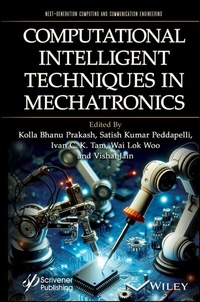
Computational Intelligent Techniques in Mechatronics
Description

This book, set against the backdrop of huge advancements in artificial intelligence and machine learning within mechatronic systems, serves as a comprehensive guide to navigating the intricacies of mechatronics and harnessing its transformative potential.
Mechatronics has been a revolutionary force in engineering and medical robotics over the past decade. It will lead to a major industrial revolution and affect research in every field of engineering. This book covers the basics of mechatronics, computational intelligence approaches, simulation and modeling concepts, architectures, nanotechnology, real-time monitoring and control, different actuators, and sensors. The book explains clearly and comprehensively the engineering design process at different stages. As the historical divisions between the various branches of engineering and computer science become less clearly defined, mechatronics may provide a roadmap for nontraditional engineering students studying within the traditional university structure. This book covers all the algorithms and techniques found in mechatronics engineering, well explained with real-time examples, especially lab experiments that will be very informative to students and scholars.
Audience
This resource is important for R & D departments in academia, government, and industry. It will appeal to mechanical engineers, electronics engineers, computer scientists, robotics engineers, professionals in manufacturing, automation and related industries, as well as innovators and entrepreneurs.
More details
Other editions
Additional editions
Persons
Kolla Bhanu Prakash, PhD, is a professor and associate dean and R & D head for A.I. & Data Science Research Group at K L University, Vijayawada, Andhra Pradesh, India. He is also an adjunct professor atTaylors University, Malaysia. He has published 150+ research papers in international and national journals and conferences. He has authored two and edited 12 books as well as published 15 patents. His research interests include deep learning, data science, and quantum computing.
Satish Kumar Peddapelli, PhD, is the Director at the Rajiv Gandhi University of Knowledge Technologies, IIIT-Basara, and Professor of Electrical Engineering, University College of Engineering, Osmania University, Hyderabad, India. His areas of interest are power electronics, drives, multi-level inverters, special machines and renewable energy systems.
Ivan C.K. Tam, PhD, is an associate professor in the Dept. of Marine Engineering Design & Technology, as well as the Director of Innovation & Engagement at the University of Newcastle in Singapore. He has a wealth of experience in multi-disciplinary research and a strong track record of leading innovative projects. His research interests are in the clean fuel combustion process, exhaust emission control, energy management and renewable energy technology.
Wai Lok Woo, PhD, received his doctorate in statistical machine learning from Newcastle University, UK. Prof Woo currently holds the Chair in Machine Learning with Northumbria University, UK. He is the Faculty Director of Research (Engineering and Environment), and Head of Research for Data Science and Artificial Intelligence. He was previously the Director of Research for Newcastle Research and Innovation Institute, and Director of Operations of Newcastle University. His major research is in mathematical theory and algorithms for data science and analytics.
Vishal Jain, PhD, is an associate professor in the Department of Computer Science and Engineering, Sharda School of Engineering and Technology, Sharda University, Greater Noida, India. He has more than 16 years of experience in academics and has authored more than 100 research papers in reputed journals and conferences as well as edited several books with the Wiley-Scrivener imprint.
Content
Preface xxi
1 AI in Mechatronics 1
Vansh Gehlot and Prashant Singh Rana
1.1 Introduction to AI Techniques for Mechatronics 2
1.2 Machine Learning for Mechatronic Systems 5
1.3 Computer Vision for Mechatronic Perception 9
1.4 Soft Computing Techniques 13
1.5 AI Planning and Decision-Making 16
1.6 Natural Language Interaction 19
1.7 AI in Mechatronic System Design 21
1.8 Challenges and Future Outlook 26
1.9 Artificial General Intelligence (AGI) 30
1.10 Conclusion 35
References 38
2 Thermodynamics for Mechatronics 41
Yadav Krishnakumar Rajnath, Shrikant Tiwari and Virendra Kumar
2.1 Introduction 42
2.2 Defining Mechatronics and Its Interdisciplinary Nature 43
2.3 Fundamentals of Thermodynamics for Mechatronics 46
2.4 Enhancing Efficiency in Mechatronics Through Thermodynamics 52
2.5 Sustainability and Thermodynamics in Mechatronics 58
2.6 Innovative Applications and Future Trends 66
2.7 Educational and Professional Implications 72
References 79
3 Role of Data Acquisition, Sensors, and Actuators in Mechatronics Industry 83
Harpreet Kaur Channi
3.1 Introduction 84
3.2 Literature Survey 86
3.3 Fundamentals of Data Acquisition 87
3.4 Coordination and Synchronization in Mechatronic Systems 94
3.5 Industrial Automation and Robotics 95
3.6 Technical Challenges in Integration and Compatibility 97
3.7 Future Trends and Implications 100
3.8 Conclusion 102
References 103
4 Optimization Techniques for Mechatronics: A Comprehensive Review and Future Directions 109
Ikvinderpal Singh and Sapandeep Kaur Dhillon
4.1 Introduction 110
4.2 Related Work 111
4.3 Optimization in Mechatronics Design 113
4.4 Optimization in Mechatronics Control 116
4.5 Optimization in Mechatronics Manufacturing 118
4.6 Multi-Objective Optimization in Mechatronics 121
4.7 Real-Time Optimization for Mechatronics 123
4.8 Challenges in Optimization for Mechatronics 126
4.9 Opportunities in Optimization for Mechatronics 127
4.10 Future Directions in Optimization for Mechatronics 128
4.11 Conclusion 130
References 132
5 Reinforcement Learning for Adaptive Mechatronics Systems 135
D. Sathya, G. Saravanan and R. Thangamani
5.1 Introduction to Adaptive Mechatronics Systems 136
5.2 Fundamentals of Reinforcement Learning 139
5.3 Reinforcement Learning Algorithms for Mechatronics 142
5.4 Adaptive Control Strategies in Mechatronics 144
5.5 Autonomous Decision-Making in Mechatronics 147
5.6 Optimization and Energy Efficiency in Mechatronics 149
5.7 Safety and Robustness in Reinforcement Learning 153
5.8 Real-World Applications and Case Studies 155
5.9 Challenges and Future Directions 174
5.10 Ethical and Societal Implications 176
5.11 Conclusion 178
References 179
Further Reading 181
6 Application of PLC in the Mechatronics Industry 185
Harpreet Kaur Channi, Pulkit Kumar and Arvind Dhingra
6.1 Introduction 186
6.2 Role of PLC in Mechatronics System Integration 191
6.3 PLC Applications in Mechatronics Industry 195
6.4 PLC in Mechatronics System Design 197
6.5 Safety in Mechatronics Systems 199
6.6 Case Studies for Mechatronics Systems Using PLCs 202
6.7 Challenges and Future Trends 204
6.8 Conclusion 206
References 207
7 Fuzzy Logic and Its Applications in Mechatronic Control Systems 211
D. Sathya, G. Saravanan and R. Thangamani
7.1 Introduction 212
7.2 Fuzzy Control Systems 215
7.3 Fuzzy Logic Applications in Mechatronic Control Systems 220
7.4 Fuzzy Expert Systems in Mechatronics 221
7.5 Fuzzy Logic and Machine Learning in Mechatronics 223
7.6 Fuzzy Control in Multivariable Mechatronic Systems 227
7.7 Industrial Automation and Fuzzy Logic 230
7.8 Challenges and Future Directions 233
7.9 Conclusion 235
References 236
Further Reading 237
8 Drones and Autonomous Robotics Incorporating Computational Intelligence 243
R. Thangamani, R. K. Suguna and G. K. Kamalam
8.1 Introduction 244
8.2 Literature Review 248
8.3 Navigation and Path Planning 252
8.4 Perception and Object Detection 258
8.5 Adaptive Control and Decision-Making 265
8.6 Swarm Robotics and Multi-Agent Systems 266
8.7 Autonomous Drone Delivery Systems 270
8.8 Human-Robot Interaction and Collaboration 277
8.9 Future Trends and Challenges 284
8.10 Ethical Implications of Autonomous Robotics and Drones 289
8.11 Conclusion 293
References 294
9 Exploring the Convergence of Artificial Intelligence and Mechatronics in Autonomous Driving 297
Ritika Wason, Parul Arora, Vishal Jain, Devansh Arora and M. N. Hoda
9.1 Introduction 297
9.2 Key Components of Advanced Driver Systems 301
9.3 Current State of AI-Enabled Self-Driving Mechatronics 303
9.4 Challenges in Self-Driving Mechatronics 305
9.5 Advantages of Self-Driving Mechatronics 307
9.6 Self-Driving and Environmental Sustainability 308
9.7 Legal and Safety Issues in Autonomous Driving 310
9.8 Conclusion 310
9.9 Future Directions in Self-Driving Mechatronics 313
References 313
10 Improving Power Quality for Industry Control Using Mechatronics Devices 317
Pulkit Kumar, Harpreet Kaur Channi and Surbhi Gupta
10.1 Introduction 318
10.2 Power Quality in Industrial Settings 322
10.3 Mechatronics Devices for Power Quality Improvement 324
10.4 Case Studies of Mechatronics Devices in Industry Control 330
10.5 Integration of Mechatronics Devices in Industrial Control Systems 333
10.6 Future Trends and Innovations in Mechatronics for Power Quality Improvement 337
10.7 Conclusion 342
References 342
11 Study on Integrated Neural Networks and Fuzzy Logic Control for Autonomous Electric Vehicles 347
S. Boopathi
11.1 Introduction 348
11.2 Fundamentals of Neural Networks and Fuzzy Logic 351
11.3 Autonomous Electric Vehicles: Challenges and Control Requirements 354
11.4 Neural Network-Based Control for Autonomous Electric Vehicles 357
11.5 Fuzzy Logic Control for Energy-Efficient Driving 361
11.6 Integration of Neural Networks and Fuzzy Logic for Enhanced Autonomy 367
11.7 Case Studies and Applications 372
11.8 Future Prospects and Challenges 374
11.9 Conclusions 375
List of Abbreviations 375
References 375
12 Advancing Mechatronics Through Artificial Intelligence 381
Pawan Whig, Jhansi Bharathi Madavarapu, Venugopal Reddy Modhugu, Balaram Yadav Kasula and Ashima Bhatnagar Bhatia
12.1 Introduction 381
12.2 Foundations of Mechatronics and Artificial Intelligence 386
12.3 Synergies Between Artificial Intelligence and Mechatronics 388
12.4 Case Studies: AI-Driven Advances in Mechatronics 390
12.5 Challenges and Opportunities 392
12.6 Future Directions and Trends 395
12.7 Conclusion 397
12.8 Future Scope 398
References 398
13 Computational Intelligent Techniques in Mechatronics: Emerging Trends and Case Studies 401
Anita Mohanty, Ambarish G. Mohapatra, Subrat Kumar Mohanty, Bright Keswani and Sasmita Nayak
13.1 Introduction to Mechatronics and Computational Intelligence 402
13.2 Artificial Neural Networks (ANNs) in Mechatronics 403
13.3 Reinforcement Learning in Mechatronics 407
13.4 Evolutionary Algorithms for Mechatronic System Design 412
13.5 Emerging Trends in Mechatronics with Computational Intelligence 419
13.6 Real-World Case Studies 427
13.7 Conclusion 439
References 441
14 Advanced Sensing Systems in Automobiles: Computational Intelligence Approach 445
Mamta B. Savadatti and Ajay Sudhir Bale
14.1 Introduction 445
14.2 Computational Intelligence Approach 447
14.3 Methodology 463
14.4 Conclusions 466
References 467
15 Design of Arduino UNO-Based Novel Multi-Featured Robot 471
Jaspinder Kaur, Rohit Anand, Nidhi Sindhwani, Ajay Kumar Sharma and Vishal Jain
15.1 Introduction 472
15.2 Design Implementation 473
15.3 Proposed Model 477
15.4 Process and Working Methodology 478
15.5 Experiment and Applications 482
15.6 Conclusion 484
15.7 Future Scope 485
Acknowledgments 485
References 485
16 Integrating Mechatronics in Autonomous Agricultural Machinery: A Case Study 491
N. V. Suresh, Ananth Selvakumar, Gajalakshmi Sridhar and Vishal Jain
16.1 Introduction 492
16.2 Case Background 493
16.3 Literature Review 495
16.4 Methodology 496
16.5 Implementation 498
16.6 Findings 501
16.7 Suggestion 502
16.8 Conclusion 504
References 505
Index 509
1
AI in Mechatronics
Vansh Gehlot* and Prashant Singh Rana
Thapar Institute of Engineering and Technology, Patiala, Punjab, India
Abstract
The chapter "AI in Mechatronics" provides a comprehensive overview of how artificial intelligence (AI) techniques can enhance mechatronic systems; it covers core AI approaches, including machine learning, computer vision, soft computing methods, natural language processing, AI planning, and intelligent system design tools. Key real-world applications across areas like manufacturing automation, robotics, vehicles, and human-machine interaction are analyzed. The integration of data-driven and knowledge-based AI methods can endow mechatronics with advanced capabilities around autonomy, environmental perception, reasoning, control, and human collaboration. This creates intelligent self-optimizing systems that continue learning and adapting. Current challenges around model accuracy, data availability, security, and algorithmic transparency are discussed along with emerging opportunities in embedded intelligence and bio-inspired robotics. Overall, the synergistic fusion of AI and mechatronics promises to transform technological systems across industrial and societal domains by enhancing automation, augmenting human capabilities, and enabling next-generation smart mechanized assistants.
Keywords: Machine learning, human-robot collaboration, computer vision, robotic systems, natural language processing, manufacturing automation, self-driving vehicles
1.1 Introduction to AI Techniques for Mechatronics
Mechatronics refers to the synergistic integration of mechanical, electrical, and computer engineering to design smart systems and products capable of exhibiting both information-processing and physical-action capabilities. It combines the core disciplines of mechanics, electronics, control systems, and computing to create high-performance systems with built-in intelligence.
Although mechatronics has its origins in industrial robotics and manufacturing automation, it has grown tremendously in scope and adoption over the past few decades. Today, mechatronic systems and principles are utilized in a diverse range of applications including automotive systems, aerospace systems, industrial production systems, defense systems, material handling systems, healthcare systems, and consumer product design. Figure 1.1 shows the flowchart depicting the design methodology for mechatronics systems, mechatronics integrates various engineering disciplines.
Modern mechatronic systems incorporate sensors, actuators, microprocessors, control systems, and mathematical modeling into product design. This facilitates features like automation, precision, efficiency, adaptability, reconfigurability, safety, reliability, and productivity. For example, an automated robotic manufacturing system may use servo motors and drives for motion control, various sensors for inspection and feedback, PLCs or microcontrollers for regulated actuation and monitoring, and sophisticated control software for supervision, analysis, and coordination [1].
With rapid advances in artificial intelligence (AI) and machine learning, integrating AI techniques into mechatronic systems has become an active area of innovation and research. AI can endow mechatronics with higher levels of intelligence, autonomy, perception, and decision-making capabilities to create smart, self-optimizing systems. This introductory chapter provides an overview of promising AI approaches for modern mechatronics along with the key benefits.
1.1.1 Overview of Key AI Approaches
Several AI techniques hold promise for advancing mechatronics.
- Machine Learning: This allows systems to automatically learn and improve from data without being explicitly programmed. Algorithms identify patterns and build models based on training data. Supervised, unsupervised, and reinforcement learning methods can be used for tasks like prediction, classification, and control optimization in mechatronic systems.
Figure 1.1 Design methodology for a mechatronic system [15].
- Neural Networks: Inspired by biological neurons, artificial neural networks consist of interconnected nodes that process and transmit data signals. The strengths of connections are adjusted during training to build robust models. Types like convolutional and recurrent neural nets are ideal for perception, analysis, and decision-making in mechatronic applications.
- Fuzzy Logic: This enables representing and reasoning with vague, imprecise information using degrees of truth rather than binary logic. Fuzzy rule-based systems can model complex nonlinear behavior for control and inference in mechatronic systems with uncertainty.
1.1.2 Benefits of Integrating AI in Mechatronic Systems
Integrating appropriate AI techniques enhances mechatronic systems with the following. Figure 1.2 depicts a block diagram illustrating various AI approaches in mechatronics, from machine learning to computer vision and soft computing.
- Increased Autonomy: With machine learning, systems can independently analyze data, identify patterns, and make optimal decisions for a given task. This reduces reliance on constant human oversight.
- Improved Adaptability: AI approaches like neural networks allow systems to adapt in real-time to changes in the environment, tasks, and operating conditions. This facilitates reconfiguration without reprogramming.
- Smarter Control: Advanced control strategies enabled by fuzzy logic and reinforcement learning lead to more efficient, stable, and optimal system performance.
- Enhanced Perception: Sensors coupled with AI-based perception and analysis enable mechatronic systems to accurately interpret ambiguous, complex data from the real world.
- Higher-Level Cognition: With neural networks and machine learning, mechatronic systems can demonstrate capabilities like scene understanding, forecasting, diagnosis, and strategy optimization.
Figure 1.2 Different AI approaches in mechatronics.
1.2 Machine Learning for Mechatronic Systems
A wide repertoire of machine learning techniques can impart different types of learning abilities.
Supervised learning algorithms train predictive models by learning from labeled example inputs and expected outputs. Classification techniques like support vector machines enable tasks like image recognition and fault diagnosis. Regression methods like neural networks can model complex control systems and be used for predictive analytics [2].
Unsupervised learning techniques identify hidden patterns and relationships within unlabeled data. Clustering methods can detect anomalies and group similar data points. Dimensionality reduction can be used for simplifying complex high-dimensional data from diverse mechatronic sensors to enable efficient processing. Association rule mining reveals interesting correlations and connections in large datasets.
Reinforcement learning focuses on optimizing sequential decision-making via trial-and-error interactions with a dynamic environment. The system learns an optimal policy for taking actions to maximize cumulative reward. Dynamic programming, Monte Carlo methods, and temporal difference learning are key techniques applicable to the optimization of mechatronic control policies. Figure 1.3 shows the different parts of machine learning.
Key applications of machine learning in mechatronic systems include adaptive control, predictive maintenance, fault diagnosis, sensor fusion, motion planning, forecasting, multidimensional optimization, natural language interfaces, computer vision for inspection and navigation, and noise filtering. Learning capabilities enhance automation, precision, adaptability, productivity, and reliability [3].
Researchers have successfully demonstrated machine learning use for industrial robots, reusable launch vehicles, autonomous cars, smart prosthetics, and advanced manufacturing systems. As computing power grows exponentially, machine learning will become further ingrained in mechatronic system design.
Figure 1.3 Machine learning map.
1.2.1 Supervised, Unsupervised, and Reinforcement Learning Techniques
Supervised Learning: Algorithms like linear regression, logistic regression, decision trees, support vector machines, and neural networks can be trained on labeled input-output data to learn prediction and classification tasks for mechatronic systems like quality evaluation, fault diagnosis, sensor fusion, trajectory modeling, and process optimization. Figure 1.4 illustrates the accuracy of different machine learning models on relevant mechatronics models.
Unsupervised Learning: Algorithms like k-means clustering, hierarchical clustering, principal component analysis, and autoencoders can find hidden patterns and groupings within complex unlabeled mechatronic data. This enables anomaly detection, novel insights, data compression, noise removal, etc., without explicit training.
Reinforcement Learning: Based on dynamic programming techniques like temporal difference and Q-learning, reinforcement learning agents interact with an environment, select actions, and receive rewards or penalties to automatically determine optimal policies, maximizing long-term reward. Applicable to mechatronic control optimization,...
