

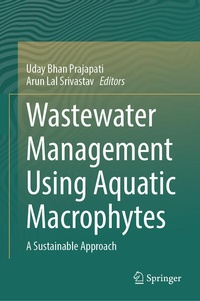
Wastewater Management Using Aquatic Macrophytes
Description

This book discusses aquatic macrophytes, their seasonal diversity and their selection criteria for wastewater treatment which provide a broad scenario to the readers, policy makers, etc. Sustainable development does not focus solely on environmental issues, but also includes economic and social development, as well as the preservation of indigenous people and culture.
Aquatic macrophytes can play an important role in sustainable development in several ways, for example by providing a range of benefits beyond wastewater treatment, including energy production, nutrient removal, habitat creation, erosion control, and carbon sequestration. Aquatic macrophytes can be used for the production of bioenergy, which can be a sustainable alternative to fossil fuels. Aquatic macrophytes have been found to have potential in treating wastewater, as they can take up organic matter from the water and remove metals such as cadmium, copper, chromium, zinc, lead, and nickel. This can be a sustainable and effective method for managing water quality. These plants treat wastewater by taking up organic matter from the water, with small zones at their roots that capture organic matter from the wastewater. Aquatic plants also act as bioindicators of heavy metal contamination; therefore, they aid in raising awareness of the problem. This book gives a guidance on how to create a botanical park at a wastewater treatment site. Aquatic macrophytes are simple to identify, making it easier to use them in the filtration of water bodies. The volume contains several case studies on this topic.
More details
Other editions
Additional editions
Persons
Dr. Uday Bhan Prajapati, Sr. Scientist at Patanjali Research Foundation, Haridwar, Uttarakhand, India has been working in revisionary, exploratory, and conservation studies of world Flora. He obtained MSc and PhD in Botany from DDU Gorakhpur University Gorakhpur, Uttar Pradesh, India. He engaged in an international project and developed a Zero Energy Cool Chamber (ZECC) & Zero Energy Sewage Treatment Plant (ZESTP) which was implemented as a model in villages, and worked as Assistant Professor in MG Post Graduate College Gorakhpur. He is correspondent of Herbarium Acronym PRFH (Patanjali Research Foundation Herbarium) and member of Society of Herbarium Curators, Los Angeles, Fellow of Indian Science Congress Association. He was awarded by several institutions for contribution in academics and research. An international book, chapters and more than 52 research papers in reputed journals to his credit. His specialization and research field include Ecology and Environment, Eco-management of Water Pollution, Phytoremediation, Ethnobotany, Plant Taxonomy and Phytoetymology having more than fifteen years' experience in teaching and research.
Dr Arun Lal Srivastav is working as Associate Professor at School of Engineering and Technology, Chitkara University, Solan, Himachal Pradesh, India. He received PhD from the Indian Institute of Technology (BHU), Varanasi in water treatment. He has done post-doctoral research at National Chung Hsing University, Taiwan. He is currently involved in the teaching of Environmental Science, Environmental Engineering, Disaster Management and Design Thinking to the undergraduate engineering students. His research interests include water quality surveillance, climate change, water treatment, river ecosystem, soil health maintenance, engineering education, phytoremediation and waste management. He has published 132 research papers in various prestigious journals (Elsevier, Springer, IWA, Taylor & Francis etc.) including some book chapters and conference publications. He has edited many books with Elsevier, Springer, NOVA, IGI global and Wiley. Additionally, he is also one of the series editors of Elsevier and ISTE-Wiley publisher on energy sustainability and AI and Environmental Sustainability, respectively. He worked on 04 Government sponsored projects (worth ~16 million INR) on phytoremediation, adsorption, capacity building, organic farming, leachate treatment, agro-waste management etc. He received the prestigious "Teachers Associateship for Research Excellence (TARE) Fellowship" followed by research grant from the Science and Engineering Research Board (SERB), Govt. of India in 2022. He has filed 31 patents on multidisciplinary topics and 13 out of which have been granted by the Government of India. He has also been recognised among the 2% worldwide scientists of Earth and Environmental Sciences jointly by Stanford University and Elsevier in the year 2023, 2024 and 2025.
Content
Phytoremediation Potentials of Aquatic Macrophytes.- Characteristics of aquatic macrophytes for water purification.- Utilization of aquatic plants for water treatment and resource recovery.- Heavy metals and toxic hydrocarbons removals from wastewater using aquatic macrophytes.- Seaweed: an aquatic macrophytes as natural tools for sustainable wastewater management.- Role of Eichhornia plants for removal of hydrocarbons from wastewater.
