

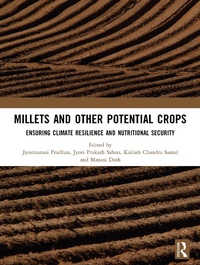
Millets and Other Potential Crops
Ensuring Climate Resilience and Nutritional Security
1st Edition
Published on 15. November 2024
372 pages
978-1-040-15526-4 (ISBN)
Description

Deeply rooted in indigenous peoples' culture and traditions, millets (also called 'nutricereals' are ancestral crops high in nutritional value. As the global agrifood systems face challenges to feed an ever-growing global population, resilient cereals like millets provide an affordable and nutritious option and help guarantee food security.
This book presents the basic principles and practices of millets and other potential crops towards climate resilience and nutritional security. It discuses the role of millets in sustainable agriculture, the medicinal use of foxtail millet, exotic fruits in India, and climate-resilient fruit and vegetable crops.
The goal of this work is to promote the sustainable cultivation of millets, also under adverse and changing climatic conditions and improving their quality, highlighting their potential to provide new sustainable market opportunities for producers and consumers.
Print edition not for sale in South Asia (India, Sri Lanka, Nepal, Bangladesh, Pakistan or Bhutan)
This book presents the basic principles and practices of millets and other potential crops towards climate resilience and nutritional security. It discuses the role of millets in sustainable agriculture, the medicinal use of foxtail millet, exotic fruits in India, and climate-resilient fruit and vegetable crops.
The goal of this work is to promote the sustainable cultivation of millets, also under adverse and changing climatic conditions and improving their quality, highlighting their potential to provide new sustainable market opportunities for producers and consumers.
Print edition not for sale in South Asia (India, Sri Lanka, Nepal, Bangladesh, Pakistan or Bhutan)
More details
Edition
1. Auflage
Language
English
Place of publication
London
United Kingdom
Publishing group
Taylor & Francis Ltd
Target group
Professional and scholarly
College/higher education
Illustrations
38 Illustrations, color
ISBN-13
978-1-040-15526-4 (9781040155264)
Copyright in bibliographic data and cover images is held by Nielsen Book Services Limited or by the publishers or by their respective licensors: all rights reserved.
Schweitzer Classification
Other editions
Additional editions
Jyostnarani Pradhan | Jyoti Prakash Sahoo | Kailash Chandra Samal
Millets and Other Potential Crops
Ensuring Climate Resilience and Nutritional Security
Book
01/2026
1st Edition
CRC Press
€102.40
Shipment within 10-20 days
Jyostnarani Pradhan | Jyoti Prakash Sahoo | Kailash Chandra Samal
Millets and Other Potential Crops
Ensuring Climate Resilience and Nutritional Security
Book
11/2024
1st Edition
CRC Press
€230.27
Shipment within 10-20 days
Persons
Jyostnarani Pradhan is Assistant Professor in the Department of Botany, Plant Physiology and Biochemistry, College of Basic Sciences and Humanities, Dr. Rajendra Prasad Central Agriculture University, Bihar, India. She has contributed to many research projects as P.I. and Co-I. and has guided 5 M.Sc.(Plant Physiology) students as Major Advisor. She is presently working on stress physiology, secondary metabolites and seed physiology in various crops.
Jyoti Prakash Sahoo is Assistant Professor in the Department of Agriculture and Allied Sciences, C.V. Raman Global University, Bhubaneswar, India. He has authored numerous research and review articles in the fields of Agricultural and Biological Science. He has also been recipient of the 'Foxcules India Prime Quality Education Award - 2021' for his contribution towards education.
Kailash Chandra Samal is Professor and Head, Department of Molecular Biology and Biotechnology, Odisha University of Agriculture and Technology, Bhubaneswar, India. He specialises in Plant Molecular Biology, Plant Tissue culture, Microbial technology, DNA fingerprinting, Computational Biology and Bioinformatics. He has also developed cost-efficient protocols for largescale micropropagation of several plant species, including banana, ginger, turmeric, sugarcane, stevia and sarpagnadha etc.
Manasi Dash serves as Faculty in the Department of Genetics and Plant Breeding and obtained her Master's and Ph.D. in Plant Breeding and Genetics from OUAT in the year 1996 and 2005 respectively. She holds the credit of releasing one Sesame variety "Kalinga Sesame-3-1" and has also been instrumental in carrying out externally funded project from DBT Bio-Care, Govt. of India and RKVY, Govt. of Odisha.
Jyoti Prakash Sahoo is Assistant Professor in the Department of Agriculture and Allied Sciences, C.V. Raman Global University, Bhubaneswar, India. He has authored numerous research and review articles in the fields of Agricultural and Biological Science. He has also been recipient of the 'Foxcules India Prime Quality Education Award - 2021' for his contribution towards education.
Kailash Chandra Samal is Professor and Head, Department of Molecular Biology and Biotechnology, Odisha University of Agriculture and Technology, Bhubaneswar, India. He specialises in Plant Molecular Biology, Plant Tissue culture, Microbial technology, DNA fingerprinting, Computational Biology and Bioinformatics. He has also developed cost-efficient protocols for largescale micropropagation of several plant species, including banana, ginger, turmeric, sugarcane, stevia and sarpagnadha etc.
Manasi Dash serves as Faculty in the Department of Genetics and Plant Breeding and obtained her Master's and Ph.D. in Plant Breeding and Genetics from OUAT in the year 1996 and 2005 respectively. She holds the credit of releasing one Sesame variety "Kalinga Sesame-3-1" and has also been instrumental in carrying out externally funded project from DBT Bio-Care, Govt. of India and RKVY, Govt. of Odisha.
Content
Message (Prof. Pravat Kumar Roul)
Message (Dr. Dilip Kumar Dash)
Message (Dr. Somnath Roy Chowdhury)
Preface
About the Editors
1. International Year of Millets-Unleashing its Potential in Making a Sustainable World
2. Millets: Super Food for Nutrition Security and Livelihood Improvement
3. Climate Change and Millets: A Global Food Security for an Improving Livelihood
4. The Vital Role of Millets in Sustainable Agriculture: Ensuring Food Security and Enhancing Environmental Sustainability
5. Role of Minor Millets in the Context of Climate Change and Genomic Resources
6. Millets in Organic Agricultural System
7. Breeding for Genetic Improvement of Millets
8. Millets: A Biotechnological Perspective
9. Finger Millet: A Sustainable Approach for Nutritional Security and its Biofortification
10. Foxtail Millet: Origin, Production, Nutritional Benefits and Medicinal Use
11. Kodo Millet (Paspalum scrobiculatum) - A Nutri-rich Millet Crop: Nutritional Composition, Health Benefits and Food Product Developments
12. Millets: Its Diseases and Management
13. Economic Importance of Major Millet Pests and their Management Techniques
14. Insect Pests of Major Millets and Integrated Strategies for their Management
15. Recent Approaches for Management of Insect Disease Problems in Pearl Millet
16. Exotic Fruits in India: Production, Nutritional Benefits and Medicinal Properties
17. Flourishing the Climate Resilient Fruit Crops to Ensure Global Food and Nutritional Security
18. Vegetables: A Food to Ensure Economic and Dietary Security
19. Bioactive Compounds in Jamun (Syzygium cumini L.) Ensuring Nutritional Security
20. Meet the Incredible, the Unsung Heroes of Crops in Alleviating Iron Deficiency Anemia
21. Importance of Millets for Enhancement of Calcium Content and Thickness in Eggshell of Granivorous Birds
22. Climate Change Resilient through Modern Farming in Vegetable Cultivation
Message (Dr. Dilip Kumar Dash)
Message (Dr. Somnath Roy Chowdhury)
Preface
About the Editors
1. International Year of Millets-Unleashing its Potential in Making a Sustainable World
2. Millets: Super Food for Nutrition Security and Livelihood Improvement
3. Climate Change and Millets: A Global Food Security for an Improving Livelihood
4. The Vital Role of Millets in Sustainable Agriculture: Ensuring Food Security and Enhancing Environmental Sustainability
5. Role of Minor Millets in the Context of Climate Change and Genomic Resources
6. Millets in Organic Agricultural System
7. Breeding for Genetic Improvement of Millets
8. Millets: A Biotechnological Perspective
9. Finger Millet: A Sustainable Approach for Nutritional Security and its Biofortification
10. Foxtail Millet: Origin, Production, Nutritional Benefits and Medicinal Use
11. Kodo Millet (Paspalum scrobiculatum) - A Nutri-rich Millet Crop: Nutritional Composition, Health Benefits and Food Product Developments
12. Millets: Its Diseases and Management
13. Economic Importance of Major Millet Pests and their Management Techniques
14. Insect Pests of Major Millets and Integrated Strategies for their Management
15. Recent Approaches for Management of Insect Disease Problems in Pearl Millet
16. Exotic Fruits in India: Production, Nutritional Benefits and Medicinal Properties
17. Flourishing the Climate Resilient Fruit Crops to Ensure Global Food and Nutritional Security
18. Vegetables: A Food to Ensure Economic and Dietary Security
19. Bioactive Compounds in Jamun (Syzygium cumini L.) Ensuring Nutritional Security
20. Meet the Incredible, the Unsung Heroes of Crops in Alleviating Iron Deficiency Anemia
21. Importance of Millets for Enhancement of Calcium Content and Thickness in Eggshell of Granivorous Birds
22. Climate Change Resilient through Modern Farming in Vegetable Cultivation
