

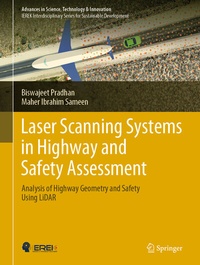
Laser Scanning Systems in Highway and Safety Assessment
Description

This book aims to promote the core understanding of a proper modelling of road traffic accidents by deep learning methods using traffic information and road geometry delineated from laser scanning data. The first two chapters of the book introduce the reader to laser scanning technology with creative explanation and graphical illustrations, review and recent methods of extracting geometric road parameters. The next three chapters present different machine learning and statistical techniques applied to extract road geometry information from laser scanning data. Chapters 6 and 7 present methods for modelling roadside features and automatic road geometry identification in vector data. After that, this book goes on reviewing methods used for road traffic accident modelling including accident frequency and injury severity of the traffic accident (Chapter 8). Then, the next chapter explores the details of neural networks and their performance in predicting the traffic accidents along with a comparison with common data mining models. Chapter 10 presents a novel hybrid model combining extreme gradient boosting and deep neural networks for predicting injury severity of road traffic accidents. This chapter is followed by deep learning applications in modelling accident data using feed-forward, convolutional, recurrent neural network models (Chapter 11). The final chapter (Chapter 12) presents a procedure for modelling traffic accident with little data based on the concept of transfer learning. This book aims to help graduate students, professionals, decision makers, and road planners in developing better traffic accident prediction models using advanced neural networks.
More details
Other editions
Additional editions
Persons
Maher Ibrahim Sameen is a postdoctoral research fellow at the School of Information Systems and Modelling, UTS. He is fuelled by his passion for developing algorithms for remote sensing and geospatial applications. His background in surveying engineering, geomatics, and remote sensing inform hismindful but competitive approach. He has published over 19 journal articles indexed in Web of Science, attended 9 conferences, and won three awards.
Content
Introduction to Laser Scanning Technology.- Road Geometric Modeling Using Laser-Scanning Data.- Optimizing support vector machine and ensemble trees using the Taguchi method for automatic road network extraction.- Road Geometric Modeling Using a Novel Hierarchical Approach.- Introduction to Neural Networks.- Traffic Accidents Predictions with Neural Networks: A Review.- Applications of Deep Learning in Severity Prediction of Traffic Accidents.- Accident Modelling Using Feedforward Neural Networks.- Accident Severity Prediction with Convolutional Neural Networks.- Injury Severity Prediction Using Recurrent Neural Networks.- Improving Traffic Accident Prediction Models with Transfer Learning.- A Comparative Study between Neural Networks, Support Vector Machine, and Logistic Regression for Accident Predictions.- Estimation of Accident Factor Importance in Neural Network Models.
