

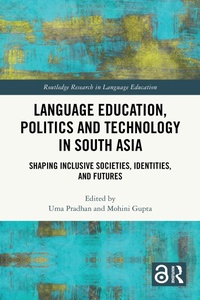
Language Education, Politics and Technology in South Asia
Shaping Inclusive Societies, Identities, and Futures
Published on 24. February 2025
278 pages
978-1-040-32157-7 (ISBN)
Description

Bringing together research from the fields of linguistics, education and technology within the dynamic context of South Asia, this timely book investigates the ways in which these fields interact with each other against the backdrop of technological innovation, linguistic diversity and socio-political transformation.
Developing and expanding on findings and insights originating from a conference organised by the Education South Asia Initiative at the University of Oxford, this interdisciplinary book features academic reflections on language politics and diversity as well as empirical insights on linguistic, educational and technological transformations in the region. Featuring analytical and methodological approaches to the study of language and education, chapters range in context from India, Bangladesh, Nepal, Pakistan and Sri Lanka, and address a range of issues such as the marginalisation of languages in education and policy, the interactions between language and social hierarchies in the South Asian context, and technology's impact on language education, acquisition, usage and preservation.
Ultimately initiating dialogue on the need for positive changes in language, education research and policy, this book will appeal to scholars, researchers and postgraduate students in the fields of language education, international and comparative education, and education and technology. Policymakers in international development and sociolinguistics may also find the volume of use.
The Open Access version of this book, available at http://www.taylorfrancis.com, has been made available under a Creative Commons Attribution-Non Commercial-No Derivatives (CC BY-NC-ND) 4.0 license.
Developing and expanding on findings and insights originating from a conference organised by the Education South Asia Initiative at the University of Oxford, this interdisciplinary book features academic reflections on language politics and diversity as well as empirical insights on linguistic, educational and technological transformations in the region. Featuring analytical and methodological approaches to the study of language and education, chapters range in context from India, Bangladesh, Nepal, Pakistan and Sri Lanka, and address a range of issues such as the marginalisation of languages in education and policy, the interactions between language and social hierarchies in the South Asian context, and technology's impact on language education, acquisition, usage and preservation.
Ultimately initiating dialogue on the need for positive changes in language, education research and policy, this book will appeal to scholars, researchers and postgraduate students in the fields of language education, international and comparative education, and education and technology. Policymakers in international development and sociolinguistics may also find the volume of use.
The Open Access version of this book, available at http://www.taylorfrancis.com, has been made available under a Creative Commons Attribution-Non Commercial-No Derivatives (CC BY-NC-ND) 4.0 license.
Reviews / Votes
"Language Education, Politics and Technology in South Asia: Shaping Inclusive Societies, Identities, and Futures is a significant contribution to understanding the intricate and often contentious relationships between language, education, politics and technology in the rapidly evolving context of South Asia. Through its three comprehensive sections with diverse and richly researched chapters, the book deftly analyses the interplay between language and power, the everyday practices and ideologies that challenge established norms, and the transformative impact of the digital age on language use and preservation. This is an essential resource for those committed to fostering inclusive and equitable societies through informed language and education policies."Tariq Rahman, PhD, DLitt (Sheffield), Humboldt Research Award, Salzburg Global Seminar Fellow, Distinguished National Professor and Professor Emeritus, Quaid-i-Azam University, Islamabad. (Member of the Common Room, Wolfson College, Oxford)
"Though language diversity is touted as a new postmodern experience by Western scholars, South Asia boasts a multilingualism that is centuries old. Recent developments such as mobility, globalization, and technology have complicated the local language ecology, and persuaded even educationists in South Asia to treat English medium instruction as the best path for progress. Authors in this book adopt a critical view of the new and the old, and provide constructive directions forward by drawing from their rich indigenous traditions to negotiate the new."
Professor Suresh Canagarajah, Evan Pugh University Professor, Penn State College of the Liberal Arts, USA
"Language Education, Politics and Technology in South Asia: Shaping Inclusive Societies, Identities, and Futures offers a compelling exploration of the complexities of language, education, and power in a postcolonial world. With a focus on the region's linguistic diversity, this book provides critical insights into the challenges and opportunities of language education, addressing the impact of technology and social hierarchies. A must-read for anyone interested in language policy, decolonial studies, and education in South Asia."
Professor Jieun Kiaer, University of Oxford, UK "Language Education, Politics and Technology in South Asia: Shaping Inclusive Societies, Identities, and Futures is a significant contribution to understanding the intricate and often contentious relationships between language, education, politics and technology in the rapidly evolving context of South Asia. Through its three comprehensive sections with diverse and richly researched chapters, the book deftly analyses the interplay between language and power, the everyday practices and ideologies that challenge established norms, and the transformative impact of the digital age on language use and preservation. This is an essential resource for those committed to fostering inclusive and equitable societies through informed language and education policies."
Tariq Rahman, PhD, DLitt (Sheffield), Humboldt Research Award, Salzburg Global Seminar Fellow, Distinguished National Professor and Professor Emeritus, Quaid-i-Azam University, Islamabad. (Member of the Common Room, Wolfson College, Oxford)
"Though language diversity is touted as a new postmodern experience by Western scholars, South Asia boasts a multilingualism that is centuries old. Recent developments such as mobility, globalization, and technology have complicated the local language ecology, and persuaded even educationists in South Asia to treat English medium instruction as the best path for progress. Authors in this book adopt a critical view of the new and the old, and provide constructive directions forward by drawing from their rich indigenous traditions to negotiate the new."
Professor Suresh Canagarajah, Evan Pugh University Professor, Penn State College of the Liberal Arts, USA
"Language Education, Politics and Technology in South Asia: Shaping Inclusive Societies, Identities, and Futures offers a compelling exploration of the complexities of language, education, and power in a postcolonial world. With a focus on the region's linguistic diversity, this book provides critical insights into the challenges and opportunities of language education, addressing the impact of technology and social hierarchies. A must-read for anyone interested in language policy, decolonial studies, and education in South Asia."
Professor Jieun Kiaer, University of Oxford, UK
More details
Series
Language
English
Place of publication
London
United Kingdom
Publishing group
Taylor & Francis Ltd
Target group
College/higher education
Illustrations
6 Tables, black and white; 1 Line drawings, black and white; 12 Halftones, black and white; 13 Illustrations, black and white
File size
7,61 MB
ISBN-13
978-1-040-32157-7 (9781040321577)
Copyright in bibliographic data and cover images is held by Nielsen Book Services Limited or by the publishers or by their respective licensors: all rights reserved.
Schweitzer Classification
Other editions
Additional editions
Uma Pradhan | Mohini Gupta
Language Education, Politics and Technology in South Asia
Shaping Inclusive Societies, Identities, and Futures
Book
approx. 07/2026
1st Edition
Routledge
€56.00
Not yet published
Uma Pradhan | Mohini Gupta
Language Education, Politics and Technology in South Asia
Shaping Inclusive Societies, Identities, and Futures
Book
02/2025
1st Edition
Routledge
€207.90
Shipment within 10-20 days
Persons
Uma Pradhan is Associate Professor at the Institute of Education, University College London, UK.
Mohini Gupta has completed a DPhil from the Faculty of Asian and Middle Eastern Studies, University of Oxford, UK. She is currently a Postdoctoral Fellow at the Danish School of Education, Aarhus University, Denmark.
Mohini Gupta has completed a DPhil from the Faculty of Asian and Middle Eastern Studies, University of Oxford, UK. She is currently a Postdoctoral Fellow at the Danish School of Education, Aarhus University, Denmark.
Content
Introduction: Language and Education Futures in South Asia
Part I: Language and Politics
Chapter 1 - Youth Perspectives on Hindi, English and India's New Politics of Language: Becoming Bharat
Chapter 2 - Language Textbooks as a Site of Conflict in India: The Phenomenon of 'Erased Curriculum'
Chapter 3 - The Challenges of Literacy Acquisition and Linguistic Proficiency in Multilingual Educational Landscape of Pakistan
Chapter 4 - Mother-tongue-based Education and Indian Teachers' views on Language Policy Reforms by the Bharatiya Janata Party
Chapter 5 - Unofficial Bilingualism in English-only Policy Context: A Postmethod Pedagogy for Difficult Circumstances in Rural Government Schools of Tamil Nadu
Part II: Language and Inclusivity
Chapter 6 - Kerala's Language Directive and the Erasure of Gendered Teacher Identities
Chapter 7 - Multilingualism and globalisation in remote trans-Himalayan India: How topography and place-experience impact language learning
Chapter 8 - Future of education in Bangladesh: Everyday politics of language between competition, integration, and modernisation
Chapter 9 - Language Documentation, Dialects, and Education among the Naawa of Nepal
Part III: Language and Technology
Chapter 10 - Indian Languages and Language Acquisition Apps: My Phone Won't Teach Me Malayalam
Chapter 11 - Remembering Nepal Bhasa through Artificial Intelligence (AI) Translations: Language, Technology and Indigenous Memory
Chapter 12 - Navigating the Pedagogical Implications of Digital Education in Bangladesh
Chapter 13 - Remote virtual teacher communities in Sri Lanka: Difficulties and possibilities
Part I: Language and Politics
Chapter 1 - Youth Perspectives on Hindi, English and India's New Politics of Language: Becoming Bharat
Chapter 2 - Language Textbooks as a Site of Conflict in India: The Phenomenon of 'Erased Curriculum'
Chapter 3 - The Challenges of Literacy Acquisition and Linguistic Proficiency in Multilingual Educational Landscape of Pakistan
Chapter 4 - Mother-tongue-based Education and Indian Teachers' views on Language Policy Reforms by the Bharatiya Janata Party
Chapter 5 - Unofficial Bilingualism in English-only Policy Context: A Postmethod Pedagogy for Difficult Circumstances in Rural Government Schools of Tamil Nadu
Part II: Language and Inclusivity
Chapter 6 - Kerala's Language Directive and the Erasure of Gendered Teacher Identities
Chapter 7 - Multilingualism and globalisation in remote trans-Himalayan India: How topography and place-experience impact language learning
Chapter 8 - Future of education in Bangladesh: Everyday politics of language between competition, integration, and modernisation
Chapter 9 - Language Documentation, Dialects, and Education among the Naawa of Nepal
Part III: Language and Technology
Chapter 10 - Indian Languages and Language Acquisition Apps: My Phone Won't Teach Me Malayalam
Chapter 11 - Remembering Nepal Bhasa through Artificial Intelligence (AI) Translations: Language, Technology and Indigenous Memory
Chapter 12 - Navigating the Pedagogical Implications of Digital Education in Bangladesh
Chapter 13 - Remote virtual teacher communities in Sri Lanka: Difficulties and possibilities
